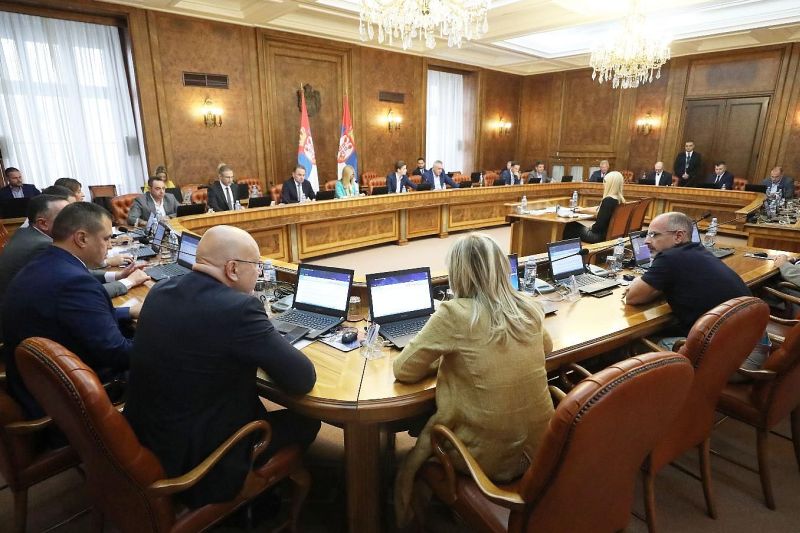
The Serbian government adopted today, based on the recommendations of the Working Group on Cooperation with the Organisation for Security and Cooperation in Europe (OSCE) and the Office for Democratic Institutions and Human Rights, a Conclusion which further improves the election process in the Republic of Serbia.

Q:
A:
Further improvement of election process in Serbia
Belgrade,
23 September 2019
The Conclusion prescribes to all members of the government, state secretaries, directors of special organisations, directors of government services and all other civil servants in positions, directors and other heads of public enterprises and public institutions, officials in the bodies of the territorial autonomy and local self-government the obligation to comply with Article 29 of the Law on the Anti-Corruption Agency in the period from calling the elections until their end.
This document specifies that an official shall not use the public meetings in which he or she takes part and the meetings which he or she has in the capacity of a functionary to promote political parties, i.e. political entities, and it is emphasised that an official shall not use the public meetings in which he or she takes part and the meetings which he or she has in the capacity of a functionary for the purpose of publicly presenting election participants, their election programmes, urging voters to vote or not to vote for particular election participants.
In addition, according to the Conclusion, an official shall not use public resources for the promotion of political parties, i.e. political entities, and this in particular includes the use of official premises, vehicles and inventories of state bodies, provincial and local institutions, public enterprises and public institutions.
Exceptionally, public resources may be used in an election campaign to protect personal security, if such use of certain public resources is governed by appropriate regulations or by a decision of the competent services.
The Serbian government points out to the above-mentioned officials the duty to comply with these legal provisions stated in the Conclusion, and recommends to those not belonging to this group that all activities related to the promotion of political parties, i.e. political entities, as well as the election campaign should not be carried out during the working hours of the organisation to which they belong.
Also, with the aim of properly implementing these measures, the Serbian government particularly emphasises the duty of a public official to always unambiguously state to the interlocutors and the public whether he or she presents the opinion of the body in which he or she performs such a function or the opinion of a political party or political entity.
The Serbian government highlights in particular that the breach of duty under Article 29 of the Law on the Anti-Corruption Agency entails misdemeanour liability. At the same time, the government also points out that civil servants' failure to comply with this Article constitutes a grave breach of duty.
The Conclusion adopted by the Serbian government today also states that non-compliance with the rules of Article 29 of the Law on the Anti-Corruption Agency by the directors of public companies and public services constitutes a negligent performance of duties which results in a significant deviation from the achievement of the basic objective of the public company, that is, public services.
-
 Belgrade, 15 October 2026
Next year declared Year of Saint Despot Stefan Lazarević
-
 Belgrade, 12 October 2026
5th “Wine Vision by Open Balkan” international fair ends
-
 Belgrade, 8 October 2026
Government adopts multiple documents across various sectors
-
 Belgrade, 5 October 2026
“Wine Vision by Open Balkan” to be held from 10 to 12 October
-
 Belgrade, 1 October 2026
Conclusion adopted on remediation plan for Deliblato Sands area
-
 Belgrade, 28 September 2026
Continuity of reforms in EU accession process
-
 Belgrade, 24 September 2026
Government adopts decrees, decisions of importance for migration, sport
-
 Belgrade, 17 September 2026
Linking state support measures for housing for families with children
-
 Belgrade, 14 September 2026
Official request for overflight clearance for Serbian government aircraft submitted on 11 September
-
 Belgrade, 11 September 2026
Eligibility expanded for rural house purchase grant scheme