
Q:
A:
Members of religious communities in Serbia use constitutional religious freedoms
Belgrade/Washington,
26 July 2018
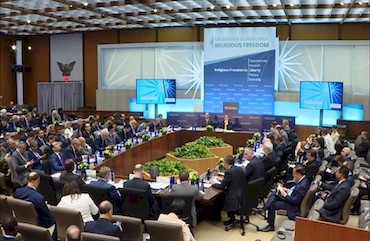
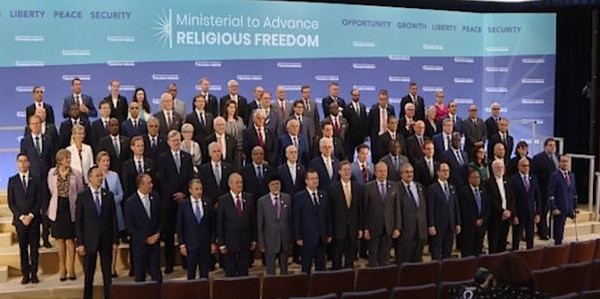
First Deputy Prime Minister and Minister of Foreign Affairs Ivica Dacic stated today in Washington that members of all churches and religious freedoms in Serbia use religious freedoms guaranteed by the Constitution.
Author:
Танјуг
The official website of the Serbian government brings the full speech of Minister Dacic at the II plenary session (theme: Innovative Solutions) of the Ministerial to Advance Religious Freedom:
“Vice President Pence, Secretary of State Pompeo, Ladies and gentlemen,
I am indeed pleased to attend this high-level meeting today, which is of particular relevance in the times we live in, when religious tolerance and inter-religious dialogue are at the forefront of the promotion of human rights and building of harmonious societies that may decisively influence day-to-day issues which used to be the exclusive prerogative of politics, both international and national, inside a society itself. Having said this, I refer to the present-day challenges, primarily in the context of the emerging radicalization, which in certain countries misuses some religious concepts, twists their very core, assigning them the meaning that their founders have never had in mind and placing them in the context of ecumenical dialogue within Christian communities or the internal dialogue within any other religious community. That is why I would like to express my appreciation for this very important and timely initiative.
The right to profess one’s own religion and to meet one’s spiritual needs is one of the fundamental freedoms of every individual and a civilizational achievement. As a secular state which recognizes seven traditional religious communities, but having at the same time as many as 28 religious communities active in its territory under the Law on Churches and Religious Communities (adopted in 2006), guaranteeing them all their rights and full religious and canonical equality, the Republic of Serbia is truly committed to ensuring the exercise of this human right in all life domains. This is done through full compliance with the letter of the law but also by respecting all international norms and standards existing in the field of religion, considering the right to freedom of religion to be a fundamental human right. In addition to the fact that this right has been available to all Serbian citizens under the above law, a number of other laws and bylaws regulate the rights of believers and religious communities in various areas, such as the performance of religious rites in armed forces, religious education received in elementary and secondary schools, exemption of taxes and other fiscal duties, etc.
As regards a guarantee of freedom of religion, my country is a party to eight fundamental UN instruments in the human rights field. In that respect, Serbia prepares and submits regular periodic reports to UN human rights mechanisms. The Council at the Government level has been set up to ensure that UN recommendations in the human rights field are followed in a systematic manner. This mechanism, developed by Serbia as the only state in the region and one of the few at the international level, was also commended by the UN Human Rights Council when evaluating the human rights record of my country in the framework of the Universal Periodic Review in January 2018. First and foremost, it implies an inclusive and transparent approach in following and addressing all issues of importance to the promotion of human rights, by liaising and joint action of relevant state authorities in charge of implementation of the recommendations, of civil society organizations and independent state bodies. To that end, a unique plan to evaluate fulfilment of these recommendations has been drawn up, currently containing 388 recommendations of UN treaty bodies and the Human Rights Council. Besides the list of recommendations, it contains a summary of activities carried out to implement the above recommendations, a list of relevant institutions as well as implementation timelines, including comments of civil society organizations and other stakeholders involved. In order to ensure that the Plan fully reflects the impact of policies and laws at the national and local levels, the Government’s Council is currently working to define indicators for UN recommendations fulfilment as well as to connect the process of reporting to UN bodies with 2030 UN Agenda for Sustainable Development.
To illustrate what I have just said, I would like to bring to your attention that out of 175 accepted recommendations (out of 190 received) in the Third Cycle of the Universal Periodic Report, 9 refer to religious tolerance. They, among other things, pertain to stepping up efforts aimed at the promotion of tolerance to persons belonging to ethnic, national, racial, religious and other minorities, advancement of the position of persons belonging to national minorities with a view to preserving and improving their access to religious services, undertaking additional measures and developing strategies in order to eliminate xenophobia, hate speech and discrimination based on racial, national, ethnic, religious or any other backgrounds.
“Vice President Pence, Secretary of State Pompeo, Ladies and gentlemen,
I am indeed pleased to attend this high-level meeting today, which is of particular relevance in the times we live in, when religious tolerance and inter-religious dialogue are at the forefront of the promotion of human rights and building of harmonious societies that may decisively influence day-to-day issues which used to be the exclusive prerogative of politics, both international and national, inside a society itself. Having said this, I refer to the present-day challenges, primarily in the context of the emerging radicalization, which in certain countries misuses some religious concepts, twists their very core, assigning them the meaning that their founders have never had in mind and placing them in the context of ecumenical dialogue within Christian communities or the internal dialogue within any other religious community. That is why I would like to express my appreciation for this very important and timely initiative.
The right to profess one’s own religion and to meet one’s spiritual needs is one of the fundamental freedoms of every individual and a civilizational achievement. As a secular state which recognizes seven traditional religious communities, but having at the same time as many as 28 religious communities active in its territory under the Law on Churches and Religious Communities (adopted in 2006), guaranteeing them all their rights and full religious and canonical equality, the Republic of Serbia is truly committed to ensuring the exercise of this human right in all life domains. This is done through full compliance with the letter of the law but also by respecting all international norms and standards existing in the field of religion, considering the right to freedom of religion to be a fundamental human right. In addition to the fact that this right has been available to all Serbian citizens under the above law, a number of other laws and bylaws regulate the rights of believers and religious communities in various areas, such as the performance of religious rites in armed forces, religious education received in elementary and secondary schools, exemption of taxes and other fiscal duties, etc.
As regards a guarantee of freedom of religion, my country is a party to eight fundamental UN instruments in the human rights field. In that respect, Serbia prepares and submits regular periodic reports to UN human rights mechanisms. The Council at the Government level has been set up to ensure that UN recommendations in the human rights field are followed in a systematic manner. This mechanism, developed by Serbia as the only state in the region and one of the few at the international level, was also commended by the UN Human Rights Council when evaluating the human rights record of my country in the framework of the Universal Periodic Review in January 2018. First and foremost, it implies an inclusive and transparent approach in following and addressing all issues of importance to the promotion of human rights, by liaising and joint action of relevant state authorities in charge of implementation of the recommendations, of civil society organizations and independent state bodies. To that end, a unique plan to evaluate fulfilment of these recommendations has been drawn up, currently containing 388 recommendations of UN treaty bodies and the Human Rights Council. Besides the list of recommendations, it contains a summary of activities carried out to implement the above recommendations, a list of relevant institutions as well as implementation timelines, including comments of civil society organizations and other stakeholders involved. In order to ensure that the Plan fully reflects the impact of policies and laws at the national and local levels, the Government’s Council is currently working to define indicators for UN recommendations fulfilment as well as to connect the process of reporting to UN bodies with 2030 UN Agenda for Sustainable Development.
To illustrate what I have just said, I would like to bring to your attention that out of 175 accepted recommendations (out of 190 received) in the Third Cycle of the Universal Periodic Report, 9 refer to religious tolerance. They, among other things, pertain to stepping up efforts aimed at the promotion of tolerance to persons belonging to ethnic, national, racial, religious and other minorities, advancement of the position of persons belonging to national minorities with a view to preserving and improving their access to religious services, undertaking additional measures and developing strategies in order to eliminate xenophobia, hate speech and discrimination based on racial, national, ethnic, religious or any other backgrounds.
Additionally, I consider it important to inform you that my country has been actively working to fulfil the recommendations made by the UN Human Rights Committee when reviewing the Third Periodic Report submitted by the Republic of Serbia concerning the implementation of the International Covenant on Civil and Political Rights, in March 2017. In this regard, I particularly wish to underline the recommendation explicitly indicating that a State Party should guarantee, in practice, the principle of equal treatment of religions, as provided for in Article 18 of the Covenant. In this context, Serbia has been actively cooperating with the Council of Europe where it received, in the 3rd cycle of monitoring the implementation of the Framework Convention for the Protection of National Minorities, two recommendations under Article 8, requiring the States Parties to guarantee every person belonging to a national minority member the right to profess their religion or religious belief and to establish religious institutions, organizations and associations.
In line with these efforts, all churches and religious communities in the Republic of Serbia exercise their freedom of religion under the Constitution, and we have not received any information on, or report of, denial or violation of religious freedom. These rights pertain to practicing of a religion both by individuals and in community with others by churches and religious communities, as well as to their relations with other churches and religious communities and state bodies. As to the prospect of future relations between churches and religious communities in Serbia, we can say with certainty that these rights will be exercised without negative occurrences, in the future as well, through the inter-faith dialogue conducted in the Republic of Serbia at all levels and the concern of the state about the enjoyment of human rights in accordance with the highest international standards.
It is unfortunate that this does not reflect the situation in our southern Province of Kosovo and Metohija, which has been under the United Nations mandate since the beginning of 1999, where, due to the regrettable activity of provisional institutions of local self-government, the Serbian population, their church and cultural and historical heritage have been targeted by the majority population and their nationalist chauvinist ideology for almost two decades. I would like to recall that ever since June 1999, all aspects of the presence of the Serbian community and history have been equally affected – the people, both living and deceased (destruction of cemeteries), cultural heritage, churches and monasteries, while the religious, cultural, historical traces of their Slavic origins and Orthodoxy have been destroyed and devastated in other ways, including verbal and physical assaults, even killing of priests of the Serbian Orthodox Church. Out of four exceptional religious sites inscribed on the UNESCO World Heritage List – Pec Patriarchate, Monastery of Visoki Decani, Gracanica Monastery and the Church of Our Lady of Ljevis, only three have survived, because they were physically fully protected by NATO forces, i.e. KFOR. Even more tragic is the situation of the religious rights of the Serbian population, which is directly dependent on the community surrounding the respective religious site. As a result, the right and freedom to perform religious rites, including baptism, marriage, communion, funeral and memorial mass services, and prayers of Orthodox believers in general are provided only in churches and monasteries located in areas predominantly populated by Serbs or having a Serbian majority population. Unfortunately, the causes of this tragic situation are of an ethnic and systemic nature. It is important to understand that the sites of the Serbian Orthodox Church in Kosovo and Metohija are neither museums nor monuments – they are parts of the concept of the living church, whose temples are always accessible, and whose priests and monkhood available to, and in the service of, its believers. Likewise, the visits of the displaced Serbian population to their churches and monasteries must not be regarded as pilgrimages. These visits are not visits by strangers but by worshippers who come to pray, light candles or visit the tombs of their ancestors and akin…
For these reasons, if we are to advance religious freedom in the Province, it is necessary to change the approach to and abandon the practice of denial, minimization and casting a pall of relativity over continued intolerance by the majority community and its institutions, which needs to be accompanied by systematic efforts aimed at raising the awareness of the rights of others to practice their religion freely and unimpededly. Thank you for your attention.”
In line with these efforts, all churches and religious communities in the Republic of Serbia exercise their freedom of religion under the Constitution, and we have not received any information on, or report of, denial or violation of religious freedom. These rights pertain to practicing of a religion both by individuals and in community with others by churches and religious communities, as well as to their relations with other churches and religious communities and state bodies. As to the prospect of future relations between churches and religious communities in Serbia, we can say with certainty that these rights will be exercised without negative occurrences, in the future as well, through the inter-faith dialogue conducted in the Republic of Serbia at all levels and the concern of the state about the enjoyment of human rights in accordance with the highest international standards.
It is unfortunate that this does not reflect the situation in our southern Province of Kosovo and Metohija, which has been under the United Nations mandate since the beginning of 1999, where, due to the regrettable activity of provisional institutions of local self-government, the Serbian population, their church and cultural and historical heritage have been targeted by the majority population and their nationalist chauvinist ideology for almost two decades. I would like to recall that ever since June 1999, all aspects of the presence of the Serbian community and history have been equally affected – the people, both living and deceased (destruction of cemeteries), cultural heritage, churches and monasteries, while the religious, cultural, historical traces of their Slavic origins and Orthodoxy have been destroyed and devastated in other ways, including verbal and physical assaults, even killing of priests of the Serbian Orthodox Church. Out of four exceptional religious sites inscribed on the UNESCO World Heritage List – Pec Patriarchate, Monastery of Visoki Decani, Gracanica Monastery and the Church of Our Lady of Ljevis, only three have survived, because they were physically fully protected by NATO forces, i.e. KFOR. Even more tragic is the situation of the religious rights of the Serbian population, which is directly dependent on the community surrounding the respective religious site. As a result, the right and freedom to perform religious rites, including baptism, marriage, communion, funeral and memorial mass services, and prayers of Orthodox believers in general are provided only in churches and monasteries located in areas predominantly populated by Serbs or having a Serbian majority population. Unfortunately, the causes of this tragic situation are of an ethnic and systemic nature. It is important to understand that the sites of the Serbian Orthodox Church in Kosovo and Metohija are neither museums nor monuments – they are parts of the concept of the living church, whose temples are always accessible, and whose priests and monkhood available to, and in the service of, its believers. Likewise, the visits of the displaced Serbian population to their churches and monasteries must not be regarded as pilgrimages. These visits are not visits by strangers but by worshippers who come to pray, light candles or visit the tombs of their ancestors and akin…
For these reasons, if we are to advance religious freedom in the Province, it is necessary to change the approach to and abandon the practice of denial, minimization and casting a pall of relativity over continued intolerance by the majority community and its institutions, which needs to be accompanied by systematic efforts aimed at raising the awareness of the rights of others to practice their religion freely and unimpededly. Thank you for your attention.”
-
 Belgrade/Jinan, 25 April 2026
Chinese companies plan new investments in Serbia
-
 Belgrade/Jinan, 25 April 2026
Jinan Economic Forum confirms companies' interest in investing in Serbia
-
 Belgrade/Jinan, 25 April 2026
Support for marketing of Serbian wines, other products on Chinese market agreed
-
 Belgrade/Athens, 24 April 2026
Serbia cooperative partner in fight against organised crime
-
 Belgrade/Athens, 24 April 2026
Joint action of Serbia, Greece in fight against irregular migration
-
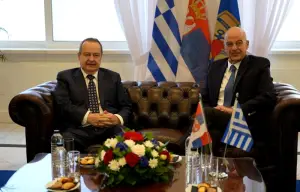 Belgrade/Athens, 24 April 2026
Potential for improving cooperation with Greece in field of security
-
 Belgrade/Shenzhen, 24 April 2026
Cooperation with Chinese retail giant opens doors to Serbian products
-
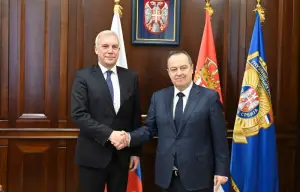 Belgrade, 23 April 2026
Intensifying cooperation with Russia in field of internal affairs
-
 Belgrade/Guangzhou, 23 April 2026
Opening up new investment opportunities between Serbia, Guangzhou
-
 Belgrade/Shenzhen, 23 April 2026
Serbia strengthens its position in automotive industry through cooperation with BYD Company