Q:
A:
Preventing revision of history by remembering victims of Jasenovac
Belgrade/New York,
26 January 2018
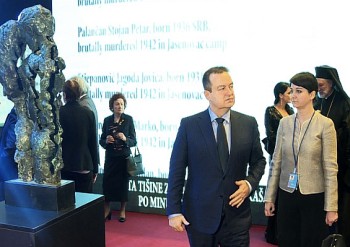
First Deputy Prime Minister and Minister of Foreign Affairs Ivica Dacic said that the atrocities committed in the Jasenovac concentration camp must not be forgotten and that it must remain one of the most significant symbols of the suffering of the Serbs, Jews, Roma, anti-fascist Croats and other nations, a symbol of mass and unparalleled ruthless killings.

The official website of the Serbian government brings the speech of Dacic at the exhibition "Jasenovac - the right to unforgettable", which was opened yesterday afternoon New York time in the United Nations, and at midnight Serbian time:
“Ladies and Gentlemen, Distinguished Guests,
I am honoured to say a few words on the occasion of the opening of the exhibition on the concentration camp, the camp of death, of Jasenovac within the marking of International Holocaust Remembrance Day on 27 January, established by the United Nations to remember the day of the liberation of Auschwitz. This exhibition is aimed not only at informing the international public of a little known chapter of the Second World War; it is also aimed at warning of the dangerous attempts to revive the ideology and political practice that brought horror and atrocities. These attempts are in part exemplified by unscientific reinterpretations of the events and processes that took place during the Second World War that are becoming part of public discourse and justify crimes. It is our duty to fight these attempts at amnesia, which are a new crime and a call to commit it all over again.
Jasenovac was the largest concentration camp in Europe not operated by the Nazis. It was operated by the Croatian Ustaše, perhaps the most unusual right-wing extremists of Europe. Great British historian Hobsbawm writes that the Ustaše spoke of themselves as greater Nazis than the SS-members and in that he was right. The Ustaše made a singular contribution to the Holocaust: in addition to the Jews and Roma, they were after extermination of all the Serbs who lived in their State, as well as the anti-fascist Croats and Muslims. The Serbs were banned from some parts of Croatian cities, just as were the Jews. Just as had the Jews, they had to wear special badges on their clothes, blue ribbons with the Latin letter ‘P’ which stood for ‘pravoslavac’ (Orthodox Christian in Croatian). Mile Budak, the ideologist of their movement, proclaimed that one third of the Serbs should be killed, one third expelled and one third converted to Catholicism. In that regard, the Ustaše were much more ambitious than the Nazis themselves. The Independent State of Croatia included entire Bosnia and Herzegovina, the largest part of present-day Croatia and a part of northern Serbia. The Serbs accounted for more than one third of the population of that State; they numbered 1.9 million.
When we speak of Jasenovac, we must understand it not only as the place of horror, mass murder and unspeakable pain, but also as an embodiment of the system created after the aggression against Yugoslavia in April 1941 and the creation of Greater Croatia, i.e. the Independent State of Croatia. It was the mainstay of Nazi Germany and fascist Italy in this area; after all, it should not be forgotten that Berlin fell on 30 April 1945, while Zagreb was liberated only on 8 May 1945. By its system, the Ustaša Independent State of Croatia was identical to the Nazi German model. It is reflected primarily in the fact that it posited, as the national task of the first order, the extermination of entire national, religious and ‘racial’ groups. This similarity is evinced also by the establishment of a network of concentration and death camps as was organized only by Nazi Germany. But unlike the German killing machine, the Croatian Ustaše had exclusively their own citizens, the Serbs, the Jews and, later on, the Roma, in the crosshairs of their guns. Indeed the fact that, until the very end of its existence, a newly created State of the ‘New European Order’ sought to annihilate in various ways, mainly through physical force, almost a third of the population of its own country is a phenomenon without a precedent even in such a bloody war as was the Second World War. The example of such a policy and system is exactly the camp at Jasenovac that this exhibition commemorates.
I repeat, it is the system that is involved here and in that we should bear in mind some other facts, too. The policy of the extermination of the Serbs and the Jews had its phases, but it was evident from the first day of the establishment of the Independent State of Croatia. Legalized discrimination, plunder and repression were soon followed by mass murders in Serbian ethnic territories. Researchers have established that there were over 320 pits and crevices of various sizes up and down the Independent State of Croatia in which the Serbs of all ages and both sexes were thrown alive or massacred. Unfortunately, many of them have been covered with concrete lest intra-national relations be negatively affected and with the aim of casting a pall of oblivion over the crimes. Soon enough this method of killing was supplemented with a much more effective one: the camps. A network of temporary camps was created from which the Serbs and the Jews were sent to Gospić, the first death camp of the Ustaša State. The camp consisted of a range of smaller camps and killing fields on Mt. Velebit and the Adriatic island of Pag. Unfortunately, the vestiges of these camps are continually removed even though these camps devoured dozens of thousands of victims in a very short period of time. Practically, Gospić was the first death camp in Europe and preceded the big Nazi death camps which began to be established since the end of 1941. The ‘final solution of the Jewish question’, i.e. the Holocaust in the Independent State of Croatia, began in this camp before Nazi Germany itself set in motion the mechanism of the total annihilation of the Jews. Because of a mass uprising of the Serbs and the arrival of the Italian troops in August 1941, the Gospić camp was hastily abandoned and the few surviving Serbs and Jews were transferred to a new big camp set up at Jasenovac. This was the only camp in the ‘New European Order’ that was not included in the Nazi camp system. It was intended exclusively for the realization of the Croatian Ustaša policy of the annihilation of ‘unwanted’ national-religious and ‘racial’ groups.
“Ladies and Gentlemen, Distinguished Guests,
I am honoured to say a few words on the occasion of the opening of the exhibition on the concentration camp, the camp of death, of Jasenovac within the marking of International Holocaust Remembrance Day on 27 January, established by the United Nations to remember the day of the liberation of Auschwitz. This exhibition is aimed not only at informing the international public of a little known chapter of the Second World War; it is also aimed at warning of the dangerous attempts to revive the ideology and political practice that brought horror and atrocities. These attempts are in part exemplified by unscientific reinterpretations of the events and processes that took place during the Second World War that are becoming part of public discourse and justify crimes. It is our duty to fight these attempts at amnesia, which are a new crime and a call to commit it all over again.
Jasenovac was the largest concentration camp in Europe not operated by the Nazis. It was operated by the Croatian Ustaše, perhaps the most unusual right-wing extremists of Europe. Great British historian Hobsbawm writes that the Ustaše spoke of themselves as greater Nazis than the SS-members and in that he was right. The Ustaše made a singular contribution to the Holocaust: in addition to the Jews and Roma, they were after extermination of all the Serbs who lived in their State, as well as the anti-fascist Croats and Muslims. The Serbs were banned from some parts of Croatian cities, just as were the Jews. Just as had the Jews, they had to wear special badges on their clothes, blue ribbons with the Latin letter ‘P’ which stood for ‘pravoslavac’ (Orthodox Christian in Croatian). Mile Budak, the ideologist of their movement, proclaimed that one third of the Serbs should be killed, one third expelled and one third converted to Catholicism. In that regard, the Ustaše were much more ambitious than the Nazis themselves. The Independent State of Croatia included entire Bosnia and Herzegovina, the largest part of present-day Croatia and a part of northern Serbia. The Serbs accounted for more than one third of the population of that State; they numbered 1.9 million.
When we speak of Jasenovac, we must understand it not only as the place of horror, mass murder and unspeakable pain, but also as an embodiment of the system created after the aggression against Yugoslavia in April 1941 and the creation of Greater Croatia, i.e. the Independent State of Croatia. It was the mainstay of Nazi Germany and fascist Italy in this area; after all, it should not be forgotten that Berlin fell on 30 April 1945, while Zagreb was liberated only on 8 May 1945. By its system, the Ustaša Independent State of Croatia was identical to the Nazi German model. It is reflected primarily in the fact that it posited, as the national task of the first order, the extermination of entire national, religious and ‘racial’ groups. This similarity is evinced also by the establishment of a network of concentration and death camps as was organized only by Nazi Germany. But unlike the German killing machine, the Croatian Ustaše had exclusively their own citizens, the Serbs, the Jews and, later on, the Roma, in the crosshairs of their guns. Indeed the fact that, until the very end of its existence, a newly created State of the ‘New European Order’ sought to annihilate in various ways, mainly through physical force, almost a third of the population of its own country is a phenomenon without a precedent even in such a bloody war as was the Second World War. The example of such a policy and system is exactly the camp at Jasenovac that this exhibition commemorates.
I repeat, it is the system that is involved here and in that we should bear in mind some other facts, too. The policy of the extermination of the Serbs and the Jews had its phases, but it was evident from the first day of the establishment of the Independent State of Croatia. Legalized discrimination, plunder and repression were soon followed by mass murders in Serbian ethnic territories. Researchers have established that there were over 320 pits and crevices of various sizes up and down the Independent State of Croatia in which the Serbs of all ages and both sexes were thrown alive or massacred. Unfortunately, many of them have been covered with concrete lest intra-national relations be negatively affected and with the aim of casting a pall of oblivion over the crimes. Soon enough this method of killing was supplemented with a much more effective one: the camps. A network of temporary camps was created from which the Serbs and the Jews were sent to Gospić, the first death camp of the Ustaša State. The camp consisted of a range of smaller camps and killing fields on Mt. Velebit and the Adriatic island of Pag. Unfortunately, the vestiges of these camps are continually removed even though these camps devoured dozens of thousands of victims in a very short period of time. Practically, Gospić was the first death camp in Europe and preceded the big Nazi death camps which began to be established since the end of 1941. The ‘final solution of the Jewish question’, i.e. the Holocaust in the Independent State of Croatia, began in this camp before Nazi Germany itself set in motion the mechanism of the total annihilation of the Jews. Because of a mass uprising of the Serbs and the arrival of the Italian troops in August 1941, the Gospić camp was hastily abandoned and the few surviving Serbs and Jews were transferred to a new big camp set up at Jasenovac. This was the only camp in the ‘New European Order’ that was not included in the Nazi camp system. It was intended exclusively for the realization of the Croatian Ustaša policy of the annihilation of ‘unwanted’ national-religious and ‘racial’ groups.

There were other camps, too, and the Serbs were murdered also in towns and villages, burned in their churches or thrown into deep karst pits. Yet, Jasenovac was the epicentre of the realization of the ambitious Ustaša project. By the number of victims, it was one of the largest concentration camps in Europe. The final number of those who died at Jasenovac has not been determined to-date. Even by the lowest Croatian estimates, Jasenovac belonged in the very top of death camps that existed during the Second World War. Only a number of camps in Poland were larger, while the infamous camps at Buchenwald and Dachau were two times smaller.
Even if we do not mention the number of victims, Jasenovac is perhaps the first in Europe by bestiality of killings. Croatian author Miljenko Jergović said that in Nazi camps people were killed bureaucratically and industrially, while Ustaše killed with bare hands and with passion. This emotional and unorganized approach may have been one of the reasons that they failed to achieve their goal of the extermination of the Serbs in their State entirely, even though the half million of Serbs conservatively estimated to have been killed up and down the Independent State of Croatia brought them very close to their plans. The other factor that impeded their ambitions was a mass anti-fascist uprising. The Serbs in Croatia and Bosnia and Herzegovina rushed to join the Partisan resistance movement in droves. They accounted for the preponderant part of the Partisan army, the largest guerrilla anti-fascist armed force in Europe.
The Nazis themselves were shocked by the Ustaša methods, including Glaise von Horstenau, German Plenipotentiary General in Zagreb. In his reports to Berlin, he said that “the Ustaše have gone raging mad”. Indeed The Ustaša atrocities are recounted in Croatian poet Ivan Goran Kovačić’s poem Pit. They included slaughters, eye-gouging, killing by mallet and the burning of people alive. On an Orthodox Christmas, the Ustaše organized a competition in killing with knives. We know of the event because one of the ‘competitors’ subsequently asked for psychiatric help.
Exhibited here is also a ‘srbosjek’ (Serb-cutter), a weapon specially designed to kill Serbs faster. The Croatian Ustaše used these cutters to slaughter people in the camps of the Independent State of Croatia during the Second World War, but most frequently and brutally in the Jasenovac camp. For slaughtering 1 360 Serbs during only one August night of 1942 at Jasenovac, Petar Brzica was awarded an Ustaša medal.
Among the Ustaša victims were 91 members of the family of Nikola Tesla. Most tragically, 19 432 children were also murdered by the Ustaše at Jasenovac alone.
Even if we do not mention the number of victims, Jasenovac is perhaps the first in Europe by bestiality of killings. Croatian author Miljenko Jergović said that in Nazi camps people were killed bureaucratically and industrially, while Ustaše killed with bare hands and with passion. This emotional and unorganized approach may have been one of the reasons that they failed to achieve their goal of the extermination of the Serbs in their State entirely, even though the half million of Serbs conservatively estimated to have been killed up and down the Independent State of Croatia brought them very close to their plans. The other factor that impeded their ambitions was a mass anti-fascist uprising. The Serbs in Croatia and Bosnia and Herzegovina rushed to join the Partisan resistance movement in droves. They accounted for the preponderant part of the Partisan army, the largest guerrilla anti-fascist armed force in Europe.
The Nazis themselves were shocked by the Ustaša methods, including Glaise von Horstenau, German Plenipotentiary General in Zagreb. In his reports to Berlin, he said that “the Ustaše have gone raging mad”. Indeed The Ustaša atrocities are recounted in Croatian poet Ivan Goran Kovačić’s poem Pit. They included slaughters, eye-gouging, killing by mallet and the burning of people alive. On an Orthodox Christmas, the Ustaše organized a competition in killing with knives. We know of the event because one of the ‘competitors’ subsequently asked for psychiatric help.
Exhibited here is also a ‘srbosjek’ (Serb-cutter), a weapon specially designed to kill Serbs faster. The Croatian Ustaše used these cutters to slaughter people in the camps of the Independent State of Croatia during the Second World War, but most frequently and brutally in the Jasenovac camp. For slaughtering 1 360 Serbs during only one August night of 1942 at Jasenovac, Petar Brzica was awarded an Ustaša medal.
Among the Ustaša victims were 91 members of the family of Nikola Tesla. Most tragically, 19 432 children were also murdered by the Ustaše at Jasenovac alone.
Distinguished Guests,
The question of the number of victims of the Jasenovac concentration camp caused controversies already during the war in Yugoslavia. It should be pointed out that comprehensive research, either field (forensic and anthropological) or historiographic, that would provide a convincing answer regarding the number and identity of the victims of the Jasenovac camp has never been done. In any case, the concentration and death camp at Jasenovac was the largest camp in the territory of the former Yugoslavia and South East Europe. By the number of victims, surely hundreds of thousands, Jasenovac equals the large Nazi concentration camps. Yet, by its systematic bestial killings, it is surely unrivalled among other concentration and death camps in the ‘New World Order’.
The question of the memorialization of the Jasenovac camp has a long history and has not been solved in a proper way to-date. One of the basic reasons is the fact that the Croatian authorities have systematically destroyed the camp buildings that remained after the Ustaše had left and mined the camp. Comparison with what happened to the Nazi camps after the war is in order here, too. Wherever it was possible, their buildings have been preserved and they became the places of remembrance and education. In some of them, including the Dachau camp near Munich, the perpetrators of the crimes committed in them were tried and in others these criminals were executed. The buildings of the Jasenovac were well preserved and could have served not only to memorialize the camp, but also to punish the most responsible, such as Fra Tomislav Filipović, Ljubo Miloš, one of the camp’s commandants and others. Unfortunately, the policy of pushing aside, oblivion and the symmetry of the crimes cannot supersede what is our civilizational debt to the dead, as well as to the living: confronting the crime, its punishment, scholarly research and appropriate memorialization. A memorial complex was erected at Jasenovac in the 1960s, partly under the pressure of the relatives of the victims. However, the museum rendition could never replace the authenticity of the camp buildings and the entire complex, including the mass killing fields at Donja Gradina. The most recent memorialization of this camp in the Republic of Croatia elicited huge controversies, primarily because of the fact that the individualization of the victim accounted for the loss of its belonging to a certain nation or ‘race’ even though this was the reason of the death of the greatest part of the prisoners. Such an approach should be viewed as part of a broader trend of the revision of the history of the Second World War and the policies of the Independent State of Croatia in which the Jasenovac camp occupies a very important place.
It is therefore necessary to condemn publicly each and every type of historical revisionism which denies the crimes exhibited on the panels around you and which runs counter to the fundamental anti-fascist values. We must not allow that views of the past and historical facts be forcibly and perfidiously changed for this casts a pall of relativity over genocidal and criminal policies conducted against entire peoples in the past. If we fail to nurture the culture of remembrance and are not vigilant, we run the risk of having the tragic destiny from the past repeated to us.
The Jasenovac camp must remain one of the symbols of the Second World War, of the suffering of the Serbs, Jews, Roma and the anti-fascist Croats and of other nations, a symbol of mass and unparalleled ruthless killings. A significant contribution to the preservation of the remembrance of that symbol is this exhibition, too, which I am honoured to open. The deaths of those who fell for the ideals of a better and freer world must not have been in vain.
I take this opportunity to welcome and thank the survivors of Jasenovac for their presence. They will speak to you as our programme continues.
Thank you for coming here today.”
The question of the number of victims of the Jasenovac concentration camp caused controversies already during the war in Yugoslavia. It should be pointed out that comprehensive research, either field (forensic and anthropological) or historiographic, that would provide a convincing answer regarding the number and identity of the victims of the Jasenovac camp has never been done. In any case, the concentration and death camp at Jasenovac was the largest camp in the territory of the former Yugoslavia and South East Europe. By the number of victims, surely hundreds of thousands, Jasenovac equals the large Nazi concentration camps. Yet, by its systematic bestial killings, it is surely unrivalled among other concentration and death camps in the ‘New World Order’.
The question of the memorialization of the Jasenovac camp has a long history and has not been solved in a proper way to-date. One of the basic reasons is the fact that the Croatian authorities have systematically destroyed the camp buildings that remained after the Ustaše had left and mined the camp. Comparison with what happened to the Nazi camps after the war is in order here, too. Wherever it was possible, their buildings have been preserved and they became the places of remembrance and education. In some of them, including the Dachau camp near Munich, the perpetrators of the crimes committed in them were tried and in others these criminals were executed. The buildings of the Jasenovac were well preserved and could have served not only to memorialize the camp, but also to punish the most responsible, such as Fra Tomislav Filipović, Ljubo Miloš, one of the camp’s commandants and others. Unfortunately, the policy of pushing aside, oblivion and the symmetry of the crimes cannot supersede what is our civilizational debt to the dead, as well as to the living: confronting the crime, its punishment, scholarly research and appropriate memorialization. A memorial complex was erected at Jasenovac in the 1960s, partly under the pressure of the relatives of the victims. However, the museum rendition could never replace the authenticity of the camp buildings and the entire complex, including the mass killing fields at Donja Gradina. The most recent memorialization of this camp in the Republic of Croatia elicited huge controversies, primarily because of the fact that the individualization of the victim accounted for the loss of its belonging to a certain nation or ‘race’ even though this was the reason of the death of the greatest part of the prisoners. Such an approach should be viewed as part of a broader trend of the revision of the history of the Second World War and the policies of the Independent State of Croatia in which the Jasenovac camp occupies a very important place.
It is therefore necessary to condemn publicly each and every type of historical revisionism which denies the crimes exhibited on the panels around you and which runs counter to the fundamental anti-fascist values. We must not allow that views of the past and historical facts be forcibly and perfidiously changed for this casts a pall of relativity over genocidal and criminal policies conducted against entire peoples in the past. If we fail to nurture the culture of remembrance and are not vigilant, we run the risk of having the tragic destiny from the past repeated to us.
The Jasenovac camp must remain one of the symbols of the Second World War, of the suffering of the Serbs, Jews, Roma and the anti-fascist Croats and of other nations, a symbol of mass and unparalleled ruthless killings. A significant contribution to the preservation of the remembrance of that symbol is this exhibition, too, which I am honoured to open. The deaths of those who fell for the ideals of a better and freer world must not have been in vain.
I take this opportunity to welcome and thank the survivors of Jasenovac for their presence. They will speak to you as our programme continues.
Thank you for coming here today.”
-
 Belgrade/Shijiazhuang, 26 April 2026
Importance of strategic partnership with HBIS company confirmed
-
 Belgrade/Jinan, 26 April 2026
Serbia builds partnerships with leading Chinese companies
-
 Belgrade/Jinan, 25 April 2026
Chinese companies plan new investments in Serbia
-
 Belgrade/Jinan, 25 April 2026
Jinan Economic Forum confirms companies' interest in investing in Serbia
-
 Belgrade/Jinan, 25 April 2026
Support for marketing of Serbian wines, other products on Chinese market agreed
-
 Belgrade/Athens, 24 April 2026
Serbia cooperative partner in fight against organised crime
-
 Belgrade/Athens, 24 April 2026
Joint action of Serbia, Greece in fight against irregular migration
-
 Belgrade/Athens, 24 April 2026
Potential for improving cooperation with Greece in field of security
-
 Belgrade/Shenzhen, 24 April 2026
Cooperation with Chinese retail giant opens doors to Serbian products
-
 Belgrade, 23 April 2026
Intensifying cooperation with Russia in field of internal affairs