
Q:
A:
Serbia made good moves in case of false asylum seekers
Belgrade,
20 May 2011
First Deputy Prime Minister and Minister of the Interior Ivica Dacic said today that in order to enter the Schengen area visitors must comply with all requirements, including having enough money to support their stay in a foreign country.
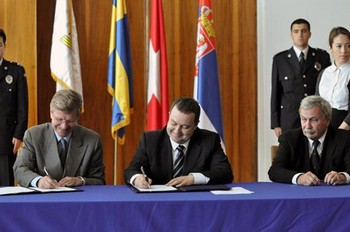
From left: Christer Asp, Ivica Dacic and Theodor Winkler
Author:
Tanjug
After the meeting with Swedish Ambassador Christer Asp and Director of the Centre for the Democratic Control of Armed Forces (DCAF) Theodor Winkler, Dacic pointed out that everyone who travels to European countries must have enough funds for their stay during the given period of time.
The consultation will be held regarding additional measures.
Asp said that Serbia reacted well and quickly in the case of false asylum seekers and highlighted that a few people who are looking for economic gain must not threaten the system of visa liberalisation.
In the process of seeking asylum there are no financial benefits and everybody will be returned to Serbia, the Swedish Ambassador warned and pointed out that the measures that have already been taken and that will follow are aimed at preventing the common problem of EU member states.
Speaking about new identity cards, Dacic said that they are valid until their expiry date after which they have to be changed.
The Bill on amendments to the Law on identity card, which is in parliamentary procedure, stipulates that the validity of identity cards be extended from five to ten years, and for children from two to five years.
The possibility for old people to get permanent identity cards will be introduced again, Dacic said and added that the Bill proposes that permanent identity cards issued so far be valid until 31 December 2016, instead of 27 July this year, as required by the law currently in force.
Dacic signed with Swedish Ambassador to Serbia Christer Asp two agreements and with Director of DCAF Theodor Winkler a memorandum of understanding.
Dacic and Asp specified that the agreements on cooperation bewteen Serbia and Sweden refer to support to the initial phase of the programme of development of the Ministry of the Interior, i.e the project “Boosting capacities for strategic management”.
This project covers the period from March 2011 to June 2013.
The memorandum signed is important for the implementatin of this project, Dacic said and recalled that Sweden has been a strategic partner of the Serbian Ministry of the Interior for many years, an important donor and initiator of projects that help develop the ministry’s capacities. The First Deputy Prime Minister reiterated that the aim of the Ministry of the Interior is that the police in Serbia be educated, efficient and accountable and become a service for all citizens.
The implementation of these projects will last two years, he added, specifying that Sweden has allocated more than €1 million for their implementation.
Asp said that the signing of documents on the upcoming cooperation confirms the understanding between the Ministry of the Interior of Serbia and Sweden, adding that both agreements deal with reforms that will be launced and which will be made more transparent by the Ministry of the Interior, being part of the public administration.
This project is important for all citizens, but also for Serbia's approximation to EU standards and its progress in the process of European integration, the Swedish Ambassador said.
Winkler recalled that DCAF has been helping the police in Serbia for a decade, and that this centre, in addition to police work, is a partner in two more fields - police cooperation in the countries of southeastern Europe and regional programmes of the border police.
DCAF experts have organised many seminars in Serbia, he said, adding that the memorandum signed is a continuation of the work that has been started.
The consultation will be held regarding additional measures.
Asp said that Serbia reacted well and quickly in the case of false asylum seekers and highlighted that a few people who are looking for economic gain must not threaten the system of visa liberalisation.
In the process of seeking asylum there are no financial benefits and everybody will be returned to Serbia, the Swedish Ambassador warned and pointed out that the measures that have already been taken and that will follow are aimed at preventing the common problem of EU member states.
Speaking about new identity cards, Dacic said that they are valid until their expiry date after which they have to be changed.
The Bill on amendments to the Law on identity card, which is in parliamentary procedure, stipulates that the validity of identity cards be extended from five to ten years, and for children from two to five years.
The possibility for old people to get permanent identity cards will be introduced again, Dacic said and added that the Bill proposes that permanent identity cards issued so far be valid until 31 December 2016, instead of 27 July this year, as required by the law currently in force.
Dacic signed with Swedish Ambassador to Serbia Christer Asp two agreements and with Director of DCAF Theodor Winkler a memorandum of understanding.
Dacic and Asp specified that the agreements on cooperation bewteen Serbia and Sweden refer to support to the initial phase of the programme of development of the Ministry of the Interior, i.e the project “Boosting capacities for strategic management”.
This project covers the period from March 2011 to June 2013.
The memorandum signed is important for the implementatin of this project, Dacic said and recalled that Sweden has been a strategic partner of the Serbian Ministry of the Interior for many years, an important donor and initiator of projects that help develop the ministry’s capacities. The First Deputy Prime Minister reiterated that the aim of the Ministry of the Interior is that the police in Serbia be educated, efficient and accountable and become a service for all citizens.
The implementation of these projects will last two years, he added, specifying that Sweden has allocated more than €1 million for their implementation.
Asp said that the signing of documents on the upcoming cooperation confirms the understanding between the Ministry of the Interior of Serbia and Sweden, adding that both agreements deal with reforms that will be launced and which will be made more transparent by the Ministry of the Interior, being part of the public administration.
This project is important for all citizens, but also for Serbia's approximation to EU standards and its progress in the process of European integration, the Swedish Ambassador said.
Winkler recalled that DCAF has been helping the police in Serbia for a decade, and that this centre, in addition to police work, is a partner in two more fields - police cooperation in the countries of southeastern Europe and regional programmes of the border police.
DCAF experts have organised many seminars in Serbia, he said, adding that the memorandum signed is a continuation of the work that has been started.
-
 Belgrade, 28 July 2026
Serbian fire-fighters sent to Spain to help extinguish fires
-
 Belgrade, 24 July 2026
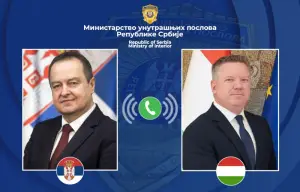
Serbia, Hungary partners in addressing regional security challenges
-
 Belgrade, 24 July 2026
Dačić congratulates UK Home Secretary on reappointment
-
 Belgrade, 22 July 2026
Serbia follows modern technological achievements, attracts investments
-
 Belgrade, 22 July 2026
Continued cooperation with Russia in field of security, emergency situations
-
 Belgrade, 22 July 2026
New opportunities for expanding economic cooperation between Serbia, China
-
 Belgrade, 20 July 2026
Cooperation in field of interior affairs important segment of relations with Germany
-
 Belgrade, 16 July 2026
Expo 2027 opportunity to further strengthen international partnerships
-
 Belgrade/Bratislava, 16 July 2026
Serbia, Slovakia continue to strengthen political, economic cooperation
-
 Belgrade, 14 July 2026
Serbia bilaterally resolves problems arising from EES implementation