
Q:
A:
Dacic opens exhibition "Youth Work Actions 1941-1981"
Belgrade,
11 April 2011
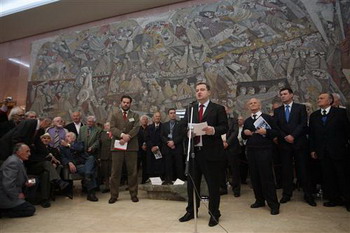
First Deputy Prime Minister and Minister of the Interior Ivica Dacic opened today at the Palace of Serbia a memorial exhibition dedicated to "Youth Work Actions 1941-1981", bringing together the builders of New Belgrade and participants in other federal work actions in the former Yugoslavia.
Author:
Tanjug
Opening the exhibition Dacic said that that was the time of construction and a system of high values in which there was no hatred between the peoples of the former Yugoslavia, who built their country together.
He thanked the participants of the youth work actions who laid the foundations of New Belgrade and pointed to the fact that they erected many buildings in Serbia.
At the time of voluntary youth actions there was work, fun and socialising, as well as the building of a system of high values in which there was no crime and no hatred between the peoples of the former Yugoslavia, said Dacic who received a badge of the Board of veteran builders of New Belgrade.
The First Deputy Prime Minister said that he participated in three youth work actions and added that many today should look up to this tradition which remained indelible in the history of the state.
In a very unfavourable post-war period, without enough skilled workers started the construction of New Belgrade in 1948 as a great architectural endeavour of the 20th century, Dacic recalled.
Chairman of the Board of veteran builders of New Belgrade Slobodan Bosiljcic stated that over 1,000 brigades with about 200,000 youths took part in the building of New Belgrade and from 1948 to 1950 they built dozens of capital facilities and industrial plants.
Some of these facilities are the student dormitory centre Studentski grad, residential neighbourhood Tosin Bunar and the Palace of Serbia.
Chairman of the organisational committee of the meeting held in the Palace of Serbia and member of work actions for the construction of New Belgrade Slobodan Ristanovic said that 1.2 million young people in around 6,000 brigades took part in work actions in the former Yugoslavia, and a total of two million in later republic work actions in the '70s and '80s of the 20th century.
He thanked the participants of the youth work actions who laid the foundations of New Belgrade and pointed to the fact that they erected many buildings in Serbia.
At the time of voluntary youth actions there was work, fun and socialising, as well as the building of a system of high values in which there was no crime and no hatred between the peoples of the former Yugoslavia, said Dacic who received a badge of the Board of veteran builders of New Belgrade.
The First Deputy Prime Minister said that he participated in three youth work actions and added that many today should look up to this tradition which remained indelible in the history of the state.
In a very unfavourable post-war period, without enough skilled workers started the construction of New Belgrade in 1948 as a great architectural endeavour of the 20th century, Dacic recalled.
Chairman of the Board of veteran builders of New Belgrade Slobodan Bosiljcic stated that over 1,000 brigades with about 200,000 youths took part in the building of New Belgrade and from 1948 to 1950 they built dozens of capital facilities and industrial plants.
Some of these facilities are the student dormitory centre Studentski grad, residential neighbourhood Tosin Bunar and the Palace of Serbia.
Chairman of the organisational committee of the meeting held in the Palace of Serbia and member of work actions for the construction of New Belgrade Slobodan Ristanovic said that 1.2 million young people in around 6,000 brigades took part in work actions in the former Yugoslavia, and a total of two million in later republic work actions in the '70s and '80s of the 20th century.
-
 Belgrade, 28 July 2026
Serbian fire-fighters sent to Spain to help extinguish fires
-
 Belgrade, 24 July 2026
Serbia, Hungary partners in addressing regional security challenges
-
 Belgrade, 24 July 2026
Dačić congratulates UK Home Secretary on reappointment
-
 Belgrade, 22 July 2026
Serbia follows modern technological achievements, attracts investments
-
 Belgrade, 22 July 2026
Continued cooperation with Russia in field of security, emergency situations
-
 Belgrade, 22 July 2026
New opportunities for expanding economic cooperation between Serbia, China
-
 Belgrade, 20 July 2026
Cooperation in field of interior affairs important segment of relations with Germany
-
 Belgrade, 16 July 2026
Expo 2027 opportunity to further strengthen international partnerships
-
 Belgrade/Bratislava, 16 July 2026
Serbia, Slovakia continue to strengthen political, economic cooperation
-
 Belgrade, 14 July 2026
Serbia bilaterally resolves problems arising from EES implementation