
Q:
A:
Serbia, Croatia to cooperate on humanitarian demining
Belgrade,
23 March 2011
First Deputy Prime Minister and Minister of the Interior Ivica Dacic and Croatian Deputy Prime Minister Slobodan Uzelac announced in Belgrade today that their countries will cooperate on joint projects related to humanitarian demining of certain areas in both states.
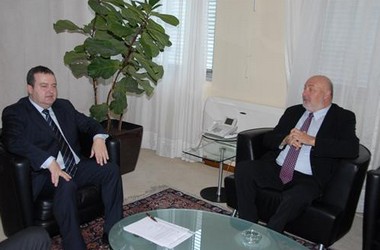
Ivica Dacic and Slobodan Uzelac
Author:
Tanjug
Dacic and Uzelac held a press conference and stated that Serbia and Croatia’s cooperation in this remit has already been established, but there is room for its expansion, especially when it comes to joint projects to secure foreign funding.
They said that there are still large areas of land in both Serbia and Croatia with mines, grenades and bombs from the conflicts in the early 1990s and the two world wars, and on top of that, in Serbia after the 1999 NATO bombing.
Dacic stressed that the two countries are faced with similar problems in this area, noting that it is necessary to bolster up cooperation through joint projects for humanitarian demining.
With these projects, our two countries could jointly appear before foreign donors – international organisations and the EU – bearing in mind that demining is expensive, Dacic noted.
He recalled that 290 risk locations have been registered in Serbia, with remnants of cassette ammunition, mine fields and aircraft bombs, as well as 110 other questionable locations.
A German fleet of 22 ships was sunk in 1944 in the Djerdap gorge, with naval mines on four of the ships, Dacic recalled.
Uzelac said that over 800 square kilometres in Croatia are scattered with remaining mines, grenades and other lethal ammunition, most often in areas to which refugees are returning.
He called upon everyone in possession of any information on these mine fields or locations of unexploded devices to notify the demining centre in either state.
The Serbian and Croatian demining centres have already cooperated in similar operations in 1990s in the border area near Sid.
They said that there are still large areas of land in both Serbia and Croatia with mines, grenades and bombs from the conflicts in the early 1990s and the two world wars, and on top of that, in Serbia after the 1999 NATO bombing.
Dacic stressed that the two countries are faced with similar problems in this area, noting that it is necessary to bolster up cooperation through joint projects for humanitarian demining.
With these projects, our two countries could jointly appear before foreign donors – international organisations and the EU – bearing in mind that demining is expensive, Dacic noted.
He recalled that 290 risk locations have been registered in Serbia, with remnants of cassette ammunition, mine fields and aircraft bombs, as well as 110 other questionable locations.
A German fleet of 22 ships was sunk in 1944 in the Djerdap gorge, with naval mines on four of the ships, Dacic recalled.
Uzelac said that over 800 square kilometres in Croatia are scattered with remaining mines, grenades and other lethal ammunition, most often in areas to which refugees are returning.
He called upon everyone in possession of any information on these mine fields or locations of unexploded devices to notify the demining centre in either state.
The Serbian and Croatian demining centres have already cooperated in similar operations in 1990s in the border area near Sid.
-
 Belgrade, 28 July 2026
Serbian fire-fighters sent to Spain to help extinguish fires
-
 Belgrade, 24 July 2026
Serbia, Hungary partners in addressing regional security challenges
-
 Belgrade, 24 July 2026
Dačić congratulates UK Home Secretary on reappointment
-
 Belgrade, 22 July 2026
Serbia follows modern technological achievements, attracts investments
-
 Belgrade, 22 July 2026
Continued cooperation with Russia in field of security, emergency situations
-
 Belgrade, 22 July 2026
New opportunities for expanding economic cooperation between Serbia, China
-
 Belgrade, 20 July 2026
Cooperation in field of interior affairs important segment of relations with Germany
-
 Belgrade, 16 July 2026
Expo 2027 opportunity to further strengthen international partnerships
-
 Belgrade/Bratislava, 16 July 2026
Serbia, Slovakia continue to strengthen political, economic cooperation
-
 Belgrade, 14 July 2026
Serbia bilaterally resolves problems arising from EES implementation