
Q:
A:
EU information centre opens in Belgrade
Belgrade,
5 February 2009
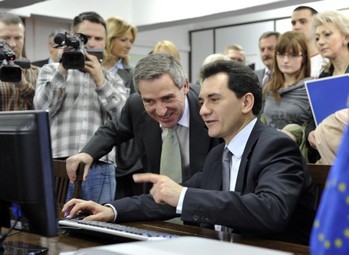
Serbian Deputy Prime Minister for EU integration Bozidar Djelic today said that only an open Serbia can benefit from the potential of the nation’s students and thus help its people to achieve the goal of EU membership.
Author:
Танјуг
Speaking at the opening of the first EU information centre at the Svetozar Markovic university library Djelic said that Serbia must defend its identity whilst being open to the world.
He said he is convinced that the centre will help to raise public awareness about the importance of EU integration, adding that any idealism about the EU would be out of place because EU integration is a process which forces each country to realise its potential, adding that there is no place for euro-scepticism, which is just an attempt to isolate the country.
He said that the EU has succeeded in establishing lasting peace in Europe, adding that EU membership for Serbia and its neighbours will guarantee lasting stability for the region.
He said that during the past eight years the EU has given Serbia non-repayable funds of €2.5 billion, and according to the financial programme signed in 2007 Serbia will get another €1 billion in assistance over the coming years.
Djelic said that the European Bank for Reconstruction and Development (EBRD) has approved €2.4 billion in development loans to Serbia under very good terms, adding that 75% of the total foreign direct investment in Serbia comes from the EU, which means the union is Serbia’s key trade, financial and economic partner.
He said that the government at its session today will review the previous six months of the national EU integration plan and assess progress. He recalled that a technical mission of the European Commission is in Belgrade to examine the progress made towards fulfilment of conditions set out in the EU road map for the removal of visa restrictions.
Head of the European Commission Delegation to Serbia Josep Lloveras said that the newly-opened information centre will help to promote the EU concept in Serbia.
Lloveras noted that Belgrade is the natural centre of the region, voicing his hope that the EU information centre – EUi, will be a valuable source of data for the academic and business community, as well as the broader public.
The opening of the centre is an important step towards increasing the EU’s presence in Belgrade’s public life, as well as in Serbia, he said, adding that the centre will promote and endorse EU research and studies.
He recalled that since 1963 similar centres have been opened worldwide, explaining that EUi will be able to provide official documents on EU institutions, reports, bulletins, statements on European policies and similar.
Our plan is to extend the network to universities in Nis and Kragujevac as well, stressed Lloveras.
Lloveras signed the agreement on opening the EU information centre with library director Stela Filipi-Matutinovic, in the presence of Deputy Prime Minister Djelic and Belgrade University’s protector for international cooperation Aleksandar Sedmak.
The centre will provide a wide range of services, such as searches of the data bases which are now available to Serbia for the first time, as well as a large number of EU-related published works.
Citizens will also be able to get information from the librarian via e-mail and the services are free-of-charge for all Serbia citizens.
He said he is convinced that the centre will help to raise public awareness about the importance of EU integration, adding that any idealism about the EU would be out of place because EU integration is a process which forces each country to realise its potential, adding that there is no place for euro-scepticism, which is just an attempt to isolate the country.
He said that the EU has succeeded in establishing lasting peace in Europe, adding that EU membership for Serbia and its neighbours will guarantee lasting stability for the region.
He said that during the past eight years the EU has given Serbia non-repayable funds of €2.5 billion, and according to the financial programme signed in 2007 Serbia will get another €1 billion in assistance over the coming years.
Djelic said that the European Bank for Reconstruction and Development (EBRD) has approved €2.4 billion in development loans to Serbia under very good terms, adding that 75% of the total foreign direct investment in Serbia comes from the EU, which means the union is Serbia’s key trade, financial and economic partner.
He said that the government at its session today will review the previous six months of the national EU integration plan and assess progress. He recalled that a technical mission of the European Commission is in Belgrade to examine the progress made towards fulfilment of conditions set out in the EU road map for the removal of visa restrictions.
Head of the European Commission Delegation to Serbia Josep Lloveras said that the newly-opened information centre will help to promote the EU concept in Serbia.
Lloveras noted that Belgrade is the natural centre of the region, voicing his hope that the EU information centre – EUi, will be a valuable source of data for the academic and business community, as well as the broader public.
The opening of the centre is an important step towards increasing the EU’s presence in Belgrade’s public life, as well as in Serbia, he said, adding that the centre will promote and endorse EU research and studies.
He recalled that since 1963 similar centres have been opened worldwide, explaining that EUi will be able to provide official documents on EU institutions, reports, bulletins, statements on European policies and similar.
Our plan is to extend the network to universities in Nis and Kragujevac as well, stressed Lloveras.
Lloveras signed the agreement on opening the EU information centre with library director Stela Filipi-Matutinovic, in the presence of Deputy Prime Minister Djelic and Belgrade University’s protector for international cooperation Aleksandar Sedmak.
The centre will provide a wide range of services, such as searches of the data bases which are now available to Serbia for the first time, as well as a large number of EU-related published works.
Citizens will also be able to get information from the librarian via e-mail and the services are free-of-charge for all Serbia citizens.
-
 Belgrade, 22 July 2026
Serbia follows modern technological achievements, attracts investments
-
 Belgrade, 22 July 2026
Continued cooperation with Russia in field of security, emergency situations
-
 Belgrade, 22 July 2026
New opportunities for expanding economic cooperation between Serbia, China
-
 Belgrade, 20 July 2026
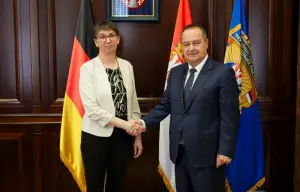
Cooperation in field of interior affairs important segment of relations with Germany
-
 Belgrade, 16 July 2026
Expo 2027 opportunity to further strengthen international partnerships
-
 Belgrade/Bratislava, 16 July 2026
Serbia, Slovakia continue to strengthen political, economic cooperation
-
 Belgrade, 14 July 2026
Serbia bilaterally resolves problems arising from EES implementation
-
 Gradina/Kalotina, 9 July 2026
Improving border cooperation between Serbia, Bulgaria
-
 Belgrade, 7 July 2026
Further strengthening economic cooperation between Serbia, Italy
-
 Belgrade, 6 July 2026
Serbia serious, responsible partner in fight against crime