
Q:
A:
Serbia leader in reforms
Belgrade,
28 November 2008
Deputy Prime Minister for EU Integration and President of the National Council for Competition Bozidar Djelic said today that according to the European Bank for Reconstruction and Development (EBRD) transition report for 2008, Serbia has advanced most in implementing reforms.
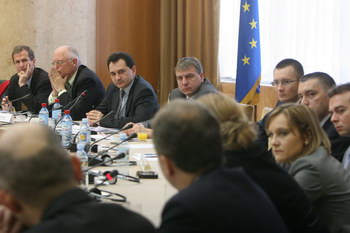
Djelic stressed that the biggest progress was made in the fields of anti-monopoly regulation and investments.
He added that the EBRD recommended us not to reduce the funding for science, education and surveys, as the whole of our development depends upon them.
The EU unblocked €620 million of support to Southeast Europe because of the global crisis, he said, explaining that €120 million is a donation while €500 million is from international financial institutions.
We still do not know how much Serbia will get from it, he said, noting that the money will be used for the stabilisation of the financial sector, providing energy efficiency and financing infrastructure projects.
He added that the EBRD recommended us not to reduce the funding for science, education and surveys, as the whole of our development depends upon them.
The EU unblocked €620 million of support to Southeast Europe because of the global crisis, he said, explaining that €120 million is a donation while €500 million is from international financial institutions.
We still do not know how much Serbia will get from it, he said, noting that the money will be used for the stabilisation of the financial sector, providing energy efficiency and financing infrastructure projects.
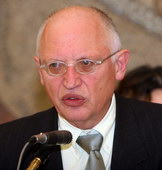
Gunter Verheugen
The Deputy Prime Minister announced that at a meeting regarding additional measures for the fight against the global financial crisis, which will be held in December in Brussels, Serbia will recommend measures for the Western Balkans, as well as the increase of its loan by €620 million.
Vice-President of the European Commission responsible for Enterprise and Industry Gunter Verheugen said that Serbia has made great economic and political progress and is developing fast on its EU road.
He pointed out that Serbia’s EU accession is also in the interest of the EU, particularly during the global financial crisis, adding that Serbia is backed by the UN in this respect.
Verheugen said that at the meeting of the National Competitiveness Council the influences of the financial crisis on Serbia were discussed, adding that the crisis could make borrowing harder and therefore the EU is striving to create new financial instruments to be at the disposal of the Serbian economy.
He voiced hope that Serbia will soon be included in the Schengen “white list”, which will enable its citizens to travel without visas all around Europe.
EBRD chief economist Erik Berglof said that according to this year’s report on transition Serbia is holding the top position regarding the implementation of its reforms, adding that there is still much to be done.
According to him the basis for long-term development is education and competitiveness, so that these fields have to be exempted from the savings programme.
Vice-President of the European Commission responsible for Enterprise and Industry Gunter Verheugen said that Serbia has made great economic and political progress and is developing fast on its EU road.
He pointed out that Serbia’s EU accession is also in the interest of the EU, particularly during the global financial crisis, adding that Serbia is backed by the UN in this respect.
Verheugen said that at the meeting of the National Competitiveness Council the influences of the financial crisis on Serbia were discussed, adding that the crisis could make borrowing harder and therefore the EU is striving to create new financial instruments to be at the disposal of the Serbian economy.
He voiced hope that Serbia will soon be included in the Schengen “white list”, which will enable its citizens to travel without visas all around Europe.
EBRD chief economist Erik Berglof said that according to this year’s report on transition Serbia is holding the top position regarding the implementation of its reforms, adding that there is still much to be done.
According to him the basis for long-term development is education and competitiveness, so that these fields have to be exempted from the savings programme.
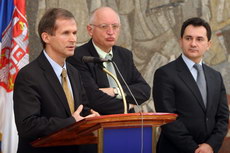
Erik Berglof
He announced that the EBRD will increase loans by approximately 20% in 2009, so that it will allocate €7 billion to Serbia, noting that the EBRD’s aim is to increase its loans to Serbia to the highest possible level.
According to the EBRD’s report on transition for 2008, published on November 25, Serbia improved its average mark regarding the transition process from 2.7 to 8.5, due to the strengthening of its financial sector and trade liberalisation.
The report says that Serbia has made considerable progress regarding EU integration as well as the negotiations with the World Trade Organisation, whose membership Serbia may join in 2009.
The EBRD also assessed that although Serbia has high economic growth, its main problems are the high level of inflation and the current balance of payments deficit.
According to the EBRD’s report, the high level of economic growth will probably be reduced to 7% in 2008 and then to 3% in 2009.
According to the EBRD’s report on transition for 2008, published on November 25, Serbia improved its average mark regarding the transition process from 2.7 to 8.5, due to the strengthening of its financial sector and trade liberalisation.
The report says that Serbia has made considerable progress regarding EU integration as well as the negotiations with the World Trade Organisation, whose membership Serbia may join in 2009.
The EBRD also assessed that although Serbia has high economic growth, its main problems are the high level of inflation and the current balance of payments deficit.
According to the EBRD’s report, the high level of economic growth will probably be reduced to 7% in 2008 and then to 3% in 2009.
-
 Belgrade, 22 July 2026
Serbia follows modern technological achievements, attracts investments
-
 Belgrade, 22 July 2026
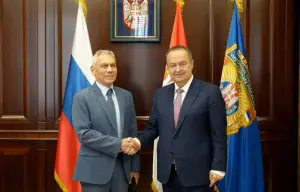
Continued cooperation with Russia in field of security, emergency situations
-
 Belgrade, 22 July 2026
New opportunities for expanding economic cooperation between Serbia, China
-
 Belgrade, 20 July 2026
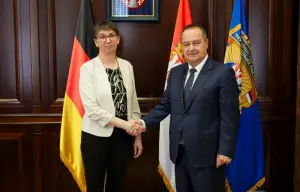
Cooperation in field of interior affairs important segment of relations with Germany
-
 Belgrade, 16 July 2026
Expo 2027 opportunity to further strengthen international partnerships
-
 Belgrade/Bratislava, 16 July 2026
Serbia, Slovakia continue to strengthen political, economic cooperation
-
 Belgrade, 14 July 2026
Serbia bilaterally resolves problems arising from EES implementation
-
 Gradina/Kalotina, 9 July 2026
Improving border cooperation between Serbia, Bulgaria
-
 Belgrade, 7 July 2026
Further strengthening economic cooperation between Serbia, Italy
-
 Belgrade, 6 July 2026
Serbia serious, responsible partner in fight against crime