
Q:
A:
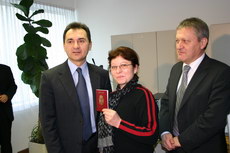
Djelic attends issuance of new passport in Vienna
Belgrade/Vienna,
18 November 2008
Deputy Prime Minister for EU Integration Bozidar Djelic today attended the beginning of the process of collecting personal data for the issuance of biometric passports at the Serbian embassy in Vienna.
Author:
Tanjug
Djelic pointed out that this is a big day for the Diaspora in Vienna, like the Serbian embassies in Paris and Dusseldorf, the embassy in Vienna started collecting personal data for the issuance of new travel documents.
Djelic said that it is of great importance since more than 100,000 Serbs live in Austria.
The new passport is essential for inclusion on the Schengen ’white list’ and a precondition for travelling to Europe without visas, said Djelic and invited citizens to start replacing old passports with new, ones despite the fact the parliament will postpone the expiry date of old passports until the end of 2009.
The new biometric passports are issued at consular offices within two months for a total fee of €51.
As for new ID cards, they still cannot be issued at consular offices due to technical reasons.
Djelic said that it is of great importance since more than 100,000 Serbs live in Austria.
The new passport is essential for inclusion on the Schengen ’white list’ and a precondition for travelling to Europe without visas, said Djelic and invited citizens to start replacing old passports with new, ones despite the fact the parliament will postpone the expiry date of old passports until the end of 2009.
The new biometric passports are issued at consular offices within two months for a total fee of €51.
As for new ID cards, they still cannot be issued at consular offices due to technical reasons.
Djelic took part today in a panel discussion on the effects of political mobility, immigration and the labour market, which was held at the conference on European economic integration organised by the Austrian National Bank in Vienna.
He said at the occasion that Serbia’s goal is to improve the standard of life for the Serbian people and to make it possible for Serbian citizens to travel freely in Europe while being based in their homeland.
A silent battle for experts will be fought during the next few decades, for instance demographics show that Germany will try to attract some 600,000 scientists, technologists, engineers and skilled workers over the next six years, said Djelic.
He said that the global financial crisis could result in many EU countries closing their doors, adding that these countries are less likely to be in favour of removing visa restrictions.
It was said at the conference that the idea of the so called Blue Card, a fast-track work visa for skilled migrants similar to the US Green Card, is in difficulties and there are countries that do not wish to accept the Blue Card, which other countries would issue, rendering the entire project pointless, said Djelic.
He said that it is in Europe’s interest to work on increasing mobility with controlled immigration and if European countries close their door to immigration they will lose from the competition developing between Europe, India, China, the US and other world markets.
Speaking about Serbia’s inclusion in the Schengen “white list”, he said that there are some difficulties but efforts should not be halted.
The growing threat posed by the global financial crisis, upcoming EU elections and the fact that no institutional solutions have been found for the EU until now are all circumstances which are obstacles to Serbia’s inclusion in the Schengen “white list”, said Djelic, adding that harder conditions should not discourage Serbia from pursuing its goals.
He reminded them that the European Commission has for the first time confirmed that it will propose removal of visa restrictions in 2009 for countries that are technically ready.
A formal dialogue between the EU and Serbia on removal of visa restrictions began only this year, said Djelic, adding that Serbia must convince Schengen countries by implementing the necessary reforms and required measures, that removal of visa restrictions will not pose a security threat, rather they would serve to improve relations.
Addressing the press, Djelic said that the Serbian government is taking serious measures to minimize the effects of the financial global crisis on Serbia.
He said that Serbia has reached an agreement with the IMF, which is the best proof of the government’s commitment to deal with the issue and to take tough measures to keep the value of the Serbian dinar and prices stable.
He said that the government will take all measures necessary to finance budgetary spending without reducing funds for infrastructure construction, particularly Corridor 10
He said that Serbia is located at a strategic geographical point in Europe, has a developing infrastructure and offers low tax rates.
It is Serbia’s responsibility to make every effort to attract foreign investors to set up production facilities in Serbia and to export their products from Serbia, said Djelic.
He said at the occasion that Serbia’s goal is to improve the standard of life for the Serbian people and to make it possible for Serbian citizens to travel freely in Europe while being based in their homeland.
A silent battle for experts will be fought during the next few decades, for instance demographics show that Germany will try to attract some 600,000 scientists, technologists, engineers and skilled workers over the next six years, said Djelic.
He said that the global financial crisis could result in many EU countries closing their doors, adding that these countries are less likely to be in favour of removing visa restrictions.
It was said at the conference that the idea of the so called Blue Card, a fast-track work visa for skilled migrants similar to the US Green Card, is in difficulties and there are countries that do not wish to accept the Blue Card, which other countries would issue, rendering the entire project pointless, said Djelic.
He said that it is in Europe’s interest to work on increasing mobility with controlled immigration and if European countries close their door to immigration they will lose from the competition developing between Europe, India, China, the US and other world markets.
Speaking about Serbia’s inclusion in the Schengen “white list”, he said that there are some difficulties but efforts should not be halted.
The growing threat posed by the global financial crisis, upcoming EU elections and the fact that no institutional solutions have been found for the EU until now are all circumstances which are obstacles to Serbia’s inclusion in the Schengen “white list”, said Djelic, adding that harder conditions should not discourage Serbia from pursuing its goals.
He reminded them that the European Commission has for the first time confirmed that it will propose removal of visa restrictions in 2009 for countries that are technically ready.
A formal dialogue between the EU and Serbia on removal of visa restrictions began only this year, said Djelic, adding that Serbia must convince Schengen countries by implementing the necessary reforms and required measures, that removal of visa restrictions will not pose a security threat, rather they would serve to improve relations.
Addressing the press, Djelic said that the Serbian government is taking serious measures to minimize the effects of the financial global crisis on Serbia.
He said that Serbia has reached an agreement with the IMF, which is the best proof of the government’s commitment to deal with the issue and to take tough measures to keep the value of the Serbian dinar and prices stable.
He said that the government will take all measures necessary to finance budgetary spending without reducing funds for infrastructure construction, particularly Corridor 10
He said that Serbia is located at a strategic geographical point in Europe, has a developing infrastructure and offers low tax rates.
It is Serbia’s responsibility to make every effort to attract foreign investors to set up production facilities in Serbia and to export their products from Serbia, said Djelic.
-
 Belgrade, 22 July 2026
Serbia follows modern technological achievements, attracts investments
-
 Belgrade, 22 July 2026
Continued cooperation with Russia in field of security, emergency situations
-
 Belgrade, 22 July 2026
New opportunities for expanding economic cooperation between Serbia, China
-
 Belgrade, 20 July 2026
Cooperation in field of interior affairs important segment of relations with Germany
-
 Belgrade, 16 July 2026
Expo 2027 opportunity to further strengthen international partnerships
-
 Belgrade/Bratislava, 16 July 2026
Serbia, Slovakia continue to strengthen political, economic cooperation
-
 Belgrade, 14 July 2026
Serbia bilaterally resolves problems arising from EES implementation
-
 Gradina/Kalotina, 9 July 2026
Improving border cooperation between Serbia, Bulgaria
-
 Belgrade, 7 July 2026
Further strengthening economic cooperation between Serbia, Italy
-
 Belgrade, 6 July 2026
Serbia serious, responsible partner in fight against crime