
Q:
A:
European Commission commends Serbia’s administration
Belgrade/Brussels,
22 October 2008
Deputy Prime Minister in charge of EU integration Bozidar Djelic stated today in Brussels that the European Commission’s draft annual report on Serbia’s progress into EU integration commends its administration, but also criticizes the small number of laws adopted by Serbian parliament.
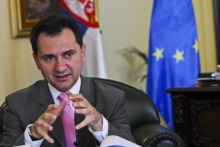
File photo of Bozidar Djelic
Author:
Tanjug
Djelic talked about the first draft annual report with Director of the European Commission Directorate for Western Balkan Pierre Mirelle, who will present the document in Belgrade.
This year’s report commends Serbia’s administrative capacity and the role of the EU Integration Office. It also speaks favourably about the implementation of the Stabilisation and Association Agreement (SAA) which is to begin on January 1, 2009, stressed Djelic.
According to him, the largest problem is the Serbian parliament’s adoption of very few laws relating to EU membership.
Therefore I now call upon parliament to conclude this sitting as soon as possible, adopt the laws necessary for the Schengen “white list” and others needed for Serbia’s European future, as well as to continue working with the same commitment in the upcoming period, said Djelic.
He voiced hope that either today or tomorrow eight laws concerning the road map on visa liberalisation will be adopted and that afterwards the law on the implementation of the SAA should be adopted, as well as that, broader synchronisation with the EU’s legal framework will follow.
Serbia is advancing, but out of 50 proposed laws we adopted just two, he said.
He said that the European Commision puts an accent on the necessity of fighting against corruption and organised crime, adding that European Commision officials were presented police reports of their fight against organized crime.
This year’s report commends Serbia’s administrative capacity and the role of the EU Integration Office. It also speaks favourably about the implementation of the Stabilisation and Association Agreement (SAA) which is to begin on January 1, 2009, stressed Djelic.
According to him, the largest problem is the Serbian parliament’s adoption of very few laws relating to EU membership.
Therefore I now call upon parliament to conclude this sitting as soon as possible, adopt the laws necessary for the Schengen “white list” and others needed for Serbia’s European future, as well as to continue working with the same commitment in the upcoming period, said Djelic.
He voiced hope that either today or tomorrow eight laws concerning the road map on visa liberalisation will be adopted and that afterwards the law on the implementation of the SAA should be adopted, as well as that, broader synchronisation with the EU’s legal framework will follow.
Serbia is advancing, but out of 50 proposed laws we adopted just two, he said.
He said that the European Commision puts an accent on the necessity of fighting against corruption and organised crime, adding that European Commision officials were presented police reports of their fight against organized crime.
Djelic today also met with European Commissioner for Economic and Financial Affairs Joaquin Almunia, who supported Serbia’s arrangement with the IMF and stressed that now the EU will further back Serbia through macro-financial assistance.
He said that next week Serbia will start negotiations on the agreement with the IMF, but will not seek loans or financial help.
According to him, Serbia will also be in the EU’s macro-financial assistance programme, which will lead to stability and economic development.
Djelic explained that this kind of help can be allocated to a country for supplementing its budget or to address other needs.
Serbia does not need monetary help at this moment, but it is good to know that the European Commission supports Serbia, stressed Djelic and added that he talked with Almunia about Hungary’s large budge deficits during the previous years.
The arrangement with IMF and EU support will be the best guarantee that a similar situation does not occur in Serbia and the country manages to maintain stability even through the global financial crisis, which will be the best possible recommendation to all investors, said Djelic.
Djelic said that Almunia also pledged to hold further talks with representatives of the European Investment Bank (EIB) and the European Bank for Reconstruction and Development about the programme for financing national infrastructure, primarily Corridor 10, and to open up new opportunities for financing the small and medium-sized enterprises sector in Serbia with EIB loans.
Djelic met today with Commissioner for Science and Research Janez Potocnik and sought from him to open up the European Atomic Energy Community or Euratom research programme for Serbia.
Following the start of negotiations yesterday concerning Serbia’s membership in the European Organisation for Nuclear Research CERN, today a step was made towards cooperation with Euratom, which is of great importance for the future of nuclear physics in Serbia, said the Deputy Prime Minister.
He said that he also met today with Commissioner for Information Society and Media Viviane Reding who recommended that Serbia should work on further liberalization and digitalization of its telecommunications market until 2012.
The Deputy Prime Minister conveyed to the commissioners that the Serbian government has decided to implement the Stabilisation and Association Agreement (SAA) with the EU in 2009, and presented the final draft of Serbia’s national EU integration plan.
He said that next week Serbia will start negotiations on the agreement with the IMF, but will not seek loans or financial help.
According to him, Serbia will also be in the EU’s macro-financial assistance programme, which will lead to stability and economic development.
Djelic explained that this kind of help can be allocated to a country for supplementing its budget or to address other needs.
Serbia does not need monetary help at this moment, but it is good to know that the European Commission supports Serbia, stressed Djelic and added that he talked with Almunia about Hungary’s large budge deficits during the previous years.
The arrangement with IMF and EU support will be the best guarantee that a similar situation does not occur in Serbia and the country manages to maintain stability even through the global financial crisis, which will be the best possible recommendation to all investors, said Djelic.
Djelic said that Almunia also pledged to hold further talks with representatives of the European Investment Bank (EIB) and the European Bank for Reconstruction and Development about the programme for financing national infrastructure, primarily Corridor 10, and to open up new opportunities for financing the small and medium-sized enterprises sector in Serbia with EIB loans.
Djelic met today with Commissioner for Science and Research Janez Potocnik and sought from him to open up the European Atomic Energy Community or Euratom research programme for Serbia.
Following the start of negotiations yesterday concerning Serbia’s membership in the European Organisation for Nuclear Research CERN, today a step was made towards cooperation with Euratom, which is of great importance for the future of nuclear physics in Serbia, said the Deputy Prime Minister.
He said that he also met today with Commissioner for Information Society and Media Viviane Reding who recommended that Serbia should work on further liberalization and digitalization of its telecommunications market until 2012.
The Deputy Prime Minister conveyed to the commissioners that the Serbian government has decided to implement the Stabilisation and Association Agreement (SAA) with the EU in 2009, and presented the final draft of Serbia’s national EU integration plan.
-
 Belgrade, 22 July 2026
Serbia follows modern technological achievements, attracts investments
-
 Belgrade, 22 July 2026
Continued cooperation with Russia in field of security, emergency situations
-
 Belgrade, 22 July 2026
New opportunities for expanding economic cooperation between Serbia, China
-
 Belgrade, 20 July 2026
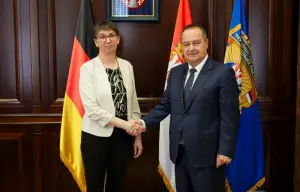
Cooperation in field of interior affairs important segment of relations with Germany
-
 Belgrade, 16 July 2026
Expo 2027 opportunity to further strengthen international partnerships
-
 Belgrade/Bratislava, 16 July 2026
Serbia, Slovakia continue to strengthen political, economic cooperation
-
 Belgrade, 14 July 2026
Serbia bilaterally resolves problems arising from EES implementation
-
 Gradina/Kalotina, 9 July 2026
Improving border cooperation between Serbia, Bulgaria
-
 Belgrade, 7 July 2026
Further strengthening economic cooperation between Serbia, Italy
-
 Belgrade, 6 July 2026
Serbia serious, responsible partner in fight against crime