
Q:
A:
Serbia must prepare for inflow of IPA funds
Belgrade,
16 October 2008
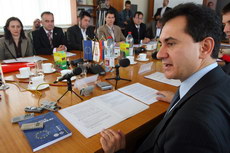
Deputy Prime Minister in charge of EU integration Bozidar Djelic stated that €40–50 million a year will be set aside from the Instrument for Pre-Accession Assistance (IPA) for Serbian municipalities and for strengthening local services.
Author:
Tanjug
At a session of the committee for EU integration and international cooperation of the Standing Conference of Towns and Municipalities, Djelic said that in 2008 €45 million was set aside from IPA funds for the development of local self-government, adding that another €10 million was allocated as co-financing from the National Investment Plan.
According to him, these funds will be used for restructuring public companies, preparing plans for future infrastructure projects and for financing projects on environmental protection, transport, tourism and education.
Djelic recalled that it was determined that Serbia annually receives around €250 million from the IPA funds and asked municipal representatives to engage in building up local services and proposing new projects because this is the first time that funds have exceeded the number of proposed projects.
He said that ties with municipalities and towns in the Schengen zone may help to increase the pressure to abolish the visa regime for Serbian citizens and pointed to the importance of fraternisation with EU towns and cities for improving cooperation.
Djelic announced that one of the key tasks for municipalities, as well as the authorities, will be the “statistical reorganisation” of the country, and noted that the broader public has a misconception about the need for this step.
It is not true that the EU demands the division of Serbia into regions, but needs clear regional boundaries established in order to have the funds approved more easily, explained Djelic and recalled the example of the Czech Republic, a country that received the most EU funds per capita thanks to its pragmatic approach to this issue.
No one expects Serbia to reorganise its territory. No one expects it to come up with regions which do not exist today, no one expects it to organise elections there. It is not true that Europe wants us to form regions, stressed the Deputy Prime Minister.
According to him, Serbia is expected to have statistical regions and institutions which will enable project implementation without making the structures more complex or reorganising the territory.
Djelic pointed out that Serbia has to implement a certain amount of regionalisation in order to use funds from the EU budget for regional development and added that the first draft law on regions, which is being prepared by the Ministry of Economy and Regional Development, is to be adopted by the end of the year.
The Minister stressed the importance of having the capacity to deal with the inflow of IPA funds after Serbia acquires EU candidate status, which will hopefully occur next year.
He added that the first real IPA funds for regional development are expected in 2011 and stressed it is important that Serbia prepares for the EU’s six year budget for the period 2014–2020.
Serbia has to present itself as capable of using the EU funds, stressed Djelic.
He said that the certification of financial services, an internal revision of authorities’ work and setting up an agency for agrarian payments are also to be executed at the local level, and added that according to estimates Serbia will receive €1.5 million from the EU’s IPA funds.
That is a much better way for financing infrastructure and other projects than the taxation of citizens, stressed Djelic and added that the law on the public ownership of local self-governments is to be adopted before the end of the year.
He explained that the document will enable municipalities to dispose of its own property and added that it will contribute considerably to their functionability.
The Minister announced that on October 28 the Serbian Ministry of Finance and the Standing Conference of Towns and Municipalities will hold a press conference on IPA funds.
According to him, these funds will be used for restructuring public companies, preparing plans for future infrastructure projects and for financing projects on environmental protection, transport, tourism and education.
Djelic recalled that it was determined that Serbia annually receives around €250 million from the IPA funds and asked municipal representatives to engage in building up local services and proposing new projects because this is the first time that funds have exceeded the number of proposed projects.
He said that ties with municipalities and towns in the Schengen zone may help to increase the pressure to abolish the visa regime for Serbian citizens and pointed to the importance of fraternisation with EU towns and cities for improving cooperation.
Djelic announced that one of the key tasks for municipalities, as well as the authorities, will be the “statistical reorganisation” of the country, and noted that the broader public has a misconception about the need for this step.
It is not true that the EU demands the division of Serbia into regions, but needs clear regional boundaries established in order to have the funds approved more easily, explained Djelic and recalled the example of the Czech Republic, a country that received the most EU funds per capita thanks to its pragmatic approach to this issue.
No one expects Serbia to reorganise its territory. No one expects it to come up with regions which do not exist today, no one expects it to organise elections there. It is not true that Europe wants us to form regions, stressed the Deputy Prime Minister.
According to him, Serbia is expected to have statistical regions and institutions which will enable project implementation without making the structures more complex or reorganising the territory.
Djelic pointed out that Serbia has to implement a certain amount of regionalisation in order to use funds from the EU budget for regional development and added that the first draft law on regions, which is being prepared by the Ministry of Economy and Regional Development, is to be adopted by the end of the year.
The Minister stressed the importance of having the capacity to deal with the inflow of IPA funds after Serbia acquires EU candidate status, which will hopefully occur next year.
He added that the first real IPA funds for regional development are expected in 2011 and stressed it is important that Serbia prepares for the EU’s six year budget for the period 2014–2020.
Serbia has to present itself as capable of using the EU funds, stressed Djelic.
He said that the certification of financial services, an internal revision of authorities’ work and setting up an agency for agrarian payments are also to be executed at the local level, and added that according to estimates Serbia will receive €1.5 million from the EU’s IPA funds.
That is a much better way for financing infrastructure and other projects than the taxation of citizens, stressed Djelic and added that the law on the public ownership of local self-governments is to be adopted before the end of the year.
He explained that the document will enable municipalities to dispose of its own property and added that it will contribute considerably to their functionability.
The Minister announced that on October 28 the Serbian Ministry of Finance and the Standing Conference of Towns and Municipalities will hold a press conference on IPA funds.
-
 Belgrade, 22 July 2026
Serbia follows modern technological achievements, attracts investments
-
 Belgrade, 22 July 2026
Continued cooperation with Russia in field of security, emergency situations
-
 Belgrade, 22 July 2026
New opportunities for expanding economic cooperation between Serbia, China
-
 Belgrade, 20 July 2026
Cooperation in field of interior affairs important segment of relations with Germany
-
 Belgrade, 16 July 2026
Expo 2027 opportunity to further strengthen international partnerships
-
 Belgrade/Bratislava, 16 July 2026
Serbia, Slovakia continue to strengthen political, economic cooperation
-
 Belgrade, 14 July 2026
Serbia bilaterally resolves problems arising from EES implementation
-
 Gradina/Kalotina, 9 July 2026
Improving border cooperation between Serbia, Bulgaria
-
 Belgrade, 7 July 2026
Further strengthening economic cooperation between Serbia, Italy
-
 Belgrade, 6 July 2026
Serbia serious, responsible partner in fight against crime