
Q:
A:
World Bank, EIB provide funds for Corridor 10
Belgrade/Washington,
13 October 2008
Serbian Deputy Prime Minister Bozidar Djelic said this evening that Serbia has secured funds from the World Bank and the European Investment Bank (EIB) to complete construction of Corridor 10.
In a statement to the news agency Tanjug, Djelic said that the Serbian delegation, which took part in the annual meeting of the International Monetary Fund (IMF) and the World Bank in Washington during the past three days, has secured funds worth $388 million for the completion of Corridor 10, from the $600 million in World Bank support.
World Bank support to Serbia will be increased by a further $600 million at the session to be held in April, and an additional $200 million will be set aside for Corridor 10, said Djelic.
According to Djelic, the Serbian delegation also secured $500 million from the EIB for infrastructure projects in Serbia.
He said that the Serbian delegation was also successful in sending out the message that Serbia is stable and an attractive investment destination.
We wish to send a strong message to the world that Serbia in present conditions has one of the most stable financial systems and is a country that offers very attractive terms to investors, said Djelic.
According to Djelic, it was agreed that an IMF delegation should visit Serbia on October 28 for a joint examination of the 2009 draft budget.
It was agreed that in order to strengthen Serbia, next year’s deficit should not be allowed to exceed this year’s 2% of GDP, and must be kept significantly lower, said the Deputy Prime Minister.
Djelic stressed that Serbia’s efforts to have a balanced budget next year will not affect social benefits.
He said that Serbia’s problem is that for years it has been spending far more than its earnings, making additional efforts and savings necessary.
He said that the government is fulfilling all its promises despite these problems and this is visible in the 10% pension increase and many other things which will be mentioned while presenting results of 100 days of the government’s work.
According to Djelic, one of the Serbian delegation’s aims in Washington was to create an opening for Serbian companies in the European market.
Djelic said that agreement was reached with Swiss government representatives that negotiations will be held on free trade with the European Free Trade Association (EFTA) that includes Switzerland, Norway, Iceland and Liechtenstein.
He said that Serbian representatives made it clear in Washington that Belgrade expects of international financial institutions such as the IMF and World Bank that are based on international law, not to accept any initiative for making Kosovo a member until a decision by the International Court of Justice on the legality of Kosovo’s independence.
At a time when all leading business figures in the world are considering their options and thinking about where to set up production and where to invest, Serbia’s priority is to strengthen its economic and diplomatic offensive and to draw those who have production under harder conditions elsewhere to come and invest in Serbia, said Djelic.
The Serbian delegation, which was led by Djelic, also included Governor of the National Bank of Serbia Radovan Jelasic and Finance Minister Diana Dragutinovic.
World Bank support to Serbia will be increased by a further $600 million at the session to be held in April, and an additional $200 million will be set aside for Corridor 10, said Djelic.
According to Djelic, the Serbian delegation also secured $500 million from the EIB for infrastructure projects in Serbia.
He said that the Serbian delegation was also successful in sending out the message that Serbia is stable and an attractive investment destination.
We wish to send a strong message to the world that Serbia in present conditions has one of the most stable financial systems and is a country that offers very attractive terms to investors, said Djelic.
According to Djelic, it was agreed that an IMF delegation should visit Serbia on October 28 for a joint examination of the 2009 draft budget.
It was agreed that in order to strengthen Serbia, next year’s deficit should not be allowed to exceed this year’s 2% of GDP, and must be kept significantly lower, said the Deputy Prime Minister.
Djelic stressed that Serbia’s efforts to have a balanced budget next year will not affect social benefits.
He said that Serbia’s problem is that for years it has been spending far more than its earnings, making additional efforts and savings necessary.
He said that the government is fulfilling all its promises despite these problems and this is visible in the 10% pension increase and many other things which will be mentioned while presenting results of 100 days of the government’s work.
According to Djelic, one of the Serbian delegation’s aims in Washington was to create an opening for Serbian companies in the European market.
Djelic said that agreement was reached with Swiss government representatives that negotiations will be held on free trade with the European Free Trade Association (EFTA) that includes Switzerland, Norway, Iceland and Liechtenstein.
He said that Serbian representatives made it clear in Washington that Belgrade expects of international financial institutions such as the IMF and World Bank that are based on international law, not to accept any initiative for making Kosovo a member until a decision by the International Court of Justice on the legality of Kosovo’s independence.
At a time when all leading business figures in the world are considering their options and thinking about where to set up production and where to invest, Serbia’s priority is to strengthen its economic and diplomatic offensive and to draw those who have production under harder conditions elsewhere to come and invest in Serbia, said Djelic.
The Serbian delegation, which was led by Djelic, also included Governor of the National Bank of Serbia Radovan Jelasic and Finance Minister Diana Dragutinovic.
-
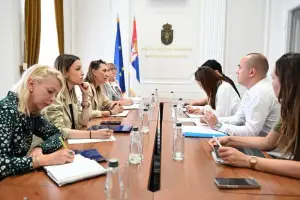 Belgrade, 22 July 2026
Serbia follows modern technological achievements, attracts investments
-
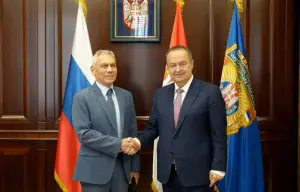 Belgrade, 22 July 2026
Continued cooperation with Russia in field of security, emergency situations
-
 Belgrade, 22 July 2026
New opportunities for expanding economic cooperation between Serbia, China
-
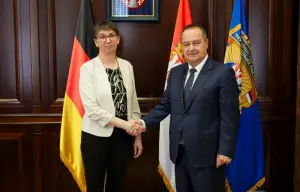 Belgrade, 20 July 2026
Cooperation in field of interior affairs important segment of relations with Germany
-
 Belgrade, 16 July 2026
Expo 2027 opportunity to further strengthen international partnerships
-
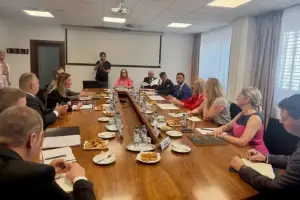 Belgrade/Bratislava, 16 July 2026
Serbia, Slovakia continue to strengthen political, economic cooperation
-
 Belgrade, 14 July 2026
Serbia bilaterally resolves problems arising from EES implementation
-
 Gradina/Kalotina, 9 July 2026
Improving border cooperation between Serbia, Bulgaria
-
 Belgrade, 7 July 2026
Further strengthening economic cooperation between Serbia, Italy
-
 Belgrade, 6 July 2026
Serbia serious, responsible partner in fight against crime