
Q:
A:
Serbian delegation concludes work at IAEA general conference
Vienna,
1 October 2008
Serbian Deputy Prime Minister and Minister of Science and Technological Development and the Serbian delegation participated at a donors’ conference for the project for removal of spent nuclear fuel from the Vinca research reactor, thus wrapping up a three day visit to Vienna where they took part in the 52nd International Atomic Energy Agency (IAEA) general conference.
Speaking to the press, Djelic said that the Serbian delegation produced good results at the IAEA general conference and brought the problem of spent nuclear fuel in Vinca to the attention of the entire world.
He said that agreement was reached with Russia that the interstate agreement on transportation of spent nuclear fuel from Vinca to Russia by 2010 will be finalised by the end of this year, adding that he expects that the agreement will be signed by the end of January 2009.
According to Djelic, the US provided $3 million and the Czech Republic $1 million for financing this project, while help has been sought of other countries and international organisations as well.
Djelic added that the total cost of the project is estimated at $25 million and Serbia will have to finance it in part from the budget.
He said that Nobel Award winner IAEA Director General Mohamed ElBaradei, will visit Serbia for the first time in March or April next year, and Serbia has pledged to pass a new law on nuclear safety, establish necessary institutions and join an additional protocol on nuclear safety until then.
Spent nuclear fuel in Vinca has been a problem for 24 years not only for Vinca and Serbia but the entire world, and by solving it Serbia will enter the group of countries that are safe and responsible and work towards global stability and safety, said the Deputy Prime Minister.
According to Djelic, Serbia will play an active role in finding donors and on October 13 in Washington will make more efforts together with the US administration. Meetings with representations of European administration and EU member states will be held in Brussels on October 22 and 23, and more contacts will be made with the Russians.
He said that Serbia is planning to actively resolve the problem in Vinca, and also to work on developing nuclear energy know-how in Serbia, since nuclear energy has many positive applications in health and other areas.
In Vienna a renaissance of nuclear energy is being talked about. Nuclear energy is getting a lot of attention because of constantly rising oil prices. Serbia has no plans to build a nuclear reactor since that is forbidden by law, but the country must build its own capacities and follow evolution in this area which is the scientific future of the world, said Djelic.
During his stay in Vienna, the Serbian Deputy Prime Minister met with Russian and US delegations, Mohamed ElBaradei and Director General of the United Nations Industrial Development Organization Kandeh Yumkella, with whom he talked about projects of the organisation in Serbia.
He said that agreement was reached with Russia that the interstate agreement on transportation of spent nuclear fuel from Vinca to Russia by 2010 will be finalised by the end of this year, adding that he expects that the agreement will be signed by the end of January 2009.
According to Djelic, the US provided $3 million and the Czech Republic $1 million for financing this project, while help has been sought of other countries and international organisations as well.
Djelic added that the total cost of the project is estimated at $25 million and Serbia will have to finance it in part from the budget.
He said that Nobel Award winner IAEA Director General Mohamed ElBaradei, will visit Serbia for the first time in March or April next year, and Serbia has pledged to pass a new law on nuclear safety, establish necessary institutions and join an additional protocol on nuclear safety until then.
Spent nuclear fuel in Vinca has been a problem for 24 years not only for Vinca and Serbia but the entire world, and by solving it Serbia will enter the group of countries that are safe and responsible and work towards global stability and safety, said the Deputy Prime Minister.
According to Djelic, Serbia will play an active role in finding donors and on October 13 in Washington will make more efforts together with the US administration. Meetings with representations of European administration and EU member states will be held in Brussels on October 22 and 23, and more contacts will be made with the Russians.
He said that Serbia is planning to actively resolve the problem in Vinca, and also to work on developing nuclear energy know-how in Serbia, since nuclear energy has many positive applications in health and other areas.
In Vienna a renaissance of nuclear energy is being talked about. Nuclear energy is getting a lot of attention because of constantly rising oil prices. Serbia has no plans to build a nuclear reactor since that is forbidden by law, but the country must build its own capacities and follow evolution in this area which is the scientific future of the world, said Djelic.
During his stay in Vienna, the Serbian Deputy Prime Minister met with Russian and US delegations, Mohamed ElBaradei and Director General of the United Nations Industrial Development Organization Kandeh Yumkella, with whom he talked about projects of the organisation in Serbia.
-
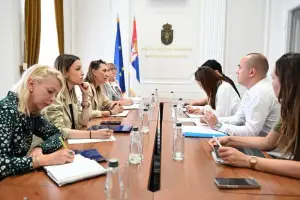 Belgrade, 22 July 2026
Serbia follows modern technological achievements, attracts investments
-
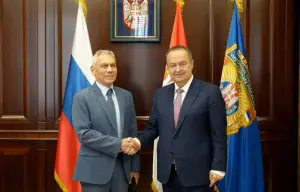 Belgrade, 22 July 2026
Continued cooperation with Russia in field of security, emergency situations
-
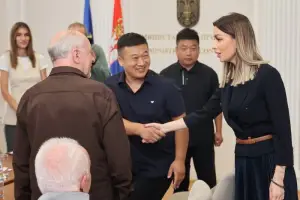 Belgrade, 22 July 2026
New opportunities for expanding economic cooperation between Serbia, China
-
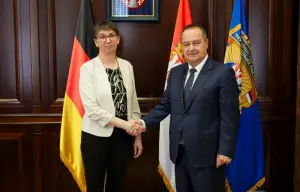 Belgrade, 20 July 2026
Cooperation in field of interior affairs important segment of relations with Germany
-
 Belgrade, 16 July 2026
Expo 2027 opportunity to further strengthen international partnerships
-
 Belgrade/Bratislava, 16 July 2026
Serbia, Slovakia continue to strengthen political, economic cooperation
-
 Belgrade, 14 July 2026
Serbia bilaterally resolves problems arising from EES implementation
-
 Gradina/Kalotina, 9 July 2026
Improving border cooperation between Serbia, Bulgaria
-
 Belgrade, 7 July 2026
Further strengthening economic cooperation between Serbia, Italy
-
 Belgrade, 6 July 2026
Serbia serious, responsible partner in fight against crime