
Q:
A:
Republic, province to jointly invest in Matica Srpska
Novi Sad,
17 September 2008
Serbian Deputy Prime Minister Bozidar Djelic and Chairman of Vojvodina Executive Board Bojan Pajtic said today that the Republic and the province will jointly invest funds to repair the roof on the building of Matica Srpska, the oldest Serbian cultural and scientific building.
At a press conference in Novi Sad, which was also attended by Vojvodina Secretary for Science and Technological Development Dragoslav Petrovic, Djelic said that the repair of the roof will cost RSD 42 million, which will be equally divided between two parties, and the work is to be completed within seven months.
The Deputy Prime Minister and Minister of Science and Technological Development announced the beginning of the digitalisation of the entire Matica Srpska so that its research results are accessible to internet users in English.
Vojvodina is a leader in science and technology, and our common interest is to increase investments in this field from the current 0.4% to 1% of GDP and establish priorities which will speed up the development of the entire country.
In his capacity as the head of the national council for Roma inclusion, Djelic pointed to the assistance to the Roma community which can only prosper with the help of better living and educational conditions.
Pajtic said that the process of buying abandoned houses for Roma people started in Kula and in some other municipalities in Vojvodina, adding that the province is increasingly investing in the education of Roma children and employment of members of that ethnic minority.
Vojvodina set aside RSD 300 million to improve the living conditions of the Roma, while 38 companies opened where almost all employees and owners are Roma, Pajtic said.
Speaking about Serbia’s European road, Djelic commented that a great injustice was done to Serbia on September 15.
However, he said that Serbia will not give up its European perspective and recalled that 25 EU members backed Serbia up, which is unprecedented support ever shown to Serbia within the EU.
He said that the unilateral implementation of the Stabilisation and Association Agreement (SAA) can be beneficial for Serbia if it is formally acknowledged by the European Commission.
Djelic also said that Serbia started implementing some of SAA provisions back in 2003 and added that the new law on customs will regulate minimum customs from 1% to 3% as well as customs duties on the import of cars.
He also repeated that on Monday in Brussels he had special talks on Serbia’s inclusion on the White Schengen List.
I handed out the list of what we have done. EU foreign ministers will examine it in November and possibly give us some suggestions or requirements. I expect the European Commission to abolish visas for Serbian citizens by spring next year, by which time we need to be technically ready, he concluded.
The Deputy Prime Minister and Minister of Science and Technological Development announced the beginning of the digitalisation of the entire Matica Srpska so that its research results are accessible to internet users in English.
Vojvodina is a leader in science and technology, and our common interest is to increase investments in this field from the current 0.4% to 1% of GDP and establish priorities which will speed up the development of the entire country.
In his capacity as the head of the national council for Roma inclusion, Djelic pointed to the assistance to the Roma community which can only prosper with the help of better living and educational conditions.
Pajtic said that the process of buying abandoned houses for Roma people started in Kula and in some other municipalities in Vojvodina, adding that the province is increasingly investing in the education of Roma children and employment of members of that ethnic minority.
Vojvodina set aside RSD 300 million to improve the living conditions of the Roma, while 38 companies opened where almost all employees and owners are Roma, Pajtic said.
Speaking about Serbia’s European road, Djelic commented that a great injustice was done to Serbia on September 15.
However, he said that Serbia will not give up its European perspective and recalled that 25 EU members backed Serbia up, which is unprecedented support ever shown to Serbia within the EU.
He said that the unilateral implementation of the Stabilisation and Association Agreement (SAA) can be beneficial for Serbia if it is formally acknowledged by the European Commission.
Djelic also said that Serbia started implementing some of SAA provisions back in 2003 and added that the new law on customs will regulate minimum customs from 1% to 3% as well as customs duties on the import of cars.
He also repeated that on Monday in Brussels he had special talks on Serbia’s inclusion on the White Schengen List.
I handed out the list of what we have done. EU foreign ministers will examine it in November and possibly give us some suggestions or requirements. I expect the European Commission to abolish visas for Serbian citizens by spring next year, by which time we need to be technically ready, he concluded.
-
 Belgrade, 22 July 2026
Serbia follows modern technological achievements, attracts investments
-
 Belgrade, 22 July 2026
Continued cooperation with Russia in field of security, emergency situations
-
 Belgrade, 22 July 2026
New opportunities for expanding economic cooperation between Serbia, China
-
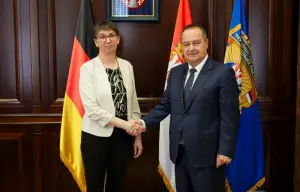 Belgrade, 20 July 2026
Cooperation in field of interior affairs important segment of relations with Germany
-
 Belgrade, 16 July 2026
Expo 2027 opportunity to further strengthen international partnerships
-
 Belgrade/Bratislava, 16 July 2026
Serbia, Slovakia continue to strengthen political, economic cooperation
-
 Belgrade, 14 July 2026
Serbia bilaterally resolves problems arising from EES implementation
-
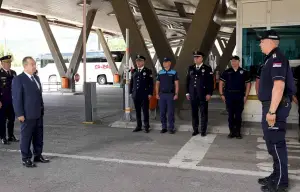 Gradina/Kalotina, 9 July 2026
Improving border cooperation between Serbia, Bulgaria
-
 Belgrade, 7 July 2026
Further strengthening economic cooperation between Serbia, Italy
-
 Belgrade, 6 July 2026
Serbia serious, responsible partner in fight against crime