
Q:
A:
Parliament must ratify SAA as soon as possible
Belgrade,
7 August 2008
Deputy Prime Minister in charge of EU integration and Minister of Science and Technological Development Bozidar Djelic stated today he expects the EU Council of Ministers to decide to activate the transitional agreement with Serbia on September 15.
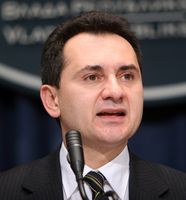
Bozidar Djelic
In a statement for today’s edition of the Blic daily, Djelic said that it would be unrealistic if Serbia then decided to demand such a decision, without first having ratified the Stabilisation and Association Agreement (SAA).
He warned that further obstruction of parliament will clearly endanger Serbia’s goal to become EU candidate by the year’s end and enter the white Schengen list.
According to him, the obstruction can be overcome either by the opposition becoming constructive or through amendments in the parliament’s Rules of Order and a debate on whether to stop broadcasting parliament’s sessions.
He also said that conditions for the implementation of the SAA were clear at the moment of its signing – a unanimous decision by the EU Council of ministers, based on a positive report by Hague Prosecutor Serge Brammertz.
Djelic said he expects Brammertz’s report to be positive, adding that the letter which the Italian Foreign Minister sent to his Dutch counterpart is encouraging, as well as the German government’s demand for the implementation of the SAA.
The implementation of the SAA is crucial for Serbia because the agreement must be ratified by all countries, and until that is achieved, the transitional agreement will be in force for a year or two, he said.
He explained that the SAA does not have to be fully ratified in order for Serbia to acquire candidate status, but the transitional agreement must be thoroughly implemented.
Another Serbia’s goal is the white Schengen list. In mid-November, at the meeting of interior ministers from Europe and the Western Balkans, the visa liberalisation plan will be presented, he announced.
Before September 1, Serbia must submit a report, however, it is important for the white Schengen list that we adopt laws on the protection of personal data, border management and foreigners, which have to be ratified by parliament before end-September, noted the Deputy Prime Minister.
He warned that further obstruction of parliament will clearly endanger Serbia’s goal to become EU candidate by the year’s end and enter the white Schengen list.
According to him, the obstruction can be overcome either by the opposition becoming constructive or through amendments in the parliament’s Rules of Order and a debate on whether to stop broadcasting parliament’s sessions.
He also said that conditions for the implementation of the SAA were clear at the moment of its signing – a unanimous decision by the EU Council of ministers, based on a positive report by Hague Prosecutor Serge Brammertz.
Djelic said he expects Brammertz’s report to be positive, adding that the letter which the Italian Foreign Minister sent to his Dutch counterpart is encouraging, as well as the German government’s demand for the implementation of the SAA.
The implementation of the SAA is crucial for Serbia because the agreement must be ratified by all countries, and until that is achieved, the transitional agreement will be in force for a year or two, he said.
He explained that the SAA does not have to be fully ratified in order for Serbia to acquire candidate status, but the transitional agreement must be thoroughly implemented.
Another Serbia’s goal is the white Schengen list. In mid-November, at the meeting of interior ministers from Europe and the Western Balkans, the visa liberalisation plan will be presented, he announced.
Before September 1, Serbia must submit a report, however, it is important for the white Schengen list that we adopt laws on the protection of personal data, border management and foreigners, which have to be ratified by parliament before end-September, noted the Deputy Prime Minister.
-
 Belgrade, 22 July 2026
Serbia follows modern technological achievements, attracts investments
-
 Belgrade, 22 July 2026
Continued cooperation with Russia in field of security, emergency situations
-
 Belgrade, 22 July 2026
New opportunities for expanding economic cooperation between Serbia, China
-
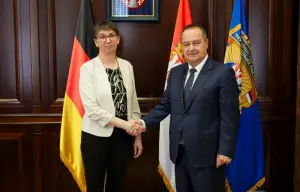 Belgrade, 20 July 2026
Cooperation in field of interior affairs important segment of relations with Germany
-
 Belgrade, 16 July 2026
Expo 2027 opportunity to further strengthen international partnerships
-
 Belgrade/Bratislava, 16 July 2026
Serbia, Slovakia continue to strengthen political, economic cooperation
-
 Belgrade, 14 July 2026
Serbia bilaterally resolves problems arising from EES implementation
-
 Gradina/Kalotina, 9 July 2026
Improving border cooperation between Serbia, Bulgaria
-
 Belgrade, 7 July 2026
Further strengthening economic cooperation between Serbia, Italy
-
 Belgrade, 6 July 2026
Serbia serious, responsible partner in fight against crime