
Q:
A:
Transitional agreement with EU in force, earliest September 15
Belgrade,
6 August 2008
Deputy Prime Minister in charge of EU integration and Minister of Science and Technological Development Bozidar Djelic stated today that the transitional agreement with the EU will not come into force before September 15, when the next meeting of the EU Council of Ministers will be held.
Appearing on radio television B92, Djelic announced that Chief Hague Prosecutor Serge Brammertz will visit Serbia in late August, adding that this time he will not draft a report for the UN Security Council, but for the Council of Ministers, scheduled to meet on September 15.
He said he hopes the report will be positive and that EU foreign ministers will decide to lift the block on application of the transitional agreement.
According to him, the agreement is the responsibility of the European Commission and will be enforced as soon as it is ratified by parliaments of all 27 countries, as well as by Serbian parliament. He added it is also necessary for the Stabilisation and Association Agreement (SAA) to be ratified at the next Serbian parliament session on September 2.
Djelic said that it will be very awkward for Serbia if its representatives arrived in Brussels and Luxembourg on September 15 without the ratified agreement, as that would considerably undermine its position.
Speaking about Serbian parliament, Djelic stressed it is necessary for the opposition to allow parliament to continue with its work in order to ratify the SAA, and noted that parliament’s Book of Orders will have to be amended if the opposition keeps obstructing its work.
He added that the programme "13 Plus 19", which he agreed on with Serbian parliament speaker Slavica Djukic-Dejanovic, is to make sure that by end-September, Serbia shows progress which will be represented in the European Commission’s annual report for Serbia, and published in the first week of November.
He recalled it is necessary to rebalance the budget in September in order to meet all arrangements, such as a 10% pension increase, and cover the expenses for Kosovo properly.
The previous government adopted a draft plan of Serbia’s EU integration and distributed it to the ministries. It is a comprehensive report of 800 pages, recalled Djelic adding that Director General of the European Commission’s Enlargement Directorate General Michael Leigh sent his comments regarding this plan on August 1.
Djelic also said that by end-September, an integration plan will be adopted by the government and parliament, envisaging a four-year adjustment period for domestic institutional and legal frameworks, so that Serbia can be fully prepared for EU entry on December 31, 2012.
We estimate that we will need another 3,737 people to do this job, he specified and announced that a certain number of employees in the administration sector will be retrained, whereas a number of others will have to go so that people will skills and knowledge can be recruited.
He reiterated that Serbia respects international law, which gives it additional arguments for the respect of international law in the case of Kosovo-Metohija, and which will help her at the UN General Assembly in September.
Djelic said that Kosovo and EU integration are two separate processes and that Serbia will not agree to them being connected in any way, that is, it will not be blackmailed and forced to accept concessions on one issue for the sake of the other, said Djelic.
Asked when Serbian citizens will be able to travel to EU countries without visas and when Serbia will be on the white Schengen list, he replied that the white Schengen will be set up either before the end of this year, or in the first half of the next, depending on Serbian parliament’s work.
He said he hopes the report will be positive and that EU foreign ministers will decide to lift the block on application of the transitional agreement.
According to him, the agreement is the responsibility of the European Commission and will be enforced as soon as it is ratified by parliaments of all 27 countries, as well as by Serbian parliament. He added it is also necessary for the Stabilisation and Association Agreement (SAA) to be ratified at the next Serbian parliament session on September 2.
Djelic said that it will be very awkward for Serbia if its representatives arrived in Brussels and Luxembourg on September 15 without the ratified agreement, as that would considerably undermine its position.
Speaking about Serbian parliament, Djelic stressed it is necessary for the opposition to allow parliament to continue with its work in order to ratify the SAA, and noted that parliament’s Book of Orders will have to be amended if the opposition keeps obstructing its work.
He added that the programme "13 Plus 19", which he agreed on with Serbian parliament speaker Slavica Djukic-Dejanovic, is to make sure that by end-September, Serbia shows progress which will be represented in the European Commission’s annual report for Serbia, and published in the first week of November.
He recalled it is necessary to rebalance the budget in September in order to meet all arrangements, such as a 10% pension increase, and cover the expenses for Kosovo properly.
The previous government adopted a draft plan of Serbia’s EU integration and distributed it to the ministries. It is a comprehensive report of 800 pages, recalled Djelic adding that Director General of the European Commission’s Enlargement Directorate General Michael Leigh sent his comments regarding this plan on August 1.
Djelic also said that by end-September, an integration plan will be adopted by the government and parliament, envisaging a four-year adjustment period for domestic institutional and legal frameworks, so that Serbia can be fully prepared for EU entry on December 31, 2012.
We estimate that we will need another 3,737 people to do this job, he specified and announced that a certain number of employees in the administration sector will be retrained, whereas a number of others will have to go so that people will skills and knowledge can be recruited.
He reiterated that Serbia respects international law, which gives it additional arguments for the respect of international law in the case of Kosovo-Metohija, and which will help her at the UN General Assembly in September.
Djelic said that Kosovo and EU integration are two separate processes and that Serbia will not agree to them being connected in any way, that is, it will not be blackmailed and forced to accept concessions on one issue for the sake of the other, said Djelic.
Asked when Serbian citizens will be able to travel to EU countries without visas and when Serbia will be on the white Schengen list, he replied that the white Schengen will be set up either before the end of this year, or in the first half of the next, depending on Serbian parliament’s work.
-
 Belgrade, 22 July 2026
Serbia follows modern technological achievements, attracts investments
-
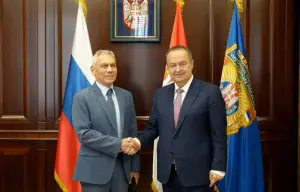 Belgrade, 22 July 2026
Continued cooperation with Russia in field of security, emergency situations
-
 Belgrade, 22 July 2026
New opportunities for expanding economic cooperation between Serbia, China
-
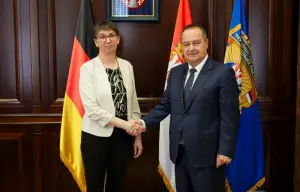 Belgrade, 20 July 2026
Cooperation in field of interior affairs important segment of relations with Germany
-
 Belgrade, 16 July 2026
Expo 2027 opportunity to further strengthen international partnerships
-
 Belgrade/Bratislava, 16 July 2026
Serbia, Slovakia continue to strengthen political, economic cooperation
-
 Belgrade, 14 July 2026
Serbia bilaterally resolves problems arising from EES implementation
-
 Gradina/Kalotina, 9 July 2026
Improving border cooperation between Serbia, Bulgaria
-
 Belgrade, 7 July 2026
Further strengthening economic cooperation between Serbia, Italy
-
 Belgrade, 6 July 2026
Serbia serious, responsible partner in fight against crime