
Q:
A:
32 laws to be adopted by end-September to speed up Serbia’s European integration
Belgrade,
15 July 2008
Serbian Deputy Prime Minister for European Integration and Minister of Science and Technological Development Bozidar Djelic expressed expectation today that 32 laws will be adopted by the end of September in order to speed up Serbia’s European integration.
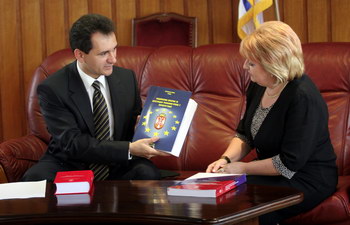
Bozidar Djelic, left, and Slavica Djukic-Dejanovic
Author:
Tanjug
After meeting with Serbian parliament Speaker Slavica Djukic-Dejanovic, he told journalists that the adoption of those laws is the strongest possible recommendation for the country to acquire EU candidate status by the end of the year.
He announced that the government will return 13 bills to the parliamentary procedure, adopted by the previous government, and added that the ambitious goal is to hold another session by the end of July so that parliament can adopt those laws.
Djelic stressed that an additional 19 laws should be adopted at an extraordinary parliament session in September.
He added that Serbia’s acquisition of EU candidate status depends on the adoption of 49 laws because in the first week of November the European Commission will adopt a report on Serbia’s progress in approaching the EU.
Djelic said that the government’s policy on Kosovo will not slow down Serbia’s European integration.
According to him, the issue of European integration and Kosovo are two separate issues, and one is being solved in Brussels and the other in the UN in New York and through direct contact with countries that recognised the so-called independent Kosovo.
Serbia is not against the international presence in Kosovo, but on condition it is approved in the Security Council, which is not the case with the EULEX mission. We demand that the mission is status neutral such as UNMIK and it should not implement Martti Ahtisaari’s rejected plan said Djelic.
He said that the Foreign Ministry announced it would re-examine the state policy on Kosovo in the segment referring to the country's representation in the world.
Djukic-Dejanovic said that she was surprised to hear that of 51 laws harmonising the country’s legal system with that of the EU, parliament last year adopted only two.
We agreed to get the remaining bills to make all preconditions for European integration, which is a top priority of this government, she said and noted that the first 13 laws refer to visa abolishment, trade and finances, environmental protection and energy and mining.
The second package includes regulations on agriculture, the fight against corruption, money laundering and judiciary reform.
He announced that the government will return 13 bills to the parliamentary procedure, adopted by the previous government, and added that the ambitious goal is to hold another session by the end of July so that parliament can adopt those laws.
Djelic stressed that an additional 19 laws should be adopted at an extraordinary parliament session in September.
He added that Serbia’s acquisition of EU candidate status depends on the adoption of 49 laws because in the first week of November the European Commission will adopt a report on Serbia’s progress in approaching the EU.
Djelic said that the government’s policy on Kosovo will not slow down Serbia’s European integration.
According to him, the issue of European integration and Kosovo are two separate issues, and one is being solved in Brussels and the other in the UN in New York and through direct contact with countries that recognised the so-called independent Kosovo.
Serbia is not against the international presence in Kosovo, but on condition it is approved in the Security Council, which is not the case with the EULEX mission. We demand that the mission is status neutral such as UNMIK and it should not implement Martti Ahtisaari’s rejected plan said Djelic.
He said that the Foreign Ministry announced it would re-examine the state policy on Kosovo in the segment referring to the country's representation in the world.
Djukic-Dejanovic said that she was surprised to hear that of 51 laws harmonising the country’s legal system with that of the EU, parliament last year adopted only two.
We agreed to get the remaining bills to make all preconditions for European integration, which is a top priority of this government, she said and noted that the first 13 laws refer to visa abolishment, trade and finances, environmental protection and energy and mining.
The second package includes regulations on agriculture, the fight against corruption, money laundering and judiciary reform.
-
 Belgrade, 22 July 2026
Serbia follows modern technological achievements, attracts investments
-
 Belgrade, 22 July 2026
Continued cooperation with Russia in field of security, emergency situations
-
 Belgrade, 22 July 2026
New opportunities for expanding economic cooperation between Serbia, China
-
 Belgrade, 20 July 2026
Cooperation in field of interior affairs important segment of relations with Germany
-
 Belgrade, 16 July 2026
Expo 2027 opportunity to further strengthen international partnerships
-
 Belgrade/Bratislava, 16 July 2026
Serbia, Slovakia continue to strengthen political, economic cooperation
-
 Belgrade, 14 July 2026
Serbia bilaterally resolves problems arising from EES implementation
-
 Gradina/Kalotina, 9 July 2026
Improving border cooperation between Serbia, Bulgaria
-
 Belgrade, 7 July 2026
Further strengthening economic cooperation between Serbia, Italy
-
 Belgrade, 6 July 2026
Serbia serious, responsible partner in fight against crime