
Q:
A:
Law on SANU by end of year
Belgrade,
11 July 2008
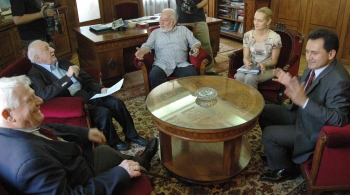
Serbian Deputy Prime Minister for European integration and Minister for Science and Technological Development Bozidar Djelic visited today the Serbian Academy for Arts and Sciences (SANU), where he spoke with president of SANU Nikola Hajdin.
Author:
Fonet
Following the meeting with Hajdin, Djelic said that he took on three obligations today – to present the law on SANU in parliament soon, to work with the institution to establish priorities in the development of science, and to contribute to the practical implementation of science.
According to Djelic, the law on SANU should come into force by the end of this year, and will regulate relations between the Academy and its institutes, the status of the academics and better conditions for pensioners.
He said that Serbia can be successful as a nation only if there is an emphasis on knowledge, science and technology.
He stressed that Serbia should make advances in the implementation of science and technology, and focus on production in the areas of building industry, biochemistry, agriculture, medical sciences, as well as humanities and social sciences.
The Deputy Prime Minister stressed that he has pledged to increase the state’s investments in science from the present 0.4% of the GDP to 1% by the end of the government’s term.
Speaking to the press, Djelic said that paragraph six of the proposed resolution on maintaining continuity of state policy towards Kosovo-Metohija clearly states that Serbia is ratifying the Stabilisation and Association Agreement with Kosovo as its integral part, and will join the EU with Kosovo.
This is how we will join the EU and defend our territorial integrity at the same time, he stressed and added that Serbia will never recognise Kosovo, never make Kosovo an object of bargaining for the sake of quicker European integration and never agree to be blackmailed in any way.
Hajdin said that SANU is proud because it is the first institution which the new Deputy Prime Minister has visited, and it was agreed at the meeting that science should be made more attractive in Serbia and the Serbian society should be transformed into one based on science.
He said that low prices for scientific work cannot be maintained; science is not a low-cost thing and it is necessary to encourage talented people to stay in the country.
According to Djelic, the law on SANU should come into force by the end of this year, and will regulate relations between the Academy and its institutes, the status of the academics and better conditions for pensioners.
He said that Serbia can be successful as a nation only if there is an emphasis on knowledge, science and technology.
He stressed that Serbia should make advances in the implementation of science and technology, and focus on production in the areas of building industry, biochemistry, agriculture, medical sciences, as well as humanities and social sciences.
The Deputy Prime Minister stressed that he has pledged to increase the state’s investments in science from the present 0.4% of the GDP to 1% by the end of the government’s term.
Speaking to the press, Djelic said that paragraph six of the proposed resolution on maintaining continuity of state policy towards Kosovo-Metohija clearly states that Serbia is ratifying the Stabilisation and Association Agreement with Kosovo as its integral part, and will join the EU with Kosovo.
This is how we will join the EU and defend our territorial integrity at the same time, he stressed and added that Serbia will never recognise Kosovo, never make Kosovo an object of bargaining for the sake of quicker European integration and never agree to be blackmailed in any way.
Hajdin said that SANU is proud because it is the first institution which the new Deputy Prime Minister has visited, and it was agreed at the meeting that science should be made more attractive in Serbia and the Serbian society should be transformed into one based on science.
He said that low prices for scientific work cannot be maintained; science is not a low-cost thing and it is necessary to encourage talented people to stay in the country.
-
 Belgrade, 22 July 2026
Serbia follows modern technological achievements, attracts investments
-
 Belgrade, 22 July 2026
Continued cooperation with Russia in field of security, emergency situations
-
 Belgrade, 22 July 2026
New opportunities for expanding economic cooperation between Serbia, China
-
 Belgrade, 20 July 2026
Cooperation in field of interior affairs important segment of relations with Germany
-
 Belgrade, 16 July 2026
Expo 2027 opportunity to further strengthen international partnerships
-
 Belgrade/Bratislava, 16 July 2026
Serbia, Slovakia continue to strengthen political, economic cooperation
-
 Belgrade, 14 July 2026
Serbia bilaterally resolves problems arising from EES implementation
-
 Gradina/Kalotina, 9 July 2026
Improving border cooperation between Serbia, Bulgaria
-
 Belgrade, 7 July 2026
Further strengthening economic cooperation between Serbia, Italy
-
 Belgrade, 6 July 2026
Serbia serious, responsible partner in fight against crime