
Q:
A:
Accelerating EU integration key to creating new social contract
Belgrade,
27 June 2008
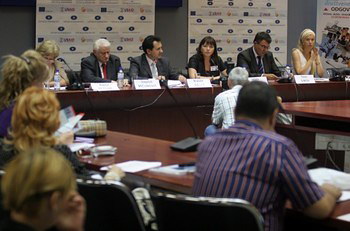
Serbian Deputy Prime Minister Bozidar Djelic said today opening a conference titled “Economic and Social Rights in Serbia” that in creating a new social model in the country, experiences of the EU and the Lisbon Agreement must be kept in mind.
Author:
Tanjug
Djelic stressed that the social plan from 1945 which was based on populism should not be copied, and added that acceleration of EU integration is one of the five key elements in the creation of a new social contract in Serbia which can contribute to reducing employment.
He gave the example of Bulgaria that halved unemployment rates using EU funds.
The new government must take care of vulnerable social groups and decentralise social services, said Djelic and recalled that Serbia has the second oldest population in Europe and fifth in the world.
Speaking about the adjustment of pensions to nearly 70% of the average salary announced recently, he recommended the Swiss model according to which one half of the pension should be adjusted with increase in salaries and the other with growing living expenses.
According to Djelic, a further €2 billion must be set aside from the Serbian budget to adjust pensions during the next four years.
Djelic said that in order to create a new social contract in Serbia, the labour market should be opened up to a wide range of social classes, and added that in order to do that practical training should be introduced into the education system.
He said that equal regional development should also be one of the principles of a new social contract and in order to achieve that Serbia will need far more than the €200 million it receives annually in EU funds, and the experience of other countries that used EU pre-accession funds should also be benefited from.
Djelic added that dialogue must be established with trade unions to form a new social contract, which could double the growth of economy in a very short period.
He gave the example of Bulgaria that halved unemployment rates using EU funds.
The new government must take care of vulnerable social groups and decentralise social services, said Djelic and recalled that Serbia has the second oldest population in Europe and fifth in the world.
Speaking about the adjustment of pensions to nearly 70% of the average salary announced recently, he recommended the Swiss model according to which one half of the pension should be adjusted with increase in salaries and the other with growing living expenses.
According to Djelic, a further €2 billion must be set aside from the Serbian budget to adjust pensions during the next four years.
Djelic said that in order to create a new social contract in Serbia, the labour market should be opened up to a wide range of social classes, and added that in order to do that practical training should be introduced into the education system.
He said that equal regional development should also be one of the principles of a new social contract and in order to achieve that Serbia will need far more than the €200 million it receives annually in EU funds, and the experience of other countries that used EU pre-accession funds should also be benefited from.
Djelic added that dialogue must be established with trade unions to form a new social contract, which could double the growth of economy in a very short period.
-
 Belgrade, 22 July 2026
Serbia follows modern technological achievements, attracts investments
-
 Belgrade, 22 July 2026
Continued cooperation with Russia in field of security, emergency situations
-
 Belgrade, 22 July 2026
New opportunities for expanding economic cooperation between Serbia, China
-
 Belgrade, 20 July 2026
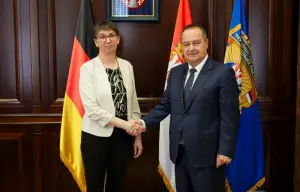
Cooperation in field of interior affairs important segment of relations with Germany
-
 Belgrade, 16 July 2026
Expo 2027 opportunity to further strengthen international partnerships
-
 Belgrade/Bratislava, 16 July 2026
Serbia, Slovakia continue to strengthen political, economic cooperation
-
 Belgrade, 14 July 2026
Serbia bilaterally resolves problems arising from EES implementation
-
 Gradina/Kalotina, 9 July 2026
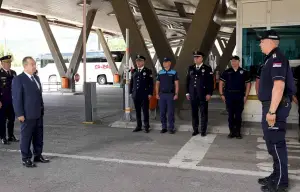
Improving border cooperation between Serbia, Bulgaria
-
 Belgrade, 7 July 2026
Further strengthening economic cooperation between Serbia, Italy
-
 Belgrade, 6 July 2026
Serbia serious, responsible partner in fight against crime