
Q:
A:
Djelic begins three-day visit to Brussels
Brussels,
10 June 2008
Serbian Deputy Prime Minister Bozidar Djelic presented today Serbia’s draft national programme for integration with the EU to President of the European Parliament Hans-Gert Pöttering.
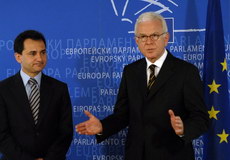
Bozidar Djelic, left, and Hans-Gert Pöttering
Author:
Fonet
Djelic, who is heading a Serbian delegation on a three-day visit to Brussels, told the press following the meeting that he thanked Pöttering and his colleagues at the European Parliament for their role in the signing of the Stabilisation and Association Agreement (SAA) in late April in Luxembourg.
He said that at today’s meeting, they discussed the issue of Kosovo-Metohija which was recently in focus at the European Parliament, because for the first time the flag of independent Kosovo was displayed in this institution.
Serbia will never recognise Kosovo’s independence and we expect the European Parliament to accept Serbia’s stance and behave accordingly, stressed Djelic and noted that he is aware of the fact that there are differing opinions in the European Parliament on this matter.
Pöttering emphasised that he wants to see the SAA ratified soon, adding that there are differences between Belgrade and the European Parliament on the Kosovo issue.
Djelic talked today in Brussels with Commissioner for Science and Research Janez Potocnik and Commissioner for Competition Neelie Kroes, and said that Serbia will be ready to join the EU in 2012.
He stressed that he presented facts to Brussels which show that Serbian authorities are doing everything in their power to conclude cooperation with the Hague tribunal, which is a condition for implementing the SAA, as Serbia’s first step towards EU membership.
The Serbian Deputy Prime Minister explained that proof of Belgrade’s cooperation with the Hague tribunal was presented because of the report which was submitted by ICTY Chief Prosecutor Serge Brammertz to the Security Council.
Our goal is for Serbia to acquire candidate status by the end of this year, sign the agreement with the EU on removal of visa restrictions for Serbian citizens and get access to EU funds, said Djelic.
He said that the commissioners were impressed by the national programme for Serbia’s EU integration, because they saw that it is a serious effort which gives a true assessment of Serbia’s present situation, but also presents an ambitious plan to prepare it for EU membership by 2012.
According to Djelic, the commissioners pledged that they will support the programme and comment on it.
In a meeting with Janez Potocnik, it was agreed to give support to Serbia for a science development strategy in the next year or two, Djelic said.
He also added that Neelie Kroes commended the draft law enforcing the anti-monopoly commission in Serbia.
We expect this law to be among the first to be adopted by the new parliament. We reached an agreement that future state assistance will be subject to additional analysis, which will be done systematically and not at the discretion of local politicians or by pressure from large international financial companies, Djelic said.
He said that these first meetings in Brussels have shown considerable will to support Serbia's European road and that we can count on substantial resources for implementation of that programme.
According to Djelic, with the implementation of the national programme for Serbia’s integration with the EU, our country will with no political privilege be seen as a certain candidate for EU membership by the end of 2012.
Whether we will enter that partnership depends on the decisions of member states and the European Commission, but Serbia will be ready, the Deputy Prime Minister said.
Djelic met tonight with EU Enlargement Commissioner Olli Rehn, who said that the EU is ready to do everything to speed up the process resulting in Serbia and other regional countries acquiring candidate status for EU membership as soon as all necessary conditions have been met.
Rehn said in a joint press conference that the Serbian Deputy Prime Minister gave him Serbia’s draft national programme for integration with the EU.
This document is a very professional and I congratulate the Serbian authorities on a well-prepared and ambitious plan, which speaks of the professionalism and dedication of the Serbian state administration, he said.
He also noted that the deadlines marked in this programme are ambitious, but if the conditions are met, if the SAA is implemented and if convincing results are shown, then there can be a next step in the process of EU integration, which are candidate status and membership negotiations.
This is a solid plan that the new parliament and government should adopt so that Serbia can make progress on its European road and so that European reforms are speeded up. It is important that the SAA comes into force as soon as the necessary conditions have been met as it will open the doors for Serbia to acquire candidate status for EU membership, Rehn explained.
Djelic expressed belief that in the weeks to come, Serbia will have a new government able to stimulate and promote a socially-responsible European programme which will in turn enable ratification of the SAA during the summer.
He added that the forming of the new government, along with additional cooperation with the Hague tribunal, should allow for implementation of the SAA.
According to Rehn, this will be followed by realisation of Serbia’s triple goal by the end of the year, i.e., acquiring EU candidate status, a visa free regime and the right to IPA funds.
The Serbian Deputy Prime Minister said that an agreement has been reached with the European Commission to hold a meeting by July 10 in Brussels in which Serbia will give its answers to the roadmap for abolishment of European visas for Serbian citizens.
He added that he brought with himself to Brussels the new Serbian biometric passport which he showed at tonight’s press conference with Rehn.
He said that at today’s meeting, they discussed the issue of Kosovo-Metohija which was recently in focus at the European Parliament, because for the first time the flag of independent Kosovo was displayed in this institution.
Serbia will never recognise Kosovo’s independence and we expect the European Parliament to accept Serbia’s stance and behave accordingly, stressed Djelic and noted that he is aware of the fact that there are differing opinions in the European Parliament on this matter.
Pöttering emphasised that he wants to see the SAA ratified soon, adding that there are differences between Belgrade and the European Parliament on the Kosovo issue.
Djelic talked today in Brussels with Commissioner for Science and Research Janez Potocnik and Commissioner for Competition Neelie Kroes, and said that Serbia will be ready to join the EU in 2012.
He stressed that he presented facts to Brussels which show that Serbian authorities are doing everything in their power to conclude cooperation with the Hague tribunal, which is a condition for implementing the SAA, as Serbia’s first step towards EU membership.
The Serbian Deputy Prime Minister explained that proof of Belgrade’s cooperation with the Hague tribunal was presented because of the report which was submitted by ICTY Chief Prosecutor Serge Brammertz to the Security Council.
Our goal is for Serbia to acquire candidate status by the end of this year, sign the agreement with the EU on removal of visa restrictions for Serbian citizens and get access to EU funds, said Djelic.
He said that the commissioners were impressed by the national programme for Serbia’s EU integration, because they saw that it is a serious effort which gives a true assessment of Serbia’s present situation, but also presents an ambitious plan to prepare it for EU membership by 2012.
According to Djelic, the commissioners pledged that they will support the programme and comment on it.
In a meeting with Janez Potocnik, it was agreed to give support to Serbia for a science development strategy in the next year or two, Djelic said.
He also added that Neelie Kroes commended the draft law enforcing the anti-monopoly commission in Serbia.
We expect this law to be among the first to be adopted by the new parliament. We reached an agreement that future state assistance will be subject to additional analysis, which will be done systematically and not at the discretion of local politicians or by pressure from large international financial companies, Djelic said.
He said that these first meetings in Brussels have shown considerable will to support Serbia's European road and that we can count on substantial resources for implementation of that programme.
According to Djelic, with the implementation of the national programme for Serbia’s integration with the EU, our country will with no political privilege be seen as a certain candidate for EU membership by the end of 2012.
Whether we will enter that partnership depends on the decisions of member states and the European Commission, but Serbia will be ready, the Deputy Prime Minister said.
Djelic met tonight with EU Enlargement Commissioner Olli Rehn, who said that the EU is ready to do everything to speed up the process resulting in Serbia and other regional countries acquiring candidate status for EU membership as soon as all necessary conditions have been met.
Rehn said in a joint press conference that the Serbian Deputy Prime Minister gave him Serbia’s draft national programme for integration with the EU.
This document is a very professional and I congratulate the Serbian authorities on a well-prepared and ambitious plan, which speaks of the professionalism and dedication of the Serbian state administration, he said.
He also noted that the deadlines marked in this programme are ambitious, but if the conditions are met, if the SAA is implemented and if convincing results are shown, then there can be a next step in the process of EU integration, which are candidate status and membership negotiations.
This is a solid plan that the new parliament and government should adopt so that Serbia can make progress on its European road and so that European reforms are speeded up. It is important that the SAA comes into force as soon as the necessary conditions have been met as it will open the doors for Serbia to acquire candidate status for EU membership, Rehn explained.
Djelic expressed belief that in the weeks to come, Serbia will have a new government able to stimulate and promote a socially-responsible European programme which will in turn enable ratification of the SAA during the summer.
He added that the forming of the new government, along with additional cooperation with the Hague tribunal, should allow for implementation of the SAA.
According to Rehn, this will be followed by realisation of Serbia’s triple goal by the end of the year, i.e., acquiring EU candidate status, a visa free regime and the right to IPA funds.
The Serbian Deputy Prime Minister said that an agreement has been reached with the European Commission to hold a meeting by July 10 in Brussels in which Serbia will give its answers to the roadmap for abolishment of European visas for Serbian citizens.
He added that he brought with himself to Brussels the new Serbian biometric passport which he showed at tonight’s press conference with Rehn.
-
 Belgrade, 22 July 2026
Serbia follows modern technological achievements, attracts investments
-
 Belgrade, 22 July 2026
Continued cooperation with Russia in field of security, emergency situations
-
 Belgrade, 22 July 2026
New opportunities for expanding economic cooperation between Serbia, China
-
 Belgrade, 20 July 2026
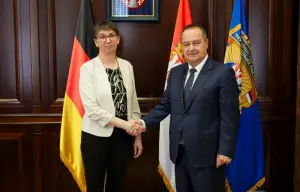
Cooperation in field of interior affairs important segment of relations with Germany
-
 Belgrade, 16 July 2026
Expo 2027 opportunity to further strengthen international partnerships
-
 Belgrade/Bratislava, 16 July 2026
Serbia, Slovakia continue to strengthen political, economic cooperation
-
 Belgrade, 14 July 2026
Serbia bilaterally resolves problems arising from EES implementation
-
 Gradina/Kalotina, 9 July 2026
Improving border cooperation between Serbia, Bulgaria
-
 Belgrade, 7 July 2026
Further strengthening economic cooperation between Serbia, Italy
-
 Belgrade, 6 July 2026
Serbia serious, responsible partner in fight against crime