
Q:
A:
Resolution of problem of negative demographic trends among most important
Belgrade,
2 October 2007
Serbian Deputy Prime Minister Bozidar Djelic said today that due to negative demographic trends Serbia looses between 25,000 and 30,000 people each year and that that problem is one of most important which has to be resolved long-term.
Author:
Tanjug
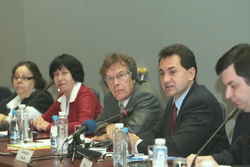
Opening a national debate called "Population, population policy and development" in Sava Centre, Djelic said that Serbia has a "disastrous combination" of low birth rate and brain drain of young population to other countries.
According to him, Serbia is one of the oldest countries in Europe, with average population age of 47.5 years and with the danger that by 2025, most of the citizens be older than 65.
The Serbian government is examining measures for increasing birth rate – paying the sum for a new-born child in its entirety, instead of instalments, payment of maternity leave allowance in the full amount of the salary, introduction of a sweeping state programme of assistance to couples who want, but can't have children, and increase of one-off aid for the second and third child.
The future of Serbia must be young employed married couples and that is why the state has to do everything to help woman be a worker and mother at the same time, the Deputy Prime Minister said.
The debate on population policy was organised by the Deputy Prime Minister's team for implementation of the Strategy for poverty reduction and the Belgrade Fund for Political Excellence.
As part of the debate on experiences of France as European state with most efficient population policy, expert from the National Institute for Demographic Studies in Paris Alan Paran spoke today, as well as many domestic experts.
According to him, Serbia is one of the oldest countries in Europe, with average population age of 47.5 years and with the danger that by 2025, most of the citizens be older than 65.
The Serbian government is examining measures for increasing birth rate – paying the sum for a new-born child in its entirety, instead of instalments, payment of maternity leave allowance in the full amount of the salary, introduction of a sweeping state programme of assistance to couples who want, but can't have children, and increase of one-off aid for the second and third child.
The future of Serbia must be young employed married couples and that is why the state has to do everything to help woman be a worker and mother at the same time, the Deputy Prime Minister said.
The debate on population policy was organised by the Deputy Prime Minister's team for implementation of the Strategy for poverty reduction and the Belgrade Fund for Political Excellence.
As part of the debate on experiences of France as European state with most efficient population policy, expert from the National Institute for Demographic Studies in Paris Alan Paran spoke today, as well as many domestic experts.
-
 Belgrade/Bratislava, 9 June 2026
Agreement signed with Slovakia on joint surveillance of Serbia’s state border
-
 Belgrade, 3 June 2026
Bizerba continues to develop production in Serbia
-
 Belgrade, 2 June 2026
Small entrepreneurs driving force of domestic economy
-
 Belgrade, 1 June 2026
Serbia joins Frontex Partnership Academies Network
-
 Belgrade/Shanghai, 28 May 2026
Commercial contracts signed with leading Chinese companies
-
 Belgrade/Jiaxing, 27 May 2026
Serbia entering new phase of technological, industrial development
-
 Belgrade, 27 May 2026
Dačić extends Kurban Bayram greetings
-
 Belgrade/Jinan, 26 May 2026
Strengthening international standing, economy through cooperation with China
-
 Belgrade/Beijing, 25 May 2026
Opening new opportunities to strengthen economic cooperation with China
-
 Belgrade, 25 May 2026
Serbia committed to developing cooperation with Singapore in field of security