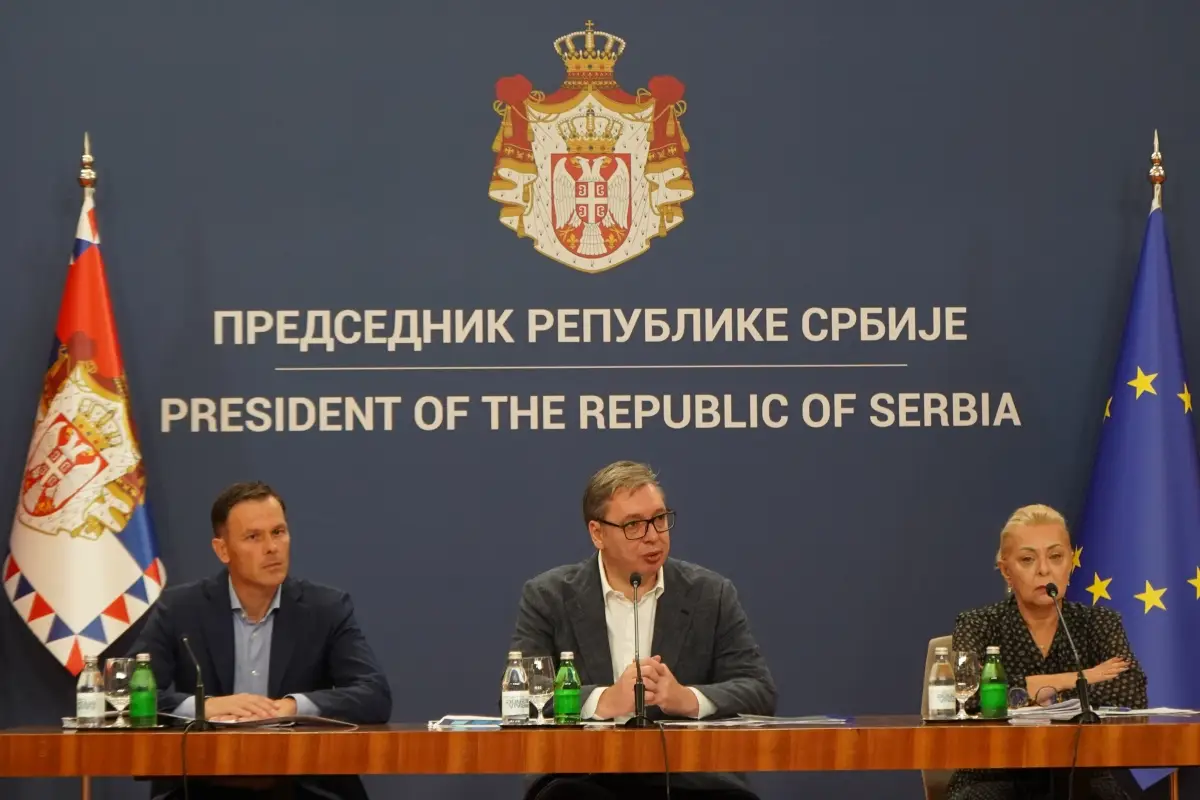
President of the Republic of Serbia Aleksandar Vučić announced today that the state will propose a law on legalisation that will resolve 4.8 million illegal properties by the end of the year without a complicated procedure, and for about 70% of the properties the price will be €100 in total.

Q:
A:
Solution for legalisation of 4.8 million properties by year’s end
Belgrade,
21 September 2025
Presenting new state measures for the benefit of Serbian citizens, in the presence of First Deputy Prime Minister and Minister of Finance Siniša Mali and Minister of Construction, Transport and Infrastructure Aleksandra Sofronijević, Vučić emphasised that the idea is for the state to record all properties and decide on ownership through a simple application in digital form.
He explained that citizens will submit an electronic application and will have a legalised property within 60 days, noting that this law will regulate the real estate market, with citizens to gain the right to have their property at their disposal.
Vučić also noted that loans will be more favourable given that a registered property can be mortgaged, with flats to become more affordable since real estate that is currently illegal will enter the regulated market.
Speaking about cities, the President pointed out that the most expensive will be Belgrade, namely Terazije and Knez Mihailova Street, where legalisation will cost €1,000.
According to him, in cities with a registered population of more than 100,000, legalisation will cost from €100 to €500 in the downtown area, while in villages it will reach a maximum of €100.
Vučić added that in cities with 50,000 to 100,000 inhabitants, the maximum price in the city centre will be up to €300, and from €100 to €150 in villages and suburban settlements.
According to him, these legalisation prices will not apply to buildings used for commercial purposes.
He particularly emphasised that the new law will also put an end to illegal construction in Serbia and that in the future illegal buildings will become property of the state.
He said that there are only two cases where the facilitated legalisation of buildings will not apply, and these are buildings built on someone else's land, as well as buildings built in a protected area.
In addition, Vučić announced that as of 1 October, the salaries of employees in healthcare and education will be increased by 5%, while an increase in pensions is planned as of 1 December, in the amount of 12.2%.
He also added that an extraordinary increase in the minimum wage of 10.1% is planned as of 1 January 2026, which will bring the cumulative increase in the minimum wage to over 30%.
-
 Author: Tanjug
-
 Šabac, 29 August 2026
Opening of humanoid robot factory in Šabac marks Serbia’s leap into future
-
 Belgrade, 14 August 2026
Intensified work on gas-fired power plant project near Niš
-
 Belgrade, 11 August 2026
Programme to be prepared for development of domestic gas infrastructure
-
 Belgrade, 8 August 2026
Serbia, Ukraine sign MoU on cooperation in field of animal health, food safety
-
 Belgrade, 5 August 2026
NIS doing everything to ensure stable fuel supply in August
-
 Belgrade/Bucharest, 16 July 2026
Deepening partnership between Serbia, Romania in field of energy
-
 Belgrade, 13 July 2026
Strengthening Serbia’s institutional capacities for nuclear programme development
-
 Belgrade, 3 July 2026
Cooperation with Germany on projects in field of energy transition
-
 Belgrade, 29 June 2026
Package of measures to improve living standards worth more than €600 million
-
 Belgrade, 16 June 2026
Shareholders’ Agreement signed with MOL Group for future governance of NIS