
Q:
A:
Serbia completes two thirds of journey towards European Union
Nis,
27 March 2006
Serbian Deputy Prime Minister and Head of the Serbian team for negotiating with the EU Miroljub Labus said today in Nis that Serbia has completed two thirds of the journey towards the European Union, but the harder part of the work is still ahead. This entails fulfilling all economic and political conditions necessary for full membership.
Author:
Fonet
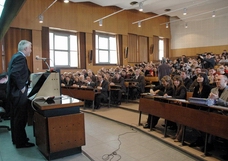
Talking with students of the Faculty of Economics in Nis, Labus explained that the essence of the Stabilisation and Association Agreement (SAA) is establishing free trade between the EU and signatory countries, after the specified transition period.
He said that Serbia will gradually have to decrease customs tariffs, an issue which was discussed also in the last round of negotiations with the EU held in February. He explained that once the transition period expires, trade in industrial goods should be completely free of customs and quantitative restrictions. In agriculture it will be possible to retain certain customs protection even after the transition period ends.
Labus said that signing the SAA is extremely important for Serbia, considering that the EU is Serbia’s most important trade partner, with whom more than 50% of Serbia’s total international trade is conducted.
Speaking on political conditions regarding EU membership such as a stable democracy and the rule of law, Labus said that becoming a member of the EU does not represent an ultimate goal rather a means to an end for Serbia, which will contribute to the acceleration of changes necessary in order to secure improved living standards.
Labus said that full EU membership will be proof of Serbia’s qualities and its capacity to compete with more developed countries.
Labus also visited today the Faculty of Philosophy in Nis, where he inaugurated the amphitheatre.
On the occasion, Labus stressed the importance of investing in education, saying that a country which has capable people will always attract financial capital.
He said that the state must invest more in human capital, and added that because of other more urgent social themes, education was not on the list of priorities until now, but that position is changing now.
Labus stressed that Serbia is not a country rich in resources, but it has human potential and a qualified work force which means the strategy for future development of the country should be based on the knowledge economy.
“As a country we must decide that investment in education, science and research is a national priority. But at the same time, we must increase the effectiveness of education in order to compete with other countries on an equal basis, and students are the best allies of such a strategy,” said Labus.
He explained that the state should secure the framework and offer the necessary conditions, but personal initiative is very important.
“We have to fight for the future of our country ourselves and should not wait for others to do it,” said Labus to the students of Nis.
He said that Serbia will gradually have to decrease customs tariffs, an issue which was discussed also in the last round of negotiations with the EU held in February. He explained that once the transition period expires, trade in industrial goods should be completely free of customs and quantitative restrictions. In agriculture it will be possible to retain certain customs protection even after the transition period ends.
Labus said that signing the SAA is extremely important for Serbia, considering that the EU is Serbia’s most important trade partner, with whom more than 50% of Serbia’s total international trade is conducted.
Speaking on political conditions regarding EU membership such as a stable democracy and the rule of law, Labus said that becoming a member of the EU does not represent an ultimate goal rather a means to an end for Serbia, which will contribute to the acceleration of changes necessary in order to secure improved living standards.
Labus said that full EU membership will be proof of Serbia’s qualities and its capacity to compete with more developed countries.
Labus also visited today the Faculty of Philosophy in Nis, where he inaugurated the amphitheatre.
On the occasion, Labus stressed the importance of investing in education, saying that a country which has capable people will always attract financial capital.
He said that the state must invest more in human capital, and added that because of other more urgent social themes, education was not on the list of priorities until now, but that position is changing now.
Labus stressed that Serbia is not a country rich in resources, but it has human potential and a qualified work force which means the strategy for future development of the country should be based on the knowledge economy.
“As a country we must decide that investment in education, science and research is a national priority. But at the same time, we must increase the effectiveness of education in order to compete with other countries on an equal basis, and students are the best allies of such a strategy,” said Labus.
He explained that the state should secure the framework and offer the necessary conditions, but personal initiative is very important.
“We have to fight for the future of our country ourselves and should not wait for others to do it,” said Labus to the students of Nis.
-
 Gradina/Kalotina, 9 July 2026
Improving border cooperation between Serbia, Bulgaria
-
 Belgrade, 7 July 2026
Further strengthening economic cooperation between Serbia, Italy
-
 Belgrade, 6 July 2026
Serbia serious, responsible partner in fight against crime
-
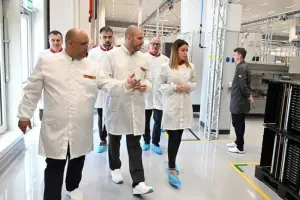 Kać, 3 July 2026
Additional foreign investment confirms confidence in Serbia
-
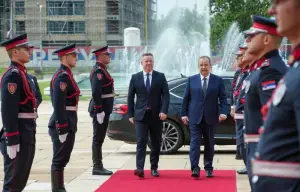 Belgrade, 3 July 2026
Serbia, Hungary reliable partners in maintaining security
-
 Belgrade/Brussels, 3 July 2026
Serbia committed to further developing partnership relations with EU
-
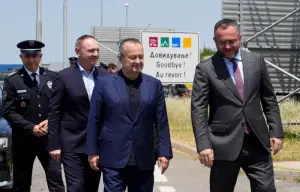 Preševo, 1 July 2026
Joint campaign by Serbia, North Macedonia for safer travel
-
 Belgrade, 30 June 2026
Serbia stable, reliable investment destination
-
 Belgrade, 25 June 2026
Dačić extends condolences to leadership, people of Venezuela
-
 Belgrade, 24 June 2026
Fiscal responsibility foundation of economic security