
Q:
A:
Continuation of talks with EU requires technical and political conditions
Belgrade,
6 February 2006
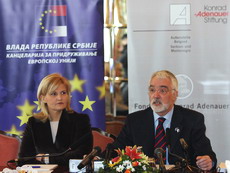
Serbian Deputy Prime Minister and head of the Serbian team for negotiations with the EU Miroljub Labus said today that the continuation of talks with the EU on the Stabilisation and Association Agreement (SAA) depends on whether Serbia-Montenegro will fulfill technical and political conditions.
Author:
FoNet
Speaking at a press conference about his visit to Brussels last week, Labus said that political conditions concern the realisation of full cooperation with the Hague tribunal. He added that it has been estimated by the EU that the technical part of the work has been excellently done, but progress has to be made in cooperation with the Hague.
Labus recalled that on February 16, European Commission President Jose Manuel Barroso will visit Belgrade, who will later submit a report to the EU Council of Ministers that will bring a decision regarding the continuation of talks in February.
According to Labus, since the arrest of Croatian General Ante Gotovina, anything less than an arrest will be considered insufficient cooperation, which has made the situation difficult for Serbia-Montenegro.
On the realisation of complete cooperation the institutions of the Serbian government and the state union of Serbia-Montenegro should work together, said Labus, and added that there is renewed political determination in the European Commission to implement the conclusions of the Thessalonica Summit which were that the future of the West Balkans lies in the EU, and it is a question of time and political measures when this will be realised.
Labus said that in Brussels he talked with EU officials on measures that Serbia-Montenegro should implement on the path towards Europe in the areas of economy, education, visas, regional cooperation and the use of funds available prior to accession.
Labus said that Serbia-Montenegro is ready to enter the free trade zone, but prior to that it is necessary to efficiently implement bilateral agreements in the region, and for improving trade practical measures of the European Commission are needed.
According to Labus, for full effects of free trade it is essential to remove obstacles in the free movement of people, and one of the problems concerning a more favourable visa regime is that the agreement on readmission with all the EU countries does not exist.
Labus said that nine agreements are waiting to be signed with the EU countries, and added that a joint agreement is also being prepared which the EU will sign with Serbia-Montenegro.
Labus said that in June a definite decision should be brought on concluding the new arrangement with the International Monetary Fund (IMF) and pointed out that after the referendum in Montenegro it will be decided if a type of “stand by” arrangement with the IMF, with withdrawal or without it, will be concluded, or whether there will be a certain type of “monitoring” by the IMF.
Labus said that minimally there should be some kind of “monitoring” by the IMF because Serbia-Montenegro’s debt is now one and a half of the quota, implying that the debt is more than half of Serbia-Montenegro’s capital in the IMF, and according to the rules of IMF, a country in that situation should have heightened “monitoring”.
Labus explained that “monitoring” would mean that every three or six months a group of IMF experts visits the country, with whom talks would be held on implementation of economic policy, without setting of conditions or withdrawal of funds.
According to him, the tighter form of cooperation is a stand-by arrangement without the withdrawal of foreign currency funds, since Serbia currently does not need new funds because it has more than $6 billion in foreign currency reserves.
As far as the reduced gas delivery is concerned, Labus said that he does not know why Serbia still receives 8.6 million of cubic metres per day instead of the agreed 10 million.
The Serbian government obtained both oral and written assurances from Gazprom that they had increased gas delivery to 10 million cubic metres, Labus said.
The Deputy Prime Minister said that as early as Saturday measures were taken to reduce gas consumption of heating plants in New Belgrade, Nis and Novi Sad by changing over to heavy fuel oil, thus saving 1 million of cubic metres of gas per day. However, some heating plants had not reacted until this morning and because of that, pressure in the gas pipeline has not increased much.
He said that the current situation with gas will speed up preparations for the construction of the underground storage facility in Banatski Dvor and a gas pipeline from Romania to Bulgaria. Labus added that during the meetings with EU officials, he touched on this issue as well.
Labus recalled that on February 16, European Commission President Jose Manuel Barroso will visit Belgrade, who will later submit a report to the EU Council of Ministers that will bring a decision regarding the continuation of talks in February.
According to Labus, since the arrest of Croatian General Ante Gotovina, anything less than an arrest will be considered insufficient cooperation, which has made the situation difficult for Serbia-Montenegro.
On the realisation of complete cooperation the institutions of the Serbian government and the state union of Serbia-Montenegro should work together, said Labus, and added that there is renewed political determination in the European Commission to implement the conclusions of the Thessalonica Summit which were that the future of the West Balkans lies in the EU, and it is a question of time and political measures when this will be realised.
Labus said that in Brussels he talked with EU officials on measures that Serbia-Montenegro should implement on the path towards Europe in the areas of economy, education, visas, regional cooperation and the use of funds available prior to accession.
Labus said that Serbia-Montenegro is ready to enter the free trade zone, but prior to that it is necessary to efficiently implement bilateral agreements in the region, and for improving trade practical measures of the European Commission are needed.
According to Labus, for full effects of free trade it is essential to remove obstacles in the free movement of people, and one of the problems concerning a more favourable visa regime is that the agreement on readmission with all the EU countries does not exist.
Labus said that nine agreements are waiting to be signed with the EU countries, and added that a joint agreement is also being prepared which the EU will sign with Serbia-Montenegro.
Labus said that in June a definite decision should be brought on concluding the new arrangement with the International Monetary Fund (IMF) and pointed out that after the referendum in Montenegro it will be decided if a type of “stand by” arrangement with the IMF, with withdrawal or without it, will be concluded, or whether there will be a certain type of “monitoring” by the IMF.
Labus said that minimally there should be some kind of “monitoring” by the IMF because Serbia-Montenegro’s debt is now one and a half of the quota, implying that the debt is more than half of Serbia-Montenegro’s capital in the IMF, and according to the rules of IMF, a country in that situation should have heightened “monitoring”.
Labus explained that “monitoring” would mean that every three or six months a group of IMF experts visits the country, with whom talks would be held on implementation of economic policy, without setting of conditions or withdrawal of funds.
According to him, the tighter form of cooperation is a stand-by arrangement without the withdrawal of foreign currency funds, since Serbia currently does not need new funds because it has more than $6 billion in foreign currency reserves.
As far as the reduced gas delivery is concerned, Labus said that he does not know why Serbia still receives 8.6 million of cubic metres per day instead of the agreed 10 million.
The Serbian government obtained both oral and written assurances from Gazprom that they had increased gas delivery to 10 million cubic metres, Labus said.
The Deputy Prime Minister said that as early as Saturday measures were taken to reduce gas consumption of heating plants in New Belgrade, Nis and Novi Sad by changing over to heavy fuel oil, thus saving 1 million of cubic metres of gas per day. However, some heating plants had not reacted until this morning and because of that, pressure in the gas pipeline has not increased much.
He said that the current situation with gas will speed up preparations for the construction of the underground storage facility in Banatski Dvor and a gas pipeline from Romania to Bulgaria. Labus added that during the meetings with EU officials, he touched on this issue as well.
-
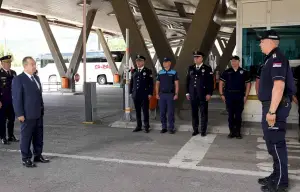 Gradina/Kalotina, 9 July 2026
Improving border cooperation between Serbia, Bulgaria
-
 Belgrade, 7 July 2026
Further strengthening economic cooperation between Serbia, Italy
-
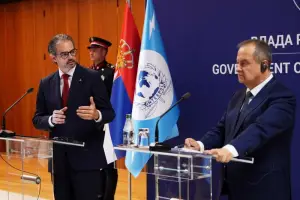 Belgrade, 6 July 2026
Serbia serious, responsible partner in fight against crime
-
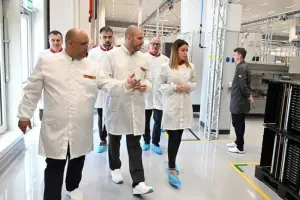 Kać, 3 July 2026
Additional foreign investment confirms confidence in Serbia
-
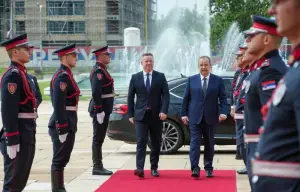 Belgrade, 3 July 2026
Serbia, Hungary reliable partners in maintaining security
-
 Belgrade/Brussels, 3 July 2026
Serbia committed to further developing partnership relations with EU
-
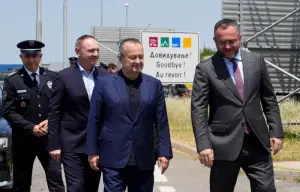 Preševo, 1 July 2026
Joint campaign by Serbia, North Macedonia for safer travel
-
 Belgrade, 30 June 2026
Serbia stable, reliable investment destination
-
 Belgrade, 25 June 2026
Dačić extends condolences to leadership, people of Venezuela
-
 Belgrade, 24 June 2026
Fiscal responsibility foundation of economic security