
Q:
A:
Serbia leads predictable, responsible foreign policy
Belgrade,
29 May 2016
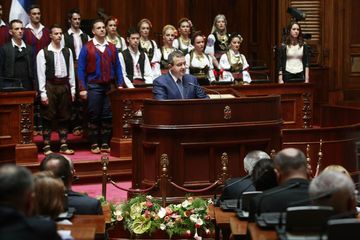
First Deputy Prime Minister and Minister of Foreign Affairs Ivica Dacic said today that the foreign policy of Serbia is highly appreciated today, perhaps the most since the outbreak of the Yugoslav crisis.
Author:
Fonet
Speaking at the ceremony marking the Serbian Diplomacy Day, he stated that the challenges and issues that Serbia is facing today are very similar to those faced by his predecessors.
That is why today, when again faced with almost the same issues and challenges as well as centuries ago, Serbia's foreign policy priorities are well known and will not be changed, said the First Deputy Prime Minister at the National Assembly.
According to Dacic, Serbia's foreign policy priorities are long-term, with the foreign policy that is responsible and predictable, based on its own national and state interests.
This means setting as a strategic objective the negotiations on Serbia's membership in the EU and accession to the EU, at the same time developing the best possible relations with our traditional partners and friends such as Russia, China, India, the countries of Latin America, Africa and of course the European countries with which we have very close ties, said Dacic.
He stressed that Serbia's foreign policy priorities include finding common interests with the great powers, as well as regional stability and peace.
Today, on behalf of the government of Serbia and its leader Aleksandar Vucic, I want to send a message to all diplomatic missions in our country that Serbia is fully committed to development, seeking the best possible options in the future, and a common interest with the international community, said Dacic.
He stressed that Serbia will therefore in the future continue to lead the predictable, responsible policy, which means never again thinking about weapons, but having friends in the world.
That is why today, when again faced with almost the same issues and challenges as well as centuries ago, Serbia's foreign policy priorities are well known and will not be changed, said the First Deputy Prime Minister at the National Assembly.
According to Dacic, Serbia's foreign policy priorities are long-term, with the foreign policy that is responsible and predictable, based on its own national and state interests.
This means setting as a strategic objective the negotiations on Serbia's membership in the EU and accession to the EU, at the same time developing the best possible relations with our traditional partners and friends such as Russia, China, India, the countries of Latin America, Africa and of course the European countries with which we have very close ties, said Dacic.
He stressed that Serbia's foreign policy priorities include finding common interests with the great powers, as well as regional stability and peace.
Today, on behalf of the government of Serbia and its leader Aleksandar Vucic, I want to send a message to all diplomatic missions in our country that Serbia is fully committed to development, seeking the best possible options in the future, and a common interest with the international community, said Dacic.
He stressed that Serbia will therefore in the future continue to lead the predictable, responsible policy, which means never again thinking about weapons, but having friends in the world.

Author:
Fonet
In the past year Serbia received from all sides and from all the relevant factors in the world the highest marks for overall economic and social reforms implemented and for an extremely constructive behaviour during the refugee crisis, as well as for the role of the factor of stability in Southeast Europe.
He listed a number of foreign policy successes that Serbia recorded in the last 12 months in extremely complex circumstances, in which a small but proud country such as Serbia managed to coordinate efforts of all stakeholders and implement foreign policy objectives defined by the government of Serbia.
Dacic singled out the presidency of the OSCE, which, as he said, was unanimously praised, crowned by a successful final meeting in Belgrade last December.
According to Dacic, no less important were the efforts to defend the principles and rules of international law, including litigation before the UN Security Council on the issue of certain resolutions, as well as from UNESCO, on the issue of membership of the so-called Republic of Kosovo.
Dacic welcomed in particular the families of the tragic victims of diplomats in Libya Sladjana Stankovic and Jovica Stepic, who were present at the National Assembly, and stressed that Serbia will do everything to help them.
The ceremony on the occasion of Serbian Diplomacy Day was attended by representatives of the government of Serbia, the Serbian National Assembly, government authorities, religious communities, Russian Ambassador Alexander Chepurin, Chinese Ambassador Li Mancang, British Ambassador Denis Keefe, and a large number of diplomats and public figures.
The ceremony started with a minute of silence as a sign of commemoration of tragically killed Serbian diplomats in Libya, after which Ensemble "Kolo" performed the national anthem and the actor Branislav Tomasevic gave a short recital of the history of Serbian diplomacy.
The government of the Republic of Serbia established the Serbian Diplomacy Day, which is celebrated to commemorate the establishment of the princely office of foreign affairs of the Principality of Serbia on 29 May 1839.
He listed a number of foreign policy successes that Serbia recorded in the last 12 months in extremely complex circumstances, in which a small but proud country such as Serbia managed to coordinate efforts of all stakeholders and implement foreign policy objectives defined by the government of Serbia.
Dacic singled out the presidency of the OSCE, which, as he said, was unanimously praised, crowned by a successful final meeting in Belgrade last December.
According to Dacic, no less important were the efforts to defend the principles and rules of international law, including litigation before the UN Security Council on the issue of certain resolutions, as well as from UNESCO, on the issue of membership of the so-called Republic of Kosovo.
Dacic welcomed in particular the families of the tragic victims of diplomats in Libya Sladjana Stankovic and Jovica Stepic, who were present at the National Assembly, and stressed that Serbia will do everything to help them.
The ceremony on the occasion of Serbian Diplomacy Day was attended by representatives of the government of Serbia, the Serbian National Assembly, government authorities, religious communities, Russian Ambassador Alexander Chepurin, Chinese Ambassador Li Mancang, British Ambassador Denis Keefe, and a large number of diplomats and public figures.
The ceremony started with a minute of silence as a sign of commemoration of tragically killed Serbian diplomats in Libya, after which Ensemble "Kolo" performed the national anthem and the actor Branislav Tomasevic gave a short recital of the history of Serbian diplomacy.
The government of the Republic of Serbia established the Serbian Diplomacy Day, which is celebrated to commemorate the establishment of the princely office of foreign affairs of the Principality of Serbia on 29 May 1839.
-
 Belgrade/Shijiazhuang, 28 April 2026
Support for increased sales of Serbian products on Chinese market
-
 Belgrade/Shijiazhuang, 27 April 2026
New opportunities for Serbian products on Chinese market
-
 Belgrade/Shijiazhuang, 26 April 2026
Importance of strategic partnership with HBIS company confirmed
-
 Belgrade/Jinan, 26 April 2026
Serbia builds partnerships with leading Chinese companies
-
 Belgrade/Jinan, 25 April 2026
Chinese companies plan new investments in Serbia
-
 Belgrade/Jinan, 25 April 2026
Jinan Economic Forum confirms companies' interest in investing in Serbia
-
 Belgrade/Jinan, 25 April 2026
Support for sale of Serbian wines, other products on Chinese market agreed
-
 Belgrade/Athens, 24 April 2026
Serbia cooperative partner in fight against organised crime
-
 Belgrade/Athens, 24 April 2026
Joint action of Serbia, Greece in fight against irregular migration
-
 Belgrade/Athens, 24 April 2026
Potential for improving cooperation with Greece in field of security