
Q:
A:
Serbia leader in implementation of reforms in region
Belgrade,
31 March 2016
Deputy Prime Minister and Minister of Construction, Transport and Infrastructure Zorana Mihajlovic talked today with World Bank Country Director Ellen Goldstein on regional integration, removal of tariff and non-tariff barriers and improving Serbia's rating to Doing Business List.
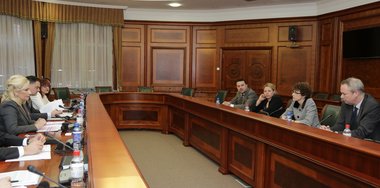
Mihajlovic said that Serbia has already implemented key reforms demanded by the European Commission, concerning the reorganisation of public enterprises in the transport sector, the establishment of full competition in the railway sector and the improvement of cross-border trade.
She stressed that the priority is to remove all barriers that restrict regional cooperation, movement of people, goods and services and trade exchanges, not only through accelerated construction of infrastructure, but also through a reform that the working group is working on to improve the rating of Serbia to the aforementioned list of the World Bank.
According to Mihajlovic, cross-border trade is one of the key areas this year to improve our position in the Doing Business List, where the goal is that Serbia joins the top 30 countries by business conditions.
Mihajlovic announced that in the coming period the Ministry of Trade, Tourism and Telecommunications, the Ministry of Finance, the Customs Administration and other state authorities will work together to improve cross-border trade, in cooperation with the World Bank.
Goldstein said that by launching the Berlin process, the European Commission has set up regional networking projects in the transport sector as one of the key issues in the process of European integration.
The World Bank is keen to be involved in this process, not only in terms of support to specific infrastructure projects, but also through monitoring the reforms implemented by the Western Balkan countries to facilitate the exchange of goods and services within the region and between the region and the EU, she said.
According to Goldstein, Serbia has imposed itself as a leader in the implementation of reforms in the region in many areas and plays an important role in this process.
She stressed that the priority is to remove all barriers that restrict regional cooperation, movement of people, goods and services and trade exchanges, not only through accelerated construction of infrastructure, but also through a reform that the working group is working on to improve the rating of Serbia to the aforementioned list of the World Bank.
According to Mihajlovic, cross-border trade is one of the key areas this year to improve our position in the Doing Business List, where the goal is that Serbia joins the top 30 countries by business conditions.
Mihajlovic announced that in the coming period the Ministry of Trade, Tourism and Telecommunications, the Ministry of Finance, the Customs Administration and other state authorities will work together to improve cross-border trade, in cooperation with the World Bank.
Goldstein said that by launching the Berlin process, the European Commission has set up regional networking projects in the transport sector as one of the key issues in the process of European integration.
The World Bank is keen to be involved in this process, not only in terms of support to specific infrastructure projects, but also through monitoring the reforms implemented by the Western Balkan countries to facilitate the exchange of goods and services within the region and between the region and the EU, she said.
According to Goldstein, Serbia has imposed itself as a leader in the implementation of reforms in the region in many areas and plays an important role in this process.
-
 Belgrade/Shijiazhuang, 28 April 2026
Support for increased sales of Serbian products on Chinese market
-
 Belgrade/Shijiazhuang, 27 April 2026
New opportunities for Serbian products on Chinese market
-
 Belgrade/Shijiazhuang, 26 April 2026
Importance of strategic partnership with HBIS company confirmed
-
 Belgrade/Jinan, 26 April 2026
Serbia builds partnerships with leading Chinese companies
-
 Belgrade/Jinan, 25 April 2026
Chinese companies plan new investments in Serbia
-
 Belgrade/Jinan, 25 April 2026
Jinan Economic Forum confirms companies' interest in investing in Serbia
-
 Belgrade/Jinan, 25 April 2026
Support for sale of Serbian wines, other products on Chinese market agreed
-
 Belgrade/Athens, 24 April 2026
Serbia cooperative partner in fight against organised crime
-
 Belgrade/Athens, 24 April 2026
Joint action of Serbia, Greece in fight against irregular migration
-
 Belgrade/Athens, 24 April 2026
Potential for improving cooperation with Greece in field of security