
Q:
A:
Fight against crime joint interest of countries in region
Belgrade,
21 December 2010
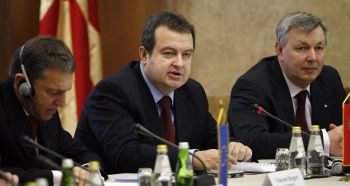
First Deputy Prime Minister and Minister of the Interior Ivica Dacic said today that the borders of Balkan countries must be easy to pass for people, goods and capital, but impassable for criminal groups and crime.
Author:
Fonet
Dacic told a news conference at the Palace of Serbia held for the occasion of completion of the project of establishing a network of border police units between airports of the capitals of member states of the Migration, Asylum, Refugees Regional Initiative (MARRI) that the Balkans should be a space in which people will travel without visas and in the future without passports.
The obligation of the border police units is to prevent criminal groups from crossing the border, Dacic explained and underlined that the fight against crime, terrorism and illegal migration are a common interest of the countries of the region, but also of Europe and the international community.
He said that this regional initiative contributes to harmonisation of cooperation in the fight against illegal migration with the EU and improvement of border security and prevention of organised crime.
Dacic announced that in April 2011 Serbia will take over the one-year presidency of MARRI and expressed Serbia’s readiness to continue participating in all joint projects that promote regional security.
Heads of border police units of the countries of the region signed today at the Palace of Serbia the Memorandum on cooperation of border police units at airports of MARRI member states.
The project of establishing a network of border police units between airports of the capitals of MARRI member states has been realised in cooperation with the Swiss Federal Office for Migration and the Frontex agency.
In this way, border police units at six international airports will establish a network of communication that will enable exchange of data on illegal migration with countries of Europe, the abuse of travel documents and faster repatriation of illegal migrants to countries of origin.
Head of the EU Delegation to Serbia Vincent Degert said that the objective of MARRI is to train the police to deal with important issues such as border control, fight against organised crime and illegal migration.
He underlined that the EU welcomes the signing of the memorandum, which is useful to both the Balkan countries and the EU. He added that the liberalisation of visa regime for Serbia, Macedonia, Montenegro, Bosnia-Herzegovina and Albania is an incentive for further progress in the relations between the EU and the region.
The obligation of the border police units is to prevent criminal groups from crossing the border, Dacic explained and underlined that the fight against crime, terrorism and illegal migration are a common interest of the countries of the region, but also of Europe and the international community.
He said that this regional initiative contributes to harmonisation of cooperation in the fight against illegal migration with the EU and improvement of border security and prevention of organised crime.
Dacic announced that in April 2011 Serbia will take over the one-year presidency of MARRI and expressed Serbia’s readiness to continue participating in all joint projects that promote regional security.
Heads of border police units of the countries of the region signed today at the Palace of Serbia the Memorandum on cooperation of border police units at airports of MARRI member states.
The project of establishing a network of border police units between airports of the capitals of MARRI member states has been realised in cooperation with the Swiss Federal Office for Migration and the Frontex agency.
In this way, border police units at six international airports will establish a network of communication that will enable exchange of data on illegal migration with countries of Europe, the abuse of travel documents and faster repatriation of illegal migrants to countries of origin.
Head of the EU Delegation to Serbia Vincent Degert said that the objective of MARRI is to train the police to deal with important issues such as border control, fight against organised crime and illegal migration.
He underlined that the EU welcomes the signing of the memorandum, which is useful to both the Balkan countries and the EU. He added that the liberalisation of visa regime for Serbia, Macedonia, Montenegro, Bosnia-Herzegovina and Albania is an incentive for further progress in the relations between the EU and the region.
-
 Belgrade, 24 July 2026
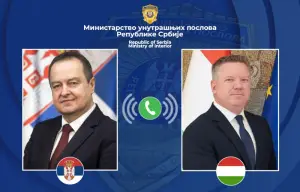
Serbia, Hungary partners in addressing regional security challenges
-
 Belgrade, 24 July 2026
Dačić congratulates UK Home Secretary on reappointment
-
 Belgrade, 22 July 2026
Serbia follows modern technological achievements, attracts investments
-
 Belgrade, 22 July 2026
Continued cooperation with Russia in field of security, emergency situations
-
 Belgrade, 22 July 2026
New opportunities for expanding economic cooperation between Serbia, China
-
 Belgrade, 20 July 2026
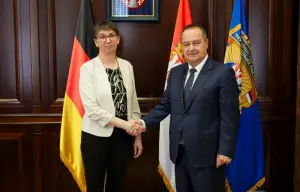
Cooperation in field of interior affairs important segment of relations with Germany
-
 Belgrade, 16 July 2026
Expo 2027 opportunity to further strengthen international partnerships
-
 Belgrade/Bratislava, 16 July 2026
Serbia, Slovakia continue to strengthen political, economic cooperation
-
 Belgrade, 14 July 2026
Serbia bilaterally resolves problems arising from EES implementation
-
 Gradina/Kalotina, 9 July 2026
Improving border cooperation between Serbia, Bulgaria