
Q:
A:
Serbia starts negotiations on CERN membership
Belgrade,
21 December 2010
Deputy Prime Minister for European Integration and Minister of Science and Technological Development Bozidar Djelic said today that Serbia is starting negotiations on membership in the European Organisation for Nuclear Research (CERN) and pointed out that membership in this organisation will be of great importance for development of science in Serbia.
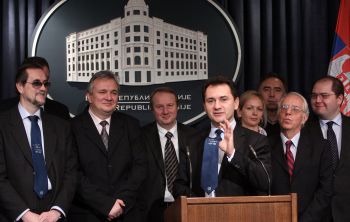
Djelic told at a news conference at the Serbian government that the membership negotiations will last one year, after which Serbia will get the status of associate member, and it will become a full member of CERN within two to five years.
He said that the beginning of membership talks is a great day for Serbia, adding that accession to CERN is very important because this organisation is conducting the greatest scientific experiment in human history - construction of Large Hadron Collider accelerator, in which 40 Serbian scientists are participating.
Djelic noted that in addition to Serbia, the countries that will also start membership talks are Slovenia, Cyprus, Israel and Turkey.
President of the Commission for Cooperation with CERN Petar Adzic thanked the Serbian government for the support it has given to scientists, adding that membership in CERN is not only an opportunity for physicists, but for all other scientists dealing with biomedicine, engineering and IT.
Representative of the Institute for Physics Marija Milosavljevic-Vranjes underlined that CERN membership will give an opportunity to young scientists from Serbia to take part in major international research projects.
The Socialist Federal Republic of Yugoslavia was one of the 12 founders of CERN in 1954, but it left the organisation in 1961.
CERN has 20 members and around 30 countries cooperate with this centre in Geneva.
He said that the beginning of membership talks is a great day for Serbia, adding that accession to CERN is very important because this organisation is conducting the greatest scientific experiment in human history - construction of Large Hadron Collider accelerator, in which 40 Serbian scientists are participating.
Djelic noted that in addition to Serbia, the countries that will also start membership talks are Slovenia, Cyprus, Israel and Turkey.
President of the Commission for Cooperation with CERN Petar Adzic thanked the Serbian government for the support it has given to scientists, adding that membership in CERN is not only an opportunity for physicists, but for all other scientists dealing with biomedicine, engineering and IT.
Representative of the Institute for Physics Marija Milosavljevic-Vranjes underlined that CERN membership will give an opportunity to young scientists from Serbia to take part in major international research projects.
The Socialist Federal Republic of Yugoslavia was one of the 12 founders of CERN in 1954, but it left the organisation in 1961.
CERN has 20 members and around 30 countries cooperate with this centre in Geneva.
-
 Belgrade, 24 July 2026
Serbia, Hungary partners in addressing regional security challenges
-
 Belgrade, 24 July 2026
Dačić congratulates UK Home Secretary on reappointment
-
 Belgrade, 22 July 2026
Serbia follows modern technological achievements, attracts investments
-
 Belgrade, 22 July 2026
Continued cooperation with Russia in field of security, emergency situations
-
 Belgrade, 22 July 2026
New opportunities for expanding economic cooperation between Serbia, China
-
 Belgrade, 20 July 2026
Cooperation in field of interior affairs important segment of relations with Germany
-
 Belgrade, 16 July 2026
Expo 2027 opportunity to further strengthen international partnerships
-
 Belgrade/Bratislava, 16 July 2026
Serbia, Slovakia continue to strengthen political, economic cooperation
-
 Belgrade, 14 July 2026
Serbia bilaterally resolves problems arising from EES implementation
-
 Gradina/Kalotina, 9 July 2026
Improving border cooperation between Serbia, Bulgaria