
Q:
A:
Danube Strategy great chance for Serbia
Golubac,
13 December 2010
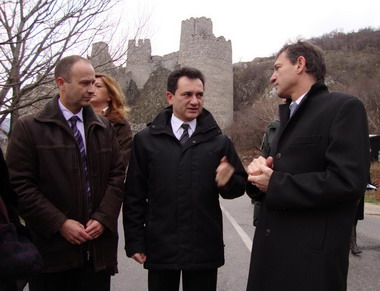
Serbian Deputy Prime Minister for European Integration and Minister of Science and Technological Development Bozidar Djelic said today in Golubac that Serbia together with the EU will set aside €18.5 million next year for Danube region projects.
Author:
Fonet
Djelic said at the gathering held for the occasion of adoption of the Danube Strategy that this strategy is a great opportunity for Serbia and will enable considerable funds to be invested in many parts of Serbia.
He recalled that the European Commission adopted the strategy on 9 December and forwarded it to the EU Council and the European Parliament for adoption, which is expected to take place in the first half of next year, during the Hungarian presidency of the EU.
The Danube Strategy will be implemented over the next two decades, Djelic said and added that out of €18.5 million, €6.5 million will be invested in the revitalisation of the Golubac Fortress and entire Golubac.
The Deputy Prime Minister said that €4.6 million will be invested in local infrastructure in Veliko Gradiste and explained that the Danube Strategy does not apply only to coastal municipalities, but to all 80 municipalities in the Danube basin.
He called on leaders of these municipalities and citizens to prepare suitable projects which should be implemented as part of the strategy.
Serbia, as a non-EU country, which has actively participated in the development of the strategy has an obligation to implement projects that are part of the strategy with money from EU pre-accession funds, Djelic explained.
The EU has sufficient funds to finance these projects, and Serbia applied to coordinate projects in the field of security, infrastructure, economy, knowledge, tourism and media.
The Deputy Prime Minister said that the Danube flows through Serbia in the length of 588 kilometres, which is a quarter of the river’s total navigable stream and added that Serbia must use the chance it is given to her through implementation of the Danube macro regional strategy. Now it is important to call a tender for the construction of the railway corridor on the Danube – for Zezelj bridge, Djelic stated and pointed out that in 2012 significant funds will be set aside for Danube Strategy projects in Belgrade. He recalled that the Danube strategy encompasses countries of the Danube basin and their immediate neighbours – Germany, Austria, Slovakia, Czech Republic, Hungary, Slovenia, Romania and Bulgaria, as EU member states, and non-EU member states Croatia, Serbia, Bosnia-Herzegovina, Montenegro, Moldova and Ukraine. Head of the EU Delegation in Serbia Vincent Degert pointed out that the Danube Strategy is important for Serbia, primarily due to the fact that, although not yet an EU member, it has participated in its preparation from the very beginning, on equal footing as the member states.
We will finance several projects, most notably the system for river navigation, a bridge in Novi Sad and the destruction of unexploded ordnance located in the Danube River so that river traffic could proceed without obstructions, Degert specified.
The implementation of these projects will enhance the connection and strengthening of the Danube region and improve the environmental protection.
Degert specified that the strategy will enable greater use of the Danube for the needs of transport, energy and cultural development of all countries it passes through.
Before the presentation of the Danube Strategy, Djelic and Degert visited the Golubac Fortress.
He recalled that the European Commission adopted the strategy on 9 December and forwarded it to the EU Council and the European Parliament for adoption, which is expected to take place in the first half of next year, during the Hungarian presidency of the EU.
The Danube Strategy will be implemented over the next two decades, Djelic said and added that out of €18.5 million, €6.5 million will be invested in the revitalisation of the Golubac Fortress and entire Golubac.
The Deputy Prime Minister said that €4.6 million will be invested in local infrastructure in Veliko Gradiste and explained that the Danube Strategy does not apply only to coastal municipalities, but to all 80 municipalities in the Danube basin.
He called on leaders of these municipalities and citizens to prepare suitable projects which should be implemented as part of the strategy.
Serbia, as a non-EU country, which has actively participated in the development of the strategy has an obligation to implement projects that are part of the strategy with money from EU pre-accession funds, Djelic explained.
The EU has sufficient funds to finance these projects, and Serbia applied to coordinate projects in the field of security, infrastructure, economy, knowledge, tourism and media.
The Deputy Prime Minister said that the Danube flows through Serbia in the length of 588 kilometres, which is a quarter of the river’s total navigable stream and added that Serbia must use the chance it is given to her through implementation of the Danube macro regional strategy. Now it is important to call a tender for the construction of the railway corridor on the Danube – for Zezelj bridge, Djelic stated and pointed out that in 2012 significant funds will be set aside for Danube Strategy projects in Belgrade. He recalled that the Danube strategy encompasses countries of the Danube basin and their immediate neighbours – Germany, Austria, Slovakia, Czech Republic, Hungary, Slovenia, Romania and Bulgaria, as EU member states, and non-EU member states Croatia, Serbia, Bosnia-Herzegovina, Montenegro, Moldova and Ukraine. Head of the EU Delegation in Serbia Vincent Degert pointed out that the Danube Strategy is important for Serbia, primarily due to the fact that, although not yet an EU member, it has participated in its preparation from the very beginning, on equal footing as the member states.
We will finance several projects, most notably the system for river navigation, a bridge in Novi Sad and the destruction of unexploded ordnance located in the Danube River so that river traffic could proceed without obstructions, Degert specified.
The implementation of these projects will enhance the connection and strengthening of the Danube region and improve the environmental protection.
Degert specified that the strategy will enable greater use of the Danube for the needs of transport, energy and cultural development of all countries it passes through.
Before the presentation of the Danube Strategy, Djelic and Degert visited the Golubac Fortress.
-
 Belgrade, 24 July 2026
Serbia, Hungary partners in addressing regional security challenges
-
 Belgrade, 24 July 2026
Dačić congratulates UK Home Secretary on reappointment
-
 Belgrade, 22 July 2026
Serbia follows modern technological achievements, attracts investments
-
 Belgrade, 22 July 2026
Continued cooperation with Russia in field of security, emergency situations
-
 Belgrade, 22 July 2026
New opportunities for expanding economic cooperation between Serbia, China
-
 Belgrade, 20 July 2026
Cooperation in field of interior affairs important segment of relations with Germany
-
 Belgrade, 16 July 2026
Expo 2027 opportunity to further strengthen international partnerships
-
 Belgrade/Bratislava, 16 July 2026
Serbia, Slovakia continue to strengthen political, economic cooperation
-
 Belgrade, 14 July 2026
Serbia bilaterally resolves problems arising from EES implementation
-
 Gradina/Kalotina, 9 July 2026
Improving border cooperation between Serbia, Bulgaria