
Q:
A:
Larger funds for trainees in 2011
Nis,
23 November 2010
Deputy Prime Minister and Minister of Economy and Regional Development Mladjan Dinkic stated today in Nis that through the Ministry’s “First Chance” programme, over 10,000 trainees were employed this year, adding that in 2011 more funds will be secured to hire 20,000 new trainees.
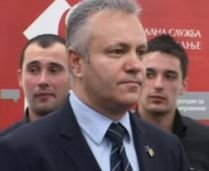
Mladjan Dinkic
Author:
Beta
Presenting employment contracts to 20 out of the total of 200 young persons from Nis, Prokuplje, Leskovac, Krusevac, Vranje and Pirot, Dinkic affirmed that the government of Vojvodina will also secure larger funds for this programme in 2011.
For the first time, municipalities and towns will join the programme and earmark funds in line with their capability, the Minister announced.
He underscored that the goal is to have more funds set aside for those towns and municipalities in which the unemployment level is the highest in order to encourage young people to remain there and not move to larger towns.
The “First Chance” programme implies a three-month probation period and a one-year employment contract. This year RSD 1.8 billion was secured from the budget for this purpose, he recalled.
Dinkic said that eligible trainees are young people with a secondary, post-secondary or university degree, below 30 years of age and without any previous experience in their field of study.
The Deputy Prime Minister also visited meat producer Biftek in Nis, which this year took on 49 unemployed persons.
Dinkic reinforced that Biftek should be an example to other companies in our country, which confirms that a small family business can grow into a company that currently employs 270 workers.
He also delivered a lecture on the government’s economic policy, the macroeconomic situation and causes of the economic crisis in the country and globally at the Faculty of Economics in Nis.
The Deputy Prime Minister confirmed that Serbia this year saw a mild economic recovery from the global economic crisis, which is slightly faster compared to other countries in the region.
Dinkic maintained that by the end of this year GDP is expected to rise by 1.9%, noting that GDP growth is still lower than in 2008, which is unsatisfactory.
Compared to last year, Serbia's industrial production index increased this year by 5% and exports by 21%, outlined the Deputy Prime Minister and emphasised that the value of exports in September were at the same level as in the period before the global economic crisis.
The problem is that Serbia mostly exported agricultural products and intermediate products, and should offer foreign markets a variety of highly processed products.
The Deputy Prime Minister pointed out that therefore the government is working to attract foreign investors, especially from those countries with which Serbia has a trade deficit.
One way to attract foreign investment is the provision of incentives for companies, especially in the electronic and auto industries, as well as in the information technologies sector, explained the Minister, adding that there are efforts to make free industrial zones in Serbia.
A great opportunity for Serbia is the existence of free trade agreements with many countries that have a market with more than a billion people, the Minister stipulated, adding that the biggest obstacles to bringing foreign investors are red tape procedures.
For the first time, municipalities and towns will join the programme and earmark funds in line with their capability, the Minister announced.
He underscored that the goal is to have more funds set aside for those towns and municipalities in which the unemployment level is the highest in order to encourage young people to remain there and not move to larger towns.
The “First Chance” programme implies a three-month probation period and a one-year employment contract. This year RSD 1.8 billion was secured from the budget for this purpose, he recalled.
Dinkic said that eligible trainees are young people with a secondary, post-secondary or university degree, below 30 years of age and without any previous experience in their field of study.
The Deputy Prime Minister also visited meat producer Biftek in Nis, which this year took on 49 unemployed persons.
Dinkic reinforced that Biftek should be an example to other companies in our country, which confirms that a small family business can grow into a company that currently employs 270 workers.
He also delivered a lecture on the government’s economic policy, the macroeconomic situation and causes of the economic crisis in the country and globally at the Faculty of Economics in Nis.
The Deputy Prime Minister confirmed that Serbia this year saw a mild economic recovery from the global economic crisis, which is slightly faster compared to other countries in the region.
Dinkic maintained that by the end of this year GDP is expected to rise by 1.9%, noting that GDP growth is still lower than in 2008, which is unsatisfactory.
Compared to last year, Serbia's industrial production index increased this year by 5% and exports by 21%, outlined the Deputy Prime Minister and emphasised that the value of exports in September were at the same level as in the period before the global economic crisis.
The problem is that Serbia mostly exported agricultural products and intermediate products, and should offer foreign markets a variety of highly processed products.
The Deputy Prime Minister pointed out that therefore the government is working to attract foreign investors, especially from those countries with which Serbia has a trade deficit.
One way to attract foreign investment is the provision of incentives for companies, especially in the electronic and auto industries, as well as in the information technologies sector, explained the Minister, adding that there are efforts to make free industrial zones in Serbia.
A great opportunity for Serbia is the existence of free trade agreements with many countries that have a market with more than a billion people, the Minister stipulated, adding that the biggest obstacles to bringing foreign investors are red tape procedures.
-
 Belgrade, 24 July 2026
Serbia, Hungary partners in addressing regional security challenges
-
 Belgrade, 24 July 2026
Dačić congratulates UK Home Secretary on reappointment
-
 Belgrade, 22 July 2026
Serbia follows modern technological achievements, attracts investments
-
 Belgrade, 22 July 2026
Continued cooperation with Russia in field of security, emergency situations
-
 Belgrade, 22 July 2026
New opportunities for expanding economic cooperation between Serbia, China
-
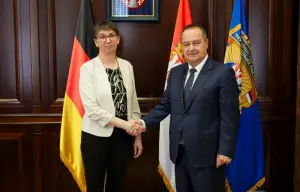 Belgrade, 20 July 2026
Cooperation in field of interior affairs important segment of relations with Germany
-
 Belgrade, 16 July 2026
Expo 2027 opportunity to further strengthen international partnerships
-
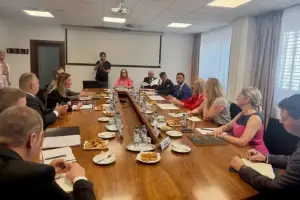 Belgrade/Bratislava, 16 July 2026
Serbia, Slovakia continue to strengthen political, economic cooperation
-
 Belgrade, 14 July 2026
Serbia bilaterally resolves problems arising from EES implementation
-
 Gradina/Kalotina, 9 July 2026
Improving border cooperation between Serbia, Bulgaria