
Q:
A:
Poverty, unemployment reduction priorities for near future
Belgrade,
30 October 2010
Deputy Prime Minister Bozidar Djelic said today that the Serbian government and the National Bank of Serbia (NBS) will work out a model for crediting entrepreneurship of the poorest citizens.
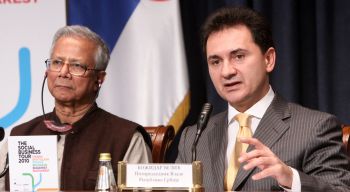
Muhammad Yunus, left, and Bozidar Djelic
Djelic said at a press conference held for the occasion of ”2010 Social entrepreneurship tour” that representatives of the ministries of finance, and economy and regional development and NBS are holding consultation with the founder of Grameen Bank and winner of the Nobel prize for peace in 2006 Professor Muhammad Yunus, who devised the concept of banking for the poor.
He explained that the idea is to give loans worth between €2,000 to €3,000 to the poor, without asking them guarantees for such loans. In this way, those who have the ability to start a business would be credited. The Deputy Prime Minister explained that Serbia’s banking system, although very developed, unfortunately is not conceived to assist entrepreneurship of the poor and that is why the Serbian government’s priority for the next period will be fight against poverty and reduction of unemployment.
In last five years, the number of citizens of Serbia who are below the regional poverty line was reduced from 14% to almost 7%, but during the world economic crisis, the number increased to 8.8%. Also, after the rate of unemployment dropped to 16.4% last year, it increased to 18% this year, which is why the Serbian government will earmark more funds for the poorest in the budget for 2011 so that they could permanently leave this condition, and not use these funds for consumption. Djelic specified that the government will launch initiatives for adoption of the law on microfinancing, creation of financial institutions that will give loans to the poor and the new law on cooperatives which are very important in agriculture and housing construction.
He added that with the new law on social protection RSD 5 billion more will be set aside for the poorest at the annual level. Yunus underlined that the banks were made for the rich, and not for the poor, which is why he came to the idea to establish Grameen bank in Bangladesh which gives loans to the poorest.
He said that his bank gives loans to around 8.3 million people in the world, and the percentage of repayment is almost 98%.
He explained that the idea is to give loans worth between €2,000 to €3,000 to the poor, without asking them guarantees for such loans. In this way, those who have the ability to start a business would be credited. The Deputy Prime Minister explained that Serbia’s banking system, although very developed, unfortunately is not conceived to assist entrepreneurship of the poor and that is why the Serbian government’s priority for the next period will be fight against poverty and reduction of unemployment.
In last five years, the number of citizens of Serbia who are below the regional poverty line was reduced from 14% to almost 7%, but during the world economic crisis, the number increased to 8.8%. Also, after the rate of unemployment dropped to 16.4% last year, it increased to 18% this year, which is why the Serbian government will earmark more funds for the poorest in the budget for 2011 so that they could permanently leave this condition, and not use these funds for consumption. Djelic specified that the government will launch initiatives for adoption of the law on microfinancing, creation of financial institutions that will give loans to the poor and the new law on cooperatives which are very important in agriculture and housing construction.
He added that with the new law on social protection RSD 5 billion more will be set aside for the poorest at the annual level. Yunus underlined that the banks were made for the rich, and not for the poor, which is why he came to the idea to establish Grameen bank in Bangladesh which gives loans to the poorest.
He said that his bank gives loans to around 8.3 million people in the world, and the percentage of repayment is almost 98%.
-
 Belgrade, 24 July 2026
Serbia, Hungary partners in addressing regional security challenges
-
 Belgrade, 24 July 2026
Dačić congratulates UK Home Secretary on reappointment
-
 Belgrade, 22 July 2026
Serbia follows modern technological achievements, attracts investments
-
 Belgrade, 22 July 2026
Continued cooperation with Russia in field of security, emergency situations
-
 Belgrade, 22 July 2026
New opportunities for expanding economic cooperation between Serbia, China
-
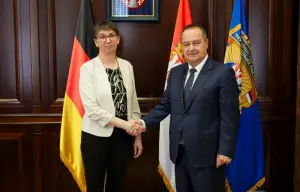 Belgrade, 20 July 2026
Cooperation in field of interior affairs important segment of relations with Germany
-
 Belgrade, 16 July 2026
Expo 2027 opportunity to further strengthen international partnerships
-
 Belgrade/Bratislava, 16 July 2026
Serbia, Slovakia continue to strengthen political, economic cooperation
-
 Belgrade, 14 July 2026
Serbia bilaterally resolves problems arising from EES implementation
-
 Gradina/Kalotina, 9 July 2026
Improving border cooperation between Serbia, Bulgaria