
Q:
A:
Stringent control at Serbian, German borders due to bogus asylum seekers
Belgrade,
21 October 2010
First Deputy Prime Minister and Minister of the Interior Ivica Dacic and Bavarian Minister for Federal and European Affairs Emilia Müller agreed today that any abuse of visa liberalisation must be prevented, announcing stringent control at Serbian and German borders.
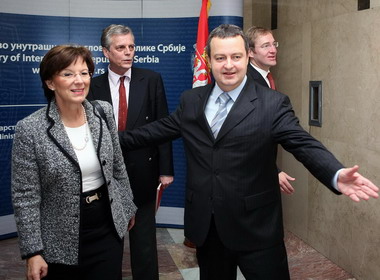
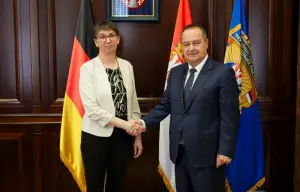
Emilia Müller and Ivica Dacic
Following a meeting with Müller, Dacic underlined that state organs of countries which are the commonest targets of asylum seekers, such as Sweden, Belgium and Germany, must unambiguously state that they will not grant asylum on political grounds and will repatriate all asylum seekers from Serbia.
The Deputy Prime Minister declared that in order to solve this problem, EU countries must cooperate with Serbia and its local authorities in South Serbia and Sandzak, since the majority of those who ask for asylum come from these parts.
It is mostly the Roma and Albanians who seek asylum and residents from the Sandzak region, he noted.
Together with local authorities we will make it clear to all that visa liberalisation does not imply the right to live and work in EU countries, and especially not the right to asylum, Dacic emphasised.
He warned Serbian citizens not to waste their money trying in vain to be granted political asylum in Germany, underscoring that several buses travelling to Germany from Macedonia were returned from the border.
Müller highlighted that Germany grants asylum only to those threatened by political persecution in their homeland, noting that since this is not the case in Serbia, none of the Serbian asylum seekers are entitled to asylum.
She observed that from January to 15 October 2010, Germany received 150 requests for asylum from Serbian nationals and 260 from Macedonian citizens, adding that this is a drastic increase compared to the whole of 2009, when only 50 Serbian residents and one Macedonian citizen requested asylum.
In August 2009 the International Organisation for Migration revoked the €300 start package which it had been paying out to asylum seekers who were to be repatriated, Müller recalled.
Dacic and Müller also announced the instalment of an electronic gate at Nikola Tesla Airport in Belgrade, a donation of Bavaria’s Milbauer Company, which will enable passenger control without the presence of customs officers on the basis of biometric passports and fingerprints.
Dacic and Müller also discussed the fight against organised crime, drugs and corruption, and pointed out the cooperation on projects within the Danube Strategy, which will increase security in the Danube region.
The Deputy Prime Minister declared that in order to solve this problem, EU countries must cooperate with Serbia and its local authorities in South Serbia and Sandzak, since the majority of those who ask for asylum come from these parts.
It is mostly the Roma and Albanians who seek asylum and residents from the Sandzak region, he noted.
Together with local authorities we will make it clear to all that visa liberalisation does not imply the right to live and work in EU countries, and especially not the right to asylum, Dacic emphasised.
He warned Serbian citizens not to waste their money trying in vain to be granted political asylum in Germany, underscoring that several buses travelling to Germany from Macedonia were returned from the border.
Müller highlighted that Germany grants asylum only to those threatened by political persecution in their homeland, noting that since this is not the case in Serbia, none of the Serbian asylum seekers are entitled to asylum.
She observed that from January to 15 October 2010, Germany received 150 requests for asylum from Serbian nationals and 260 from Macedonian citizens, adding that this is a drastic increase compared to the whole of 2009, when only 50 Serbian residents and one Macedonian citizen requested asylum.
In August 2009 the International Organisation for Migration revoked the €300 start package which it had been paying out to asylum seekers who were to be repatriated, Müller recalled.
Dacic and Müller also announced the instalment of an electronic gate at Nikola Tesla Airport in Belgrade, a donation of Bavaria’s Milbauer Company, which will enable passenger control without the presence of customs officers on the basis of biometric passports and fingerprints.
Dacic and Müller also discussed the fight against organised crime, drugs and corruption, and pointed out the cooperation on projects within the Danube Strategy, which will increase security in the Danube region.
-
 Belgrade, 24 July 2026
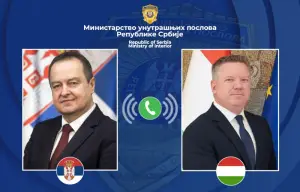
Serbia, Hungary partners in addressing regional security challenges
-
 Belgrade, 24 July 2026
Dačić congratulates UK Home Secretary on reappointment
-
 Belgrade, 22 July 2026
Serbia follows modern technological achievements, attracts investments
-
 Belgrade, 22 July 2026
Continued cooperation with Russia in field of security, emergency situations
-
 Belgrade, 22 July 2026
New opportunities for expanding economic cooperation between Serbia, China
-
 Belgrade, 20 July 2026
Cooperation in field of interior affairs important segment of relations with Germany
-
 Belgrade, 16 July 2026
Expo 2027 opportunity to further strengthen international partnerships
-
 Belgrade/Bratislava, 16 July 2026
Serbia, Slovakia continue to strengthen political, economic cooperation
-
 Belgrade, 14 July 2026
Serbia bilaterally resolves problems arising from EES implementation
-
 Gradina/Kalotina, 9 July 2026
Improving border cooperation between Serbia, Bulgaria