
Q:
A:
False asylum seekers to be returned to Serbia
Belgrade/Brdo pri Kranju,
20 October 2010
First Deputy Prime Minister and Minister of the Interior Ivica Dacic said today that one of the topics of the 10th regional ministerial conference on illegal migration, organised crime, corruption and terrorism held at Brdo pri Kranju in Slovenia was the monitoring of the implementation of agreements regarding visa liberalisation and the problem of false asylum seekers.
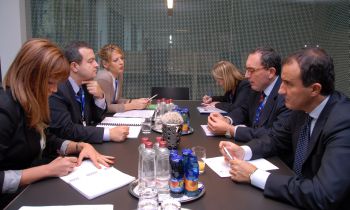
Ivica Dacic, 2nd left, meets Stefano Manservisi, 2nd right, in Brdo pri Kranju
Dacic and Director of the European Commission Stefano Manservisi spoke about how to prevent the problem of false asylum seekers.
Dacic asserted that the greatest number of asylum seekers are Roma from Vojvodina and Albanians from southern Serbia and Sandzak. He stressed that it is very important that these people know that they will not get asylum in any EU countries.
He noted that false asylum seekers can create a false picture in the EU that a large number of citizens from this region want to leave due to political reasons, while the reality is that they come because of economic reasons.
The Minister maintained that false asylum seekers are outlaying unnecessary costs because all of them will be returned to Serbia using summary procedure since Serbia has signed readmission agreements with these countries.
Dacic emphasised that the conference once again pointed to the need for all those in charge of the interior to continue with the process of meeting all requirements for visa liberalisation for all countries in the region.
We need to continue with the harmonisation of our legislation and implementation of all laws that are important in the field of interior in order to demonstrate that we as a society and a state have achieved such standards that allow us free travel to the EU, expounded Dacic.
There are general goals that connect all the countries in this region – that the region is a zone of security with preserved and stable public peace and order and with a joint fight against organised crime, corruption and terrorism, he illustrated.
The First Deputy Prime Minister remarked that cooperation between the Ministry of the Interior and the police with Europol gives a positive contribution to Serbia’s European integration.
Dacic underlined that the Serbian Ministry of the Interior signed an Agreement on strategic cooperation with Europol and that an Agreement on operational cooperation should also be signed soon.
Dacic explained that the agreement will be applied until the moment Serbia becomes a full EU member when it will become a part of the European Police Office.
The Minister specified that a so-called road map has been agreed this year and that a security communication link for data exchange with Europol has been established.
An expert mission from Europol is expected to arrive in Serbia, after which the above-mentioned Agreement on operational cooperation should be signed. However, the Minister clarified that Serbia is already cooperating with the police of EU member states even without this agreement.
Europol Director Robert Wainwright expressed his satisfaction with the meeting with Dacic and underscored that Serbia has achieved great success in the fight against organised crime.
Wainwright agreed with Dacic that the Agreement on operational cooperation should be agreed as soon as possible so that forms of cooperation could be better defined.
In addition to police ministers from Albania, Bosnia-Herzegovina, Montenegro and Macedonia, the conference was also attended by representatives of Austria, Bulgaria, Croatia, Greece, Hungary, Italy, Romania, Turkey, Belgium and the EU.
Dacic asserted that the greatest number of asylum seekers are Roma from Vojvodina and Albanians from southern Serbia and Sandzak. He stressed that it is very important that these people know that they will not get asylum in any EU countries.
He noted that false asylum seekers can create a false picture in the EU that a large number of citizens from this region want to leave due to political reasons, while the reality is that they come because of economic reasons.
The Minister maintained that false asylum seekers are outlaying unnecessary costs because all of them will be returned to Serbia using summary procedure since Serbia has signed readmission agreements with these countries.
Dacic emphasised that the conference once again pointed to the need for all those in charge of the interior to continue with the process of meeting all requirements for visa liberalisation for all countries in the region.
We need to continue with the harmonisation of our legislation and implementation of all laws that are important in the field of interior in order to demonstrate that we as a society and a state have achieved such standards that allow us free travel to the EU, expounded Dacic.
There are general goals that connect all the countries in this region – that the region is a zone of security with preserved and stable public peace and order and with a joint fight against organised crime, corruption and terrorism, he illustrated.
The First Deputy Prime Minister remarked that cooperation between the Ministry of the Interior and the police with Europol gives a positive contribution to Serbia’s European integration.
Dacic underlined that the Serbian Ministry of the Interior signed an Agreement on strategic cooperation with Europol and that an Agreement on operational cooperation should also be signed soon.
Dacic explained that the agreement will be applied until the moment Serbia becomes a full EU member when it will become a part of the European Police Office.
The Minister specified that a so-called road map has been agreed this year and that a security communication link for data exchange with Europol has been established.
An expert mission from Europol is expected to arrive in Serbia, after which the above-mentioned Agreement on operational cooperation should be signed. However, the Minister clarified that Serbia is already cooperating with the police of EU member states even without this agreement.
Europol Director Robert Wainwright expressed his satisfaction with the meeting with Dacic and underscored that Serbia has achieved great success in the fight against organised crime.
Wainwright agreed with Dacic that the Agreement on operational cooperation should be agreed as soon as possible so that forms of cooperation could be better defined.
In addition to police ministers from Albania, Bosnia-Herzegovina, Montenegro and Macedonia, the conference was also attended by representatives of Austria, Bulgaria, Croatia, Greece, Hungary, Italy, Romania, Turkey, Belgium and the EU.
-
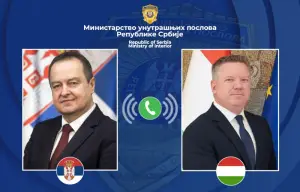 Belgrade, 24 July 2026
Serbia, Hungary partners in addressing regional security challenges
-
 Belgrade, 24 July 2026
Dačić congratulates UK Home Secretary on reappointment
-
 Belgrade, 22 July 2026
Serbia follows modern technological achievements, attracts investments
-
 Belgrade, 22 July 2026
Continued cooperation with Russia in field of security, emergency situations
-
 Belgrade, 22 July 2026
New opportunities for expanding economic cooperation between Serbia, China
-
 Belgrade, 20 July 2026
Cooperation in field of interior affairs important segment of relations with Germany
-
 Belgrade, 16 July 2026
Expo 2027 opportunity to further strengthen international partnerships
-
 Belgrade/Bratislava, 16 July 2026
Serbia, Slovakia continue to strengthen political, economic cooperation
-
 Belgrade, 14 July 2026
Serbia bilaterally resolves problems arising from EES implementation
-
 Gradina/Kalotina, 9 July 2026
Improving border cooperation between Serbia, Bulgaria