
Q:
A:
Joint operations units from Serbia and Russia in emergency situations
Merosina,
9 September 2010
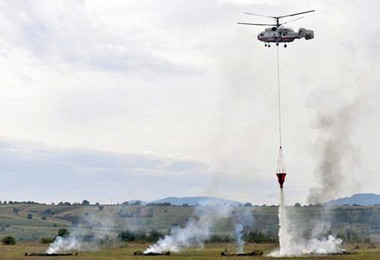
First Deputy Prime Minister and Minister of the Interior Ivica Dacic said that today’s joint exercise of the Serbian police and the Russian Ministry of Emergency Situations marks the start of a joint centre of the two countries for emergency situations based in Nis.
Author:
Tanjug
The exercise was performed by members of the Sector for Emergency Situations, the Helicopter Unit, and the Russian Ministry of Emergency Situations.
Dacic recalled that he had signed an agreement on the establishment of this centre with Russian Minister of Emergency Situations Sergei Shoigu in the presence of the presidents of Serbia and Russia.
He particularly stressed the importance of training and special rescue unit for emergency situations, and emphasised that the Nis centre will have at its disposal equipment, personnel and knowledge that goes beyond the individual capabilities of countries in the region separately.
The centre will be important for the elimination of the consequences of natural disasters and catastrophes in Southeast Europe and the EU, he added.
Prevention, response and recovery after natural disasters and catastrophes are developed at national and international level, but are most suitable at a regional level, which is why it is necessary that as many countries as possible get involved in this project, he stated.
Dacic outlined that the Serbian aircraft involved in today's exercise have a capacity for up to two tonnes, while the Russian aircraft can carry up to 15 tonnes of water and can fly continuously for seven hours.
Russian Ambassador to Serbia Alexander Konuzin highlighted that Serbia was the first country with which the Russian Federation has established a centre of this type.
He underlined that states cannot fight against natural disasters individually, which is why cooperation in this area is extremely important.
The exercise was held also in the presence of the ambassadors of Ukraine and Greece in Serbia, Viktor Nedopas and Dimosthenis Stoidis.
Dacic recalled that he had signed an agreement on the establishment of this centre with Russian Minister of Emergency Situations Sergei Shoigu in the presence of the presidents of Serbia and Russia.
He particularly stressed the importance of training and special rescue unit for emergency situations, and emphasised that the Nis centre will have at its disposal equipment, personnel and knowledge that goes beyond the individual capabilities of countries in the region separately.
The centre will be important for the elimination of the consequences of natural disasters and catastrophes in Southeast Europe and the EU, he added.
Prevention, response and recovery after natural disasters and catastrophes are developed at national and international level, but are most suitable at a regional level, which is why it is necessary that as many countries as possible get involved in this project, he stated.
Dacic outlined that the Serbian aircraft involved in today's exercise have a capacity for up to two tonnes, while the Russian aircraft can carry up to 15 tonnes of water and can fly continuously for seven hours.
Russian Ambassador to Serbia Alexander Konuzin highlighted that Serbia was the first country with which the Russian Federation has established a centre of this type.
He underlined that states cannot fight against natural disasters individually, which is why cooperation in this area is extremely important.
The exercise was held also in the presence of the ambassadors of Ukraine and Greece in Serbia, Viktor Nedopas and Dimosthenis Stoidis.
Author:
Tanjug
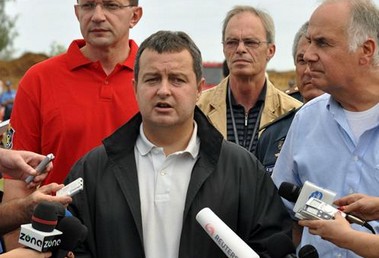
Dacic told reporters after the exercise that Serbia has opted for compromise with the EU on a resolution on Kosovo-Metohija and to continue to defend its national and state interests.
The First Deputy Prime Minister pointed out that such formulations were found that would not confirm the independence of Kosovo, opening the possibility for dialogue.
The most important strategic goal of Serbia after the presentation of the opinion of the International Court of Justice (ICJ) on the legality of the unilaterally proclaimed independence of Kosovo was that the UN General Assembly adopts a resolution that would not define Kosovo as an independent state, he stressed.
Serbia will continue to fight for its national interests in the UN Security Council and other relevant areas, maintained Dacic adding that our country will continue to cooperate with those countries it agrees with, but also with those whose opinions differ.
The First Deputy Prime Minister pointed out that such formulations were found that would not confirm the independence of Kosovo, opening the possibility for dialogue.
The most important strategic goal of Serbia after the presentation of the opinion of the International Court of Justice (ICJ) on the legality of the unilaterally proclaimed independence of Kosovo was that the UN General Assembly adopts a resolution that would not define Kosovo as an independent state, he stressed.
Serbia will continue to fight for its national interests in the UN Security Council and other relevant areas, maintained Dacic adding that our country will continue to cooperate with those countries it agrees with, but also with those whose opinions differ.
-
 Belgrade, 24 July 2026
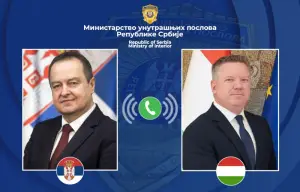
Serbia, Hungary partners in addressing regional security challenges
-
 Belgrade, 24 July 2026
Dačić congratulates UK Home Secretary on reappointment
-
 Belgrade, 22 July 2026
Serbia follows modern technological achievements, attracts investments
-
 Belgrade, 22 July 2026
Continued cooperation with Russia in field of security, emergency situations
-
 Belgrade, 22 July 2026
New opportunities for expanding economic cooperation between Serbia, China
-
 Belgrade, 20 July 2026
Cooperation in field of interior affairs important segment of relations with Germany
-
 Belgrade, 16 July 2026
Expo 2027 opportunity to further strengthen international partnerships
-
 Belgrade/Bratislava, 16 July 2026
Serbia, Slovakia continue to strengthen political, economic cooperation
-
 Belgrade, 14 July 2026
Serbia bilaterally resolves problems arising from EES implementation
-
 Gradina/Kalotina, 9 July 2026
Improving border cooperation between Serbia, Bulgaria