
Q:
A:
Sretko Kalinic extradited to Serbia
Belgrade,
25 August 2010
First Deputy Prime Minister and Minister of the Interior Ivica Dacic said today that member of the Zemun Clan Sretko Kalinic was extradited to Serbia last night around 2.00.
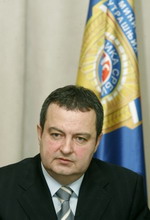
File photo of Ivica Dacic
Author:
Tanjug
Dacic told Tanjug news agency that Kalinic was transported from Croatia to Serbia by a Serbian government airplane, and added that the operation of extradition from a Croatian prison in Dubrava to Belgrade was carried out by the Anti-terrorist Unit of the Serbian Ministry of the Interior.
Within a half an hour of Kalinic’s arrival, the Serbian police took him to the confinement facility via a previously prepared route, followed by special security service personnel, and handed him over to members of the Directorate for Execution of Penalties of the Ministry of the Interior.
The facility where Kalinic is kept will be guarded by members of the Directorate and Gendarmerie.
The Minister explained that the Serbian police kept all the details regarding Kalinic’s extradition in the deepest secrecy so as to avoid possible safety risks.
Dacic noted that this is the first case of extradition since the conclusion of the inter-state agreement between Serbia and Croatia.
The Serbian police believe that Kalinic’s testimony will clear up many other crimes that have been mentioned and will enable the amplification of criminal charges regarding some other criminal offences committed in the past, the Minister declared.
This refers to 10 to 20 murders which Kalinic mentioned in his statements before Croatian investigating authorities, he specified and added that the extradition was carried out in agreement with the Croatian police, in strict secrecy and without any problems.
Kalinic was arrested in Zagreb on 8 June after being at large for several years.
He was condemned in absentia to 30 years in prison for taking part in the murder of former Serbian prime minister Zoran Djindjic, and he was condemned to 40 years in prison in the proceedings against the Zemun Clan for taking part in 19 murders, three kidnappings and two terrorist acts.
Kalinic was condemned yesterday in Zagreb to 18 months in prison for using a forged passport.
Since he was tried in his absence, Kalinic has the right to request new trials.
He is confined in the detention unit of the Special Court where he will be informed about his sentences, after which he will declare himself as to whether he wants the trials to be held again.
Within a half an hour of Kalinic’s arrival, the Serbian police took him to the confinement facility via a previously prepared route, followed by special security service personnel, and handed him over to members of the Directorate for Execution of Penalties of the Ministry of the Interior.
The facility where Kalinic is kept will be guarded by members of the Directorate and Gendarmerie.
The Minister explained that the Serbian police kept all the details regarding Kalinic’s extradition in the deepest secrecy so as to avoid possible safety risks.
Dacic noted that this is the first case of extradition since the conclusion of the inter-state agreement between Serbia and Croatia.
The Serbian police believe that Kalinic’s testimony will clear up many other crimes that have been mentioned and will enable the amplification of criminal charges regarding some other criminal offences committed in the past, the Minister declared.
This refers to 10 to 20 murders which Kalinic mentioned in his statements before Croatian investigating authorities, he specified and added that the extradition was carried out in agreement with the Croatian police, in strict secrecy and without any problems.
Kalinic was arrested in Zagreb on 8 June after being at large for several years.
He was condemned in absentia to 30 years in prison for taking part in the murder of former Serbian prime minister Zoran Djindjic, and he was condemned to 40 years in prison in the proceedings against the Zemun Clan for taking part in 19 murders, three kidnappings and two terrorist acts.
Kalinic was condemned yesterday in Zagreb to 18 months in prison for using a forged passport.
Since he was tried in his absence, Kalinic has the right to request new trials.
He is confined in the detention unit of the Special Court where he will be informed about his sentences, after which he will declare himself as to whether he wants the trials to be held again.
-
 Belgrade, 24 July 2026
Serbia, Hungary partners in addressing regional security challenges
-
 Belgrade, 24 July 2026
Dačić congratulates UK Home Secretary on reappointment
-
 Belgrade, 22 July 2026
Serbia follows modern technological achievements, attracts investments
-
 Belgrade, 22 July 2026
Continued cooperation with Russia in field of security, emergency situations
-
 Belgrade, 22 July 2026
New opportunities for expanding economic cooperation between Serbia, China
-
 Belgrade, 20 July 2026
Cooperation in field of interior affairs important segment of relations with Germany
-
 Belgrade, 16 July 2026
Expo 2027 opportunity to further strengthen international partnerships
-
 Belgrade/Bratislava, 16 July 2026
Serbia, Slovakia continue to strengthen political, economic cooperation
-
 Belgrade, 14 July 2026
Serbia bilaterally resolves problems arising from EES implementation
-
 Gradina/Kalotina, 9 July 2026
Improving border cooperation between Serbia, Bulgaria