
Q:
A:
Serbia makes progress in implementation of reforms, regional cooperation
Belgrade,
14 July 2010
Deputy Prime Minister for European Integration Bozidar Djelic stated today that participants in the meeting of the Enhanced Permanent Dialogue between the EU and Serbia agreed that there are unresolved issues regarding the depth and speed of reforms in Serbia and affirmed that reforms will be continued with the aim of improving citizens’ standard of living and achieving European integration.
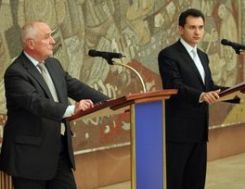
Pierre Mirel, left, and Bozidar Djelic
Author:
Fonet
Djelic, who chaired this meeting together with Director of the Western Balkans Directorate at the European Commission’s Directorate-General for Enlargement Pierre Mirel, said that topics covered in the meeting included progress in political criteria, judiciary reform, regional cooperation, the fight against organised crime and corruption, progress in the implementation of the Vojvodina Statute, minority rights, as well as the status and work of independent regulatory bodies.
He underlined that Serbia expects that the EU will soon reach a consensus on submitting Serbia’s candidacy application to the European Commission.
Mirel positively evaluated the progress Serbia has achieved in regional cooperation, as well as the fight against organised crime and implementation of reforms, but he also asked Belgrade to take a constructive approach to the problem of customs in Kosovo-Metohija.
He also welcomed the adoption of the Vojvodina Statute, formation of national councils and the work of the ombudsman and trustee for information of public importance.
He added that this also refers to the improvement of relations between Serbia and Bosnia-Herzegovina and the adoption of a Declaration on Srebrenica by the Serbian Parliament, as well as the visit to Srebrenica by President Boris Tadic.
At today’s session of the Enhanced Permanent Dialogue the foundation of the Anti-Corruption Agency was welcomed, while the success in the fight against organised crime, the uncovering of a criminal group that smuggled drugs and the political will to continue the fight were also praised.
In this context judicial reform is extremely important and necessary, Mirel pointed out adding that debates are still being led over this issue.
He listed the Extradition Agreement with Croatia and Agreement on Police Cooperation with Albania as positive examples of improved regional cooperation.
We would like a similar constructive approach to a special issue regarding Kosovo-Metohija which refers to customs and according to UNMIK it is in full accordance with Resolution 1244, Mirel noted.
Djelic recalled that Serbia consented to UNMIK signing the CEFTA agreement on behalf of Kosovo-Metohija, but added that a while ago there were attempts at unilateral implementation of this international agreement, which is not possible without all contractual parties.
As in all cases, Serbia is trying to find a solution within its state policy, but is careful not to cross the red line, the Deputy Prime Minister declared.
Djelic reiterated that Serbia will never recognise the province’s unilaterally declared independence, either directly or indirectly, adding that Serbia’s mission at the UN has asked for an official opinion of the UN customs sector regarding the issue of customs with the province.
He underlined that Serbia expects that the EU will soon reach a consensus on submitting Serbia’s candidacy application to the European Commission.
Mirel positively evaluated the progress Serbia has achieved in regional cooperation, as well as the fight against organised crime and implementation of reforms, but he also asked Belgrade to take a constructive approach to the problem of customs in Kosovo-Metohija.
He also welcomed the adoption of the Vojvodina Statute, formation of national councils and the work of the ombudsman and trustee for information of public importance.
He added that this also refers to the improvement of relations between Serbia and Bosnia-Herzegovina and the adoption of a Declaration on Srebrenica by the Serbian Parliament, as well as the visit to Srebrenica by President Boris Tadic.
At today’s session of the Enhanced Permanent Dialogue the foundation of the Anti-Corruption Agency was welcomed, while the success in the fight against organised crime, the uncovering of a criminal group that smuggled drugs and the political will to continue the fight were also praised.
In this context judicial reform is extremely important and necessary, Mirel pointed out adding that debates are still being led over this issue.
He listed the Extradition Agreement with Croatia and Agreement on Police Cooperation with Albania as positive examples of improved regional cooperation.
We would like a similar constructive approach to a special issue regarding Kosovo-Metohija which refers to customs and according to UNMIK it is in full accordance with Resolution 1244, Mirel noted.
Djelic recalled that Serbia consented to UNMIK signing the CEFTA agreement on behalf of Kosovo-Metohija, but added that a while ago there were attempts at unilateral implementation of this international agreement, which is not possible without all contractual parties.
As in all cases, Serbia is trying to find a solution within its state policy, but is careful not to cross the red line, the Deputy Prime Minister declared.
Djelic reiterated that Serbia will never recognise the province’s unilaterally declared independence, either directly or indirectly, adding that Serbia’s mission at the UN has asked for an official opinion of the UN customs sector regarding the issue of customs with the province.
-
 Belgrade, 24 July 2026
Serbia, Hungary partners in addressing regional security challenges
-
 Belgrade, 24 July 2026
Dačić congratulates UK Home Secretary on reappointment
-
 Belgrade, 22 July 2026
Serbia follows modern technological achievements, attracts investments
-
 Belgrade, 22 July 2026
Continued cooperation with Russia in field of security, emergency situations
-
 Belgrade, 22 July 2026
New opportunities for expanding economic cooperation between Serbia, China
-
 Belgrade, 20 July 2026
Cooperation in field of interior affairs important segment of relations with Germany
-
 Belgrade, 16 July 2026
Expo 2027 opportunity to further strengthen international partnerships
-
 Belgrade/Bratislava, 16 July 2026
Serbia, Slovakia continue to strengthen political, economic cooperation
-
 Belgrade, 14 July 2026
Serbia bilaterally resolves problems arising from EES implementation
-
 Gradina/Kalotina, 9 July 2026
Improving border cooperation between Serbia, Bulgaria