
Q:
A:
Danube offers opportunities for accelerating national development
Novi Sad,
9 July 2010
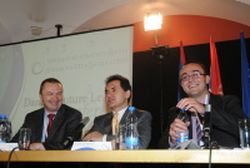
Deputy Prime Minister for European Integration Bozidar Djelic stated today that the Danube River is one of Serbia’s major resources. He confirmed that the government will set aside significant funds for implementing the Danube Strategy.
Author:
Beta
At the opening of the “Danube Conference of Future Leaders” at the Museum of Novi Sad, Djelic emphasised that Serbia is aware of the fact that the Danube river corridor will soon become one of the most modern in Europe.
The Danube offers us opportunities for accelerating our national development, he highlighted, adding that young people have a special role to play in this regard.
The length of the Danube flowing through Serbia is 588 kilometres. The universities of Belgrade and Novi Sad are located on its banks. The refineries of Novi Sad and Pancevo have also been built on the banks of the Danube, elaborated Djelic. He announced that preparations are being made to construct more bridges on the river.
The construction of the Zezeljev Bridge in Novi Sad, which will cost €60 million, will begin soon, noted Djelic, adding that the EU will provide half of the funds required for this project.
Similarly, in cooperation with Chinese partners a bridge will be built to connect Zemun and Borca. Without building roads and the railway and without developing river transport there can be no progress, he underlined.
Serbia will actively participate in the preparation of the Danube Strategy, having invested millions of Euros in developing a navigation system and areas along the Danube River, stressed Djelic.
The Strategy is expected to be adopted by the European Commission in the first half of 2011. A conference dedicated to the Strategy will be held in October this year at the Assembly of Vojvodina, he declared.
President of the government of the Autonomous Province of Vojvodina Bojan Pajtic emphasised that it is natural for Novi Sad to be the host of an international conference on this subject, considering the fact that it is the capital of a multicultural, multilingual and multi-religious province, home to 26 different ethnic communities.
The Danube is of special importance to Vojvodina. Vojvodina has already prepared 133 projects which it would like to get implemented, asserted Pajtic.
Efforts must be made to improve river transport but this should be done while being mindful of environmental protection, he observed.
Vojvodina intends to build more river ports throughout the province, which will be similar to the one built in Apatin which makes the government of Vojvodina very proud, Pajtic remarked.
Nathalie Verschelde, a representative of the European Commission’s Directorate - General for Regional Policy, pointed out that the drafting of the Danube Strategy is going on but the road from ideas to practical solutions is a long one.
An action plan has been made, she affirmed, adding that it recommends the need to mobilize people and funding in order to fully utilise the potential of the Danube.
It is not just the Danube River we are talking about, rather the wider area along the river as well. Special attention will be paid to transport, tourism and ecology, as well as the preservation of the culture and national identity of the various communities living in these areas. Work will be done to improve the situation regarding education and security and to combat crime and corruption, she outlined.
It should be remembered that in order to become an EU strategy, the Danube Strategy will have to meet the approval of all 27 EU member countries, as well as Danube River Basin countries which are not yet EU members, Verschelde illustrated.
At the moment finances for carrying out the project can become available in the form of various EU funds as well as donations, however, financing for the Strategy is expected to become a special article in the 2014 – 2020 EU budget, she observed.
The Danube is the largest navigable river in Europe which makes it a major resource for development. The river has its own identity and we feel that we share that identity, Verschelde acknowledged, adding that the Danube region can be developed only through close cooperation between countries in the area.
Today’s conference brought together future leaders from all Danube region countries in the interest of a better understanding of a future EU Strategy for the Danube Region, while raising awareness among young people about the key concepts of the Strategy.
The conference was held under the auspices of the Deputy Prime Minister for European Integration, who is also the National Coordinator for the Danube Strategy in Serbia.
The government of the province of Vojvodina, the Tourist Organisation of Serbia and Coca Cola provided financial and organisational support for holding the conference.
The Danube offers us opportunities for accelerating our national development, he highlighted, adding that young people have a special role to play in this regard.
The length of the Danube flowing through Serbia is 588 kilometres. The universities of Belgrade and Novi Sad are located on its banks. The refineries of Novi Sad and Pancevo have also been built on the banks of the Danube, elaborated Djelic. He announced that preparations are being made to construct more bridges on the river.
The construction of the Zezeljev Bridge in Novi Sad, which will cost €60 million, will begin soon, noted Djelic, adding that the EU will provide half of the funds required for this project.
Similarly, in cooperation with Chinese partners a bridge will be built to connect Zemun and Borca. Without building roads and the railway and without developing river transport there can be no progress, he underlined.
Serbia will actively participate in the preparation of the Danube Strategy, having invested millions of Euros in developing a navigation system and areas along the Danube River, stressed Djelic.
The Strategy is expected to be adopted by the European Commission in the first half of 2011. A conference dedicated to the Strategy will be held in October this year at the Assembly of Vojvodina, he declared.
President of the government of the Autonomous Province of Vojvodina Bojan Pajtic emphasised that it is natural for Novi Sad to be the host of an international conference on this subject, considering the fact that it is the capital of a multicultural, multilingual and multi-religious province, home to 26 different ethnic communities.
The Danube is of special importance to Vojvodina. Vojvodina has already prepared 133 projects which it would like to get implemented, asserted Pajtic.
Efforts must be made to improve river transport but this should be done while being mindful of environmental protection, he observed.
Vojvodina intends to build more river ports throughout the province, which will be similar to the one built in Apatin which makes the government of Vojvodina very proud, Pajtic remarked.
Nathalie Verschelde, a representative of the European Commission’s Directorate - General for Regional Policy, pointed out that the drafting of the Danube Strategy is going on but the road from ideas to practical solutions is a long one.
An action plan has been made, she affirmed, adding that it recommends the need to mobilize people and funding in order to fully utilise the potential of the Danube.
It is not just the Danube River we are talking about, rather the wider area along the river as well. Special attention will be paid to transport, tourism and ecology, as well as the preservation of the culture and national identity of the various communities living in these areas. Work will be done to improve the situation regarding education and security and to combat crime and corruption, she outlined.
It should be remembered that in order to become an EU strategy, the Danube Strategy will have to meet the approval of all 27 EU member countries, as well as Danube River Basin countries which are not yet EU members, Verschelde illustrated.
At the moment finances for carrying out the project can become available in the form of various EU funds as well as donations, however, financing for the Strategy is expected to become a special article in the 2014 – 2020 EU budget, she observed.
The Danube is the largest navigable river in Europe which makes it a major resource for development. The river has its own identity and we feel that we share that identity, Verschelde acknowledged, adding that the Danube region can be developed only through close cooperation between countries in the area.
Today’s conference brought together future leaders from all Danube region countries in the interest of a better understanding of a future EU Strategy for the Danube Region, while raising awareness among young people about the key concepts of the Strategy.
The conference was held under the auspices of the Deputy Prime Minister for European Integration, who is also the National Coordinator for the Danube Strategy in Serbia.
The government of the province of Vojvodina, the Tourist Organisation of Serbia and Coca Cola provided financial and organisational support for holding the conference.
-
 Belgrade, 24 July 2026
Serbia, Hungary partners in addressing regional security challenges
-
 Belgrade, 24 July 2026
Dačić congratulates UK Home Secretary on reappointment
-
 Belgrade, 22 July 2026
Serbia follows modern technological achievements, attracts investments
-
 Belgrade, 22 July 2026
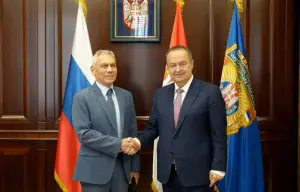
Continued cooperation with Russia in field of security, emergency situations
-
 Belgrade, 22 July 2026
New opportunities for expanding economic cooperation between Serbia, China
-
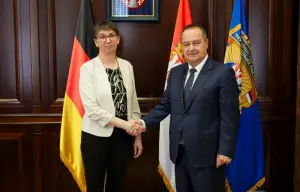 Belgrade, 20 July 2026
Cooperation in field of interior affairs important segment of relations with Germany
-
 Belgrade, 16 July 2026
Expo 2027 opportunity to further strengthen international partnerships
-
 Belgrade/Bratislava, 16 July 2026
Serbia, Slovakia continue to strengthen political, economic cooperation
-
 Belgrade, 14 July 2026
Serbia bilaterally resolves problems arising from EES implementation
-
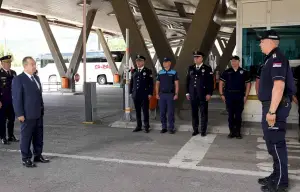 Gradina/Kalotina, 9 July 2026
Improving border cooperation between Serbia, Bulgaria