
Q:
A:
Serbia highly appreciates Romania’s support to Serbia’s territorial integrity, European integration
Belgrade/Bucharest,
6 July 2010
First Deputy Prime Minister and Minister of the Interior Ivica Dacic said today in Bucharest that Serbia highly appreciates Romania’s support to its territorial integrity and European integration.
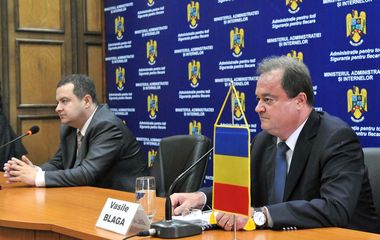
Ivica Dacic and Vasile Blaga
Author:
Tanjug
Speaking at a joint press conference with Romanian Minister of the Interior Vasile Blaga, Dacic proclaimed that Romania’s support is even more important to Serbia because Romania is an EU member, but at the same time it has not recognised the unilaterally proclaimed independence of Kosovo.
The presence of Romanian soldiers and policemen in Kosovo-Metohija is of great importance for the safety of local Serbs, Dacic stressed.
He also thanked Romania for the support it gave to Serbia during the process of obtaining visa liberalisation.
Dacic and Blaga agreed that it is necessary to improve police cooperation in the fight against crime, drug trafficking and the smuggling of people and goods. They announced that a protocol concerning readmission and other agreements will be signed.
The two countries and nations have friendly relations, remarked Dacic, adding that his wish is to see borders becoming points of connection rather than separation.
It is necessary to open up as many border crossings as possible in order to make life easier for people living on either side of the border in Serbia and Romania, observed Dacic.
He announced that very soon a protocol will be signed concerning the establishment of a joint contact point at the border.
Serbia and Romania will have greatly improved operational cooperation and will carry out joint actions in the fight against organised crime, corruption and terrorism, problems faced by all countries in the region, he noted.
In order to cooperate even more successfully it is necessary to establish better operational and functional cooperation through exchange of information, maintained Dacic.
The region has become exposed to a double drug trafficking route going towards EU countries and the drugs being smuggled are mainly heroin and cocaine, he underlined, adding that criminal groups from the region are mostly smuggling cocaine originating from Latin America through harbours in Slovenia, Montenegro, Greece and the Black Sea.
Dacic also pointed out that the smuggling of cigarettes is a problem and that recently the Serbian police force confiscated 50,000 cartons of cigarettes at the Vatin border crossing.
Blaga stated that Romania will keep on backing Serbia on the path to the EU just as it backed its visa liberalisation.
He confirmed that he spoke with Dacic about police cooperation and ways to resolve problems which concern both countries, adding that the police forces of Serbia and Romania cooperate significantly in order to combat organised crime, drug trafficking, human trafficking and the smuggling of cigarettes.
A meeting between police representatives from Serbia, Romania and Bulgaria will be held in Bucharest at the end of the year, at which mutual cooperation will be discussed.
Dacic also visited the SECI Regional Centre for Combating Trans-Border Crime in Bucharest. He emphasised at the occasion that Serbia is determined to fight against organised crime and terrorism. It is important for Serbia to be a part of the global efforts for combating organised crime and terrorism, he declared, adding that Serbia and 12 other countries are SECI members.
The SECI Centre is an important instrument for police forces in the region in their fight against crime, corruption and terrorism, acknowledged Dacic.
Serbia’s efforts in this regard are also helping its EU integration process, which along with the fight against organised crime, is one of the country’s top priorities, recounted Dacic.
Dacic specified that other member countries of the Centre are Albania, Bosnia-Herzegovina, Bulgaria, Croatia, Greece, Hungary, Macedonia, Moldova, Montenegro, Romania, Slovenia and Turkey.
He recalled that Serbia has signed bilateral agreements and protocols on cooperation with most of these countries, announcing talks with Turkey on the same subject.
Dacic highlighted the importance of this, because another topic to be discussed with Turkey is visa abolishment for citizens of both states.
With a tour of the SECI Centre Dacic concluded a one-day visit to Romania, at the invitation of his counterpart Vasile Blaga.
The presence of Romanian soldiers and policemen in Kosovo-Metohija is of great importance for the safety of local Serbs, Dacic stressed.
He also thanked Romania for the support it gave to Serbia during the process of obtaining visa liberalisation.
Dacic and Blaga agreed that it is necessary to improve police cooperation in the fight against crime, drug trafficking and the smuggling of people and goods. They announced that a protocol concerning readmission and other agreements will be signed.
The two countries and nations have friendly relations, remarked Dacic, adding that his wish is to see borders becoming points of connection rather than separation.
It is necessary to open up as many border crossings as possible in order to make life easier for people living on either side of the border in Serbia and Romania, observed Dacic.
He announced that very soon a protocol will be signed concerning the establishment of a joint contact point at the border.
Serbia and Romania will have greatly improved operational cooperation and will carry out joint actions in the fight against organised crime, corruption and terrorism, problems faced by all countries in the region, he noted.
In order to cooperate even more successfully it is necessary to establish better operational and functional cooperation through exchange of information, maintained Dacic.
The region has become exposed to a double drug trafficking route going towards EU countries and the drugs being smuggled are mainly heroin and cocaine, he underlined, adding that criminal groups from the region are mostly smuggling cocaine originating from Latin America through harbours in Slovenia, Montenegro, Greece and the Black Sea.
Dacic also pointed out that the smuggling of cigarettes is a problem and that recently the Serbian police force confiscated 50,000 cartons of cigarettes at the Vatin border crossing.
Blaga stated that Romania will keep on backing Serbia on the path to the EU just as it backed its visa liberalisation.
He confirmed that he spoke with Dacic about police cooperation and ways to resolve problems which concern both countries, adding that the police forces of Serbia and Romania cooperate significantly in order to combat organised crime, drug trafficking, human trafficking and the smuggling of cigarettes.
A meeting between police representatives from Serbia, Romania and Bulgaria will be held in Bucharest at the end of the year, at which mutual cooperation will be discussed.
Dacic also visited the SECI Regional Centre for Combating Trans-Border Crime in Bucharest. He emphasised at the occasion that Serbia is determined to fight against organised crime and terrorism. It is important for Serbia to be a part of the global efforts for combating organised crime and terrorism, he declared, adding that Serbia and 12 other countries are SECI members.
The SECI Centre is an important instrument for police forces in the region in their fight against crime, corruption and terrorism, acknowledged Dacic.
Serbia’s efforts in this regard are also helping its EU integration process, which along with the fight against organised crime, is one of the country’s top priorities, recounted Dacic.
Dacic specified that other member countries of the Centre are Albania, Bosnia-Herzegovina, Bulgaria, Croatia, Greece, Hungary, Macedonia, Moldova, Montenegro, Romania, Slovenia and Turkey.
He recalled that Serbia has signed bilateral agreements and protocols on cooperation with most of these countries, announcing talks with Turkey on the same subject.
Dacic highlighted the importance of this, because another topic to be discussed with Turkey is visa abolishment for citizens of both states.
With a tour of the SECI Centre Dacic concluded a one-day visit to Romania, at the invitation of his counterpart Vasile Blaga.
-
 Belgrade, 24 July 2026
Serbia, Hungary partners in addressing regional security challenges
-
 Belgrade, 24 July 2026
Dačić congratulates UK Home Secretary on reappointment
-
 Belgrade, 22 July 2026
Serbia follows modern technological achievements, attracts investments
-
 Belgrade, 22 July 2026
Continued cooperation with Russia in field of security, emergency situations
-
 Belgrade, 22 July 2026
New opportunities for expanding economic cooperation between Serbia, China
-
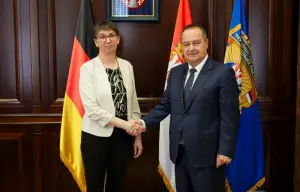 Belgrade, 20 July 2026
Cooperation in field of interior affairs important segment of relations with Germany
-
 Belgrade, 16 July 2026
Expo 2027 opportunity to further strengthen international partnerships
-
 Belgrade/Bratislava, 16 July 2026
Serbia, Slovakia continue to strengthen political, economic cooperation
-
 Belgrade, 14 July 2026
Serbia bilaterally resolves problems arising from EES implementation
-
 Gradina/Kalotina, 9 July 2026
Improving border cooperation between Serbia, Bulgaria