
Q:
A:
Signing of interstate agreement on scientific cooperation with Germany
Belgrade/Berlin,
4 May 2010
Deputy Prime Minister for European Integration and Minister of Science and Technological Development Bozidar Djelic and German Minister of Education and Research Annette Schavan reached an agreement today in Berlin on the signing of an interstate agreement on scientific cooperation.
Djelic recalled that Serbia has signed such agreements with China and the United States and stressed that it is very important for Serbia to have such a document signed with Germany as well.
The Deputy Prime Minister said Fraunhofer-Institut, the German scientific institution which has 14,000 researchers, will open offices in Serbia.
He explained that the offices of this institution in Serbia need to address priority areas such as information technology, medicine and supplies.
We also discussed specific projects, such as the development of electric cars. It was agreed that Serbia will participate in the German project LIB 15 by producing batteries, said Djelic.
Schavan said that Djelic’s speech about the Serbian government’s initiatives concerning investment in research is a strong and encouraging message for researchers in Serbia.
It is also a good signal for the international community because it will give Serbian researchers and universities an opportunity for international cooperation, she said.
Djelic also met today with German Minister of Economy and Technology Rainer Brüderle. He said following talks that a meeting of an interstate committee will be held in Berlin in August which will further advance economic relations between the two countries.
He said that he talked with Brüderle about major energy projects, the upcoming privatisation of Telekom Srbija and investment in local infrastructure and the metal and wood industries.
Brüderle accepted a request for an expert analysis of the technological aspect of the Serbian economy by his Ministry in order to provide advice for improvements, he said.
Germany is the world’s second largest exporter and its products are of the best quality and are advanced science and technology-wise, which is why it is very important for Serbia to have Germany as its advisor for the improvement of the technological conditions of the domestic economy, Djelic pointed out.
Djelic also spoke today with Advisor to the German Chancellor for European Affairs Uwe Corsepius and Advisor to the German Chancellor for Foreign Affairs Christoph Heusgen.
He also met with Chairman of the Bundestag Committee on European Affairs Günter Krichbaum and with the Director of the Fraunhofer Centre for Central and Eastern Europe.
The Deputy Prime Minister said Fraunhofer-Institut, the German scientific institution which has 14,000 researchers, will open offices in Serbia.
He explained that the offices of this institution in Serbia need to address priority areas such as information technology, medicine and supplies.
We also discussed specific projects, such as the development of electric cars. It was agreed that Serbia will participate in the German project LIB 15 by producing batteries, said Djelic.
Schavan said that Djelic’s speech about the Serbian government’s initiatives concerning investment in research is a strong and encouraging message for researchers in Serbia.
It is also a good signal for the international community because it will give Serbian researchers and universities an opportunity for international cooperation, she said.
Djelic also met today with German Minister of Economy and Technology Rainer Brüderle. He said following talks that a meeting of an interstate committee will be held in Berlin in August which will further advance economic relations between the two countries.
He said that he talked with Brüderle about major energy projects, the upcoming privatisation of Telekom Srbija and investment in local infrastructure and the metal and wood industries.
Brüderle accepted a request for an expert analysis of the technological aspect of the Serbian economy by his Ministry in order to provide advice for improvements, he said.
Germany is the world’s second largest exporter and its products are of the best quality and are advanced science and technology-wise, which is why it is very important for Serbia to have Germany as its advisor for the improvement of the technological conditions of the domestic economy, Djelic pointed out.
Djelic also spoke today with Advisor to the German Chancellor for European Affairs Uwe Corsepius and Advisor to the German Chancellor for Foreign Affairs Christoph Heusgen.
He also met with Chairman of the Bundestag Committee on European Affairs Günter Krichbaum and with the Director of the Fraunhofer Centre for Central and Eastern Europe.
-
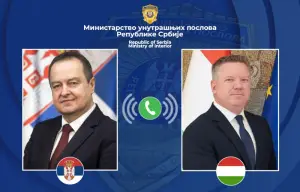 Belgrade, 24 July 2026
Serbia, Hungary partners in addressing regional security challenges
-
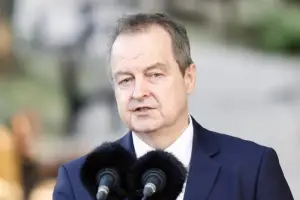 Belgrade, 24 July 2026
Dačić congratulates UK Home Secretary on reappointment
-
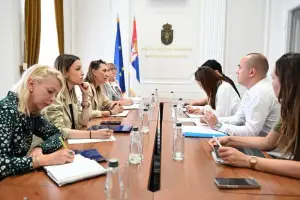 Belgrade, 22 July 2026
Serbia follows modern technological achievements, attracts investments
-
 Belgrade, 22 July 2026
Continued cooperation with Russia in field of security, emergency situations
-
 Belgrade, 22 July 2026
New opportunities for expanding economic cooperation between Serbia, China
-
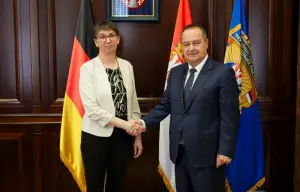 Belgrade, 20 July 2026
Cooperation in field of interior affairs important segment of relations with Germany
-
 Belgrade, 16 July 2026
Expo 2027 opportunity to further strengthen international partnerships
-
 Belgrade/Bratislava, 16 July 2026
Serbia, Slovakia continue to strengthen political, economic cooperation
-
 Belgrade, 14 July 2026
Serbia bilaterally resolves problems arising from EES implementation
-
 Gradina/Kalotina, 9 July 2026
Improving border cooperation between Serbia, Bulgaria