
Q:
A:
Programme of improvement of Roma position underway
Belgrade,
30 April 2010
Deputy Prime Minister of European Integration and President of the Council for Roma Inclusion Bozidar Djelic said today that a programme for the improvement of the Roma position, worth €37.6 million, is underway and is being financed by the EU.
Upon visiting the Museum of Roma Culture, Djelic reiterated that a strategy for improvement of the Roma position was adopted in 2009 and its implementation got off the ground successfully, by adopting a series of laws – on prohibition of discrimination, national councils of national minorities, social housing etc.
The Deputy Prime Minister said that the number of Roma in Serbia will be known after the 2011 census.
According to the 2001 census, 100,000 people declared themselves as Roma, but current estimates show that their number is around 250,000.
Djelic called upon the Roma to voice their standpoints in the upcoming census, adding that in order to gather precise data, Roma activists must also be included in the process.
The Deputy Prime Minister was presented with a newly-established recognition of the Museum, allocated for special contribution to the improvement of the Roma population.
Spanish Ambassador to Serbia Iñigo de Palacio España also visited the Museum of the Roma Culture and presented writer Rajko Djuric with an award from the Madrid Culture Institute for special contribution to the development of Roma literature and culture.
España noted that the EU, and especially Spain, have an obligation towards the Roma people, who have been an important part of our culture since the 15th century, specifying that out of 10–20 million Roma in Europe, over 700,000 live in Spain.
The Ambassador said that his country is the main stage of European efforts to solve the Roma issue and include this population in society. He also applauded the Serbian government for everything it has done in this sense during the Decade of the Roma.
The Deputy Prime Minister said that the number of Roma in Serbia will be known after the 2011 census.
According to the 2001 census, 100,000 people declared themselves as Roma, but current estimates show that their number is around 250,000.
Djelic called upon the Roma to voice their standpoints in the upcoming census, adding that in order to gather precise data, Roma activists must also be included in the process.
The Deputy Prime Minister was presented with a newly-established recognition of the Museum, allocated for special contribution to the improvement of the Roma population.
Spanish Ambassador to Serbia Iñigo de Palacio España also visited the Museum of the Roma Culture and presented writer Rajko Djuric with an award from the Madrid Culture Institute for special contribution to the development of Roma literature and culture.
España noted that the EU, and especially Spain, have an obligation towards the Roma people, who have been an important part of our culture since the 15th century, specifying that out of 10–20 million Roma in Europe, over 700,000 live in Spain.
The Ambassador said that his country is the main stage of European efforts to solve the Roma issue and include this population in society. He also applauded the Serbian government for everything it has done in this sense during the Decade of the Roma.
-
 Belgrade, 24 July 2026
Serbia, Hungary partners in addressing regional security challenges
-
 Belgrade, 24 July 2026
Dačić congratulates UK Home Secretary on reappointment
-
 Belgrade, 22 July 2026
Serbia follows modern technological achievements, attracts investments
-
 Belgrade, 22 July 2026
Continued cooperation with Russia in field of security, emergency situations
-
 Belgrade, 22 July 2026
New opportunities for expanding economic cooperation between Serbia, China
-
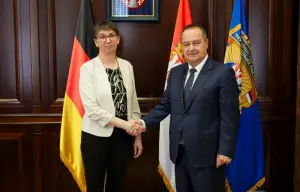 Belgrade, 20 July 2026
Cooperation in field of interior affairs important segment of relations with Germany
-
 Belgrade, 16 July 2026
Expo 2027 opportunity to further strengthen international partnerships
-
 Belgrade/Bratislava, 16 July 2026
Serbia, Slovakia continue to strengthen political, economic cooperation
-
 Belgrade, 14 July 2026
Serbia bilaterally resolves problems arising from EES implementation
-
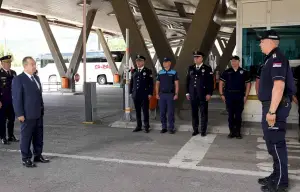 Gradina/Kalotina, 9 July 2026
Improving border cooperation between Serbia, Bulgaria