
Q:
A:
Serbia with clear strategy at Cordoba Roma Inclusion summit
Belgrade,
7 April 2010
Deputy Prime Minister for EU integration Bozidar Djelic stated that Serbia today affirmed its strategy for the second European Roma Inclusion Summit, to be held in Cordoba, Spain.
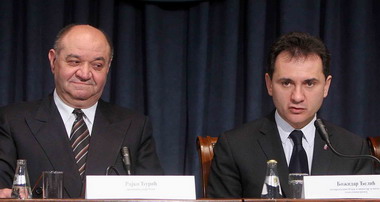
Rajko Djuric and Bozidar Djelic
Djelic told a press conference at the Serbian government that the Roma are a specific kind of population because they are a minority in every country and do not have their own homeland, which is why they require an adequate European policy.
Djelic, who presided over the fifth session of the Council for Improving the Position of the Roma and for the Implementation of the Decade of Roma Inclusion, said that the Roma are not only the largest minority group in Europe, numbering between 10 and 15 million people, but also in Serbia, where between 200,000 and 400,000 Roma live.
He stressed that the social integration of minority groups, such as the Roma, is one of the preconditions for EU integration, adding that during the last two years Serbia has managed to improve their position by setting aside considerable funds.
Serbia intends to increase funds for Roma inclusion from its budget, as well as from EU funds. In the weeks to come we will meet with the Council of Europe’s Development Bank to negotiate a €63.4 million package for the social inclusion of vulnerable groups for the period 2011–2013, the Deputy Prime Minister said.
He announced that this includes the construction of recycling facilities, which is of huge importance for the Roma because as many as 70% of them live on collecting secondary materials for recycling.
He also said that the funds from the Development Bank will be used to build 1,000 flats for the most vulnerable population and organise special educational programmes for minorities, including the Roma.
The Deputy Prime Minister extended his greetings to all Roma on the occasion of 8 April, the day of the Roma, as well as to President of the Roma Union Rajko Djuric, to whom the Madrid Institute of Culture will present an award for life’s work, for his contribution in resolving Roma related issues.
Djelic, who presided over the fifth session of the Council for Improving the Position of the Roma and for the Implementation of the Decade of Roma Inclusion, said that the Roma are not only the largest minority group in Europe, numbering between 10 and 15 million people, but also in Serbia, where between 200,000 and 400,000 Roma live.
He stressed that the social integration of minority groups, such as the Roma, is one of the preconditions for EU integration, adding that during the last two years Serbia has managed to improve their position by setting aside considerable funds.
Serbia intends to increase funds for Roma inclusion from its budget, as well as from EU funds. In the weeks to come we will meet with the Council of Europe’s Development Bank to negotiate a €63.4 million package for the social inclusion of vulnerable groups for the period 2011–2013, the Deputy Prime Minister said.
He announced that this includes the construction of recycling facilities, which is of huge importance for the Roma because as many as 70% of them live on collecting secondary materials for recycling.
He also said that the funds from the Development Bank will be used to build 1,000 flats for the most vulnerable population and organise special educational programmes for minorities, including the Roma.
The Deputy Prime Minister extended his greetings to all Roma on the occasion of 8 April, the day of the Roma, as well as to President of the Roma Union Rajko Djuric, to whom the Madrid Institute of Culture will present an award for life’s work, for his contribution in resolving Roma related issues.
-
 Belgrade, 24 July 2026
Serbia, Hungary partners in addressing regional security challenges
-
 Belgrade, 24 July 2026
Dačić congratulates UK Home Secretary on reappointment
-
 Belgrade, 22 July 2026
Serbia follows modern technological achievements, attracts investments
-
 Belgrade, 22 July 2026
Continued cooperation with Russia in field of security, emergency situations
-
 Belgrade, 22 July 2026
New opportunities for expanding economic cooperation between Serbia, China
-
 Belgrade, 20 July 2026
Cooperation in field of interior affairs important segment of relations with Germany
-
 Belgrade, 16 July 2026
Expo 2027 opportunity to further strengthen international partnerships
-
 Belgrade/Bratislava, 16 July 2026
Serbia, Slovakia continue to strengthen political, economic cooperation
-
 Belgrade, 14 July 2026
Serbia bilaterally resolves problems arising from EES implementation
-
 Gradina/Kalotina, 9 July 2026
Improving border cooperation between Serbia, Bulgaria