
Q:
A:
Djelic, Degert sign financial agreement on EU assistance
Novi Sad,
22 March 2010
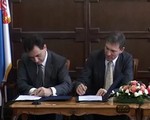
Deputy Prime Minister for EU Integration Bozidar Djelic and Head of the European Commission Delegation to Serbia Vincent Degert signed a €70 million financial agreement between the Serbian government and the European Commission today.
VIDEO: Signing of a financial agreement on EU assistance to Serbia
The agreement concerns the national programme for the Republic of Serbia which applies to the first component of the IPA funds – assistance to transition and building of institutions for 2009.
A total of nine projects have been approved within this agreement. These projects will improve living conditions for people and will help Serbia’s economic development and its EU integration process.
The agreement represents a continuation of EU assistance to Serbia with a total amount of €1.4 billion, on the basis of the October 2007 agreement, said Djelic.
Now we have finalised the third tranche of €200 billion. Earlier we received €100 million for the budget, nearly €30 million for various regional projects and now we have received €70 million for a total of nine projects, of which the most important is the Zezelj bridge, said the Deputy Prime Minister.
The bridge will gain more importance when Turkey finishes the Bosporus tunnel and Serbia becomes part of the link between Western Europe and Central Asia, he said.
The construction of the bridge will cost €60 million. Half of the funds will be provided by the EU, €20 million by the Autonomous Province of Vojvodina and €10 million by Novi Sad City, said Djelic.
From the remaining funds, €12.5 million will be spent on improving living conditions for refugees, €6.5 million on the early diagnosis and treatment of cancer of the cervix and breast cancer, €6 million for rooting out classic swine flu and €4 million for preschool education, he said.
A sum of €3 million is intended for hazardous waste disposal, €2.5 million for consumer protection, €2.5 million for the development of the capacity of the Directorate for Confiscation of Illegally Acquired Property and €2 million for civil organisations for the promotion of tolerance, he said.
Plans for using IPA funds this year are complete and a number of projects are being prepared for next year, said Djelic.
Our aim each time is to finance one major infrastructure project and several smaller projects. We will sign agreements in places where the projects will be implemented. One was signed in Pirot, another in Valjevo and now in Novi Sad, he said.
Annual assistance of €200 million is of significant help for the country but Serbia would like to see an increase in this sum so that it can accelerate preparations for joining the EU, he stressed.
It is a paradox that countries which are still making efforts to the join the EU receive smaller funds and those that are members are given more assistance. Croatia stands to receive seven times more financial support from Brussels during its first year of membership than it received as a candidate country. This is not logical and Serbia will make efforts to have the assistance increased for Western Balkans countries during the period prior to membership, concluded Djelic.
Degert stressed that this agreement confirms that Brussels is ready to help Serbia so that it can gradually progress closer to the EU.
Zezelj bridge is important for Novi Sad, Vojvodina and Serbia. It is also important for the whole of Europe as it is located on Corridor 10. Besides the construction of this bridge, many projects for improving living conditions, health protection, fight against organised crime and the development of the civil sector will be financed with the €70 million being provided through this agreement, said Degert.
The signing of the agreement was also attended by Prime Minister of the Autonomous Province of Vojvodina Bojan Pajtic and Mayor of Novi Sad Igor Pavlicic. After the signing the delegation visited the Zezelj bridge building site.
Pajtic said that Vojvodina and Novi Sad City have secured funds for the construction of the bridge and it is expected that construction will be completed by the end of 2012.
Zezelj bridge is an important transport route on Corridor 10 for both rail and road traffic. Its construction will certainly help improve the quality of life not only for people living in Novi Sad and Vojvodina but throughout Serbia, said Pajtic.
The old bridge, originally opened to traffic in 1961, was destroyed during the 1999 NATO air attacks.
A total of nine projects have been approved within this agreement. These projects will improve living conditions for people and will help Serbia’s economic development and its EU integration process.
The agreement represents a continuation of EU assistance to Serbia with a total amount of €1.4 billion, on the basis of the October 2007 agreement, said Djelic.
Now we have finalised the third tranche of €200 billion. Earlier we received €100 million for the budget, nearly €30 million for various regional projects and now we have received €70 million for a total of nine projects, of which the most important is the Zezelj bridge, said the Deputy Prime Minister.
The bridge will gain more importance when Turkey finishes the Bosporus tunnel and Serbia becomes part of the link between Western Europe and Central Asia, he said.
The construction of the bridge will cost €60 million. Half of the funds will be provided by the EU, €20 million by the Autonomous Province of Vojvodina and €10 million by Novi Sad City, said Djelic.
From the remaining funds, €12.5 million will be spent on improving living conditions for refugees, €6.5 million on the early diagnosis and treatment of cancer of the cervix and breast cancer, €6 million for rooting out classic swine flu and €4 million for preschool education, he said.
A sum of €3 million is intended for hazardous waste disposal, €2.5 million for consumer protection, €2.5 million for the development of the capacity of the Directorate for Confiscation of Illegally Acquired Property and €2 million for civil organisations for the promotion of tolerance, he said.
Plans for using IPA funds this year are complete and a number of projects are being prepared for next year, said Djelic.
Our aim each time is to finance one major infrastructure project and several smaller projects. We will sign agreements in places where the projects will be implemented. One was signed in Pirot, another in Valjevo and now in Novi Sad, he said.
Annual assistance of €200 million is of significant help for the country but Serbia would like to see an increase in this sum so that it can accelerate preparations for joining the EU, he stressed.
It is a paradox that countries which are still making efforts to the join the EU receive smaller funds and those that are members are given more assistance. Croatia stands to receive seven times more financial support from Brussels during its first year of membership than it received as a candidate country. This is not logical and Serbia will make efforts to have the assistance increased for Western Balkans countries during the period prior to membership, concluded Djelic.
Degert stressed that this agreement confirms that Brussels is ready to help Serbia so that it can gradually progress closer to the EU.
Zezelj bridge is important for Novi Sad, Vojvodina and Serbia. It is also important for the whole of Europe as it is located on Corridor 10. Besides the construction of this bridge, many projects for improving living conditions, health protection, fight against organised crime and the development of the civil sector will be financed with the €70 million being provided through this agreement, said Degert.
The signing of the agreement was also attended by Prime Minister of the Autonomous Province of Vojvodina Bojan Pajtic and Mayor of Novi Sad Igor Pavlicic. After the signing the delegation visited the Zezelj bridge building site.
Pajtic said that Vojvodina and Novi Sad City have secured funds for the construction of the bridge and it is expected that construction will be completed by the end of 2012.
Zezelj bridge is an important transport route on Corridor 10 for both rail and road traffic. Its construction will certainly help improve the quality of life not only for people living in Novi Sad and Vojvodina but throughout Serbia, said Pajtic.
The old bridge, originally opened to traffic in 1961, was destroyed during the 1999 NATO air attacks.
-
 Belgrade, 24 July 2026
Serbia, Hungary partners in addressing regional security challenges
-
 Belgrade, 24 July 2026
Dačić congratulates UK Home Secretary on reappointment
-
 Belgrade, 22 July 2026
Serbia follows modern technological achievements, attracts investments
-
 Belgrade, 22 July 2026
Continued cooperation with Russia in field of security, emergency situations
-
 Belgrade, 22 July 2026
New opportunities for expanding economic cooperation between Serbia, China
-
 Belgrade, 20 July 2026
Cooperation in field of interior affairs important segment of relations with Germany
-
 Belgrade, 16 July 2026
Expo 2027 opportunity to further strengthen international partnerships
-
 Belgrade/Bratislava, 16 July 2026
Serbia, Slovakia continue to strengthen political, economic cooperation
-
 Belgrade, 14 July 2026
Serbia bilaterally resolves problems arising from EES implementation
-
 Gradina/Kalotina, 9 July 2026
Improving border cooperation between Serbia, Bulgaria