
Q:
A:
Serbia, Poland to improve bilateral cooperation
Belgrade,
17 March 2010
Deputy Prime Minister for EU integration Bozidar Djelic said today that Serbia and Poland must improve their bilateral cooperation, especially in the energy, agriculture and infrastructure sectors.
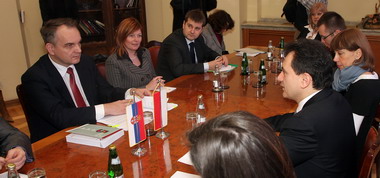
Following a meeting with Polish Deputy Prime Minister and Minister of Economy Waldemar Pawlak, Djelic announced Serbian President Boris Tadic’s visit to Warsaw next week, during which a bilateral economic agreement between the two countries will be signed.
He noted that Poland is among the countries that have achieved greatest progress over the last twenty years, adding that it managed to attract over €100 billion in foreign direct investment and increase its average salaries and pensions 12-fold.
Djelic stressed that they agreed at the meeting that trade volume between Serbia and Poland is low, since it does not exceed $300 million and Polish investment in Serbia is below $10 million.
Poland holds a strong position in energy, agriculture, infrastructure and technology and we have already reached an agreement to have a Polish expert in Serbia to help attract foreign structural funds for agriculture, he noted.
Djelic added that there are good examples of economic cooperation between the two countries, such as Polish investment in the cable plant Fabrika Kablova in Zajecar, purchase of three software companies in Serbia and a few smaller investments in the domain of agriculture, as well as the ongoing cooperation of the tractor plant IMT with Polish and Turkish companies.
The Deputy Prime Minister said that he and Pawlak discussed bilateral issues and matters concerning the European integration of Serbia.
Pawlak said that Poland gained stability and strength during the last 20 years of transition and therefore may be a good partner to Serbia when it comes to the process of European integration, as well as the plan for attracting European funds and financing systems in different sectors.
He reiterated that Poland can be an excellent partner to Serbia in terms of experience on the road towards the EU, and said that the visit of the Polish delegation will draw attention to the potential cooperation between the two countries.
Pawlak said that Poland has established excellent cooperation with its farmers, with a highly effective way of financing the agriculture sector being in place, which is a model that can be of use to Serbia as well.
He noted that Poland is among the countries that have achieved greatest progress over the last twenty years, adding that it managed to attract over €100 billion in foreign direct investment and increase its average salaries and pensions 12-fold.
Djelic stressed that they agreed at the meeting that trade volume between Serbia and Poland is low, since it does not exceed $300 million and Polish investment in Serbia is below $10 million.
Poland holds a strong position in energy, agriculture, infrastructure and technology and we have already reached an agreement to have a Polish expert in Serbia to help attract foreign structural funds for agriculture, he noted.
Djelic added that there are good examples of economic cooperation between the two countries, such as Polish investment in the cable plant Fabrika Kablova in Zajecar, purchase of three software companies in Serbia and a few smaller investments in the domain of agriculture, as well as the ongoing cooperation of the tractor plant IMT with Polish and Turkish companies.
The Deputy Prime Minister said that he and Pawlak discussed bilateral issues and matters concerning the European integration of Serbia.
Pawlak said that Poland gained stability and strength during the last 20 years of transition and therefore may be a good partner to Serbia when it comes to the process of European integration, as well as the plan for attracting European funds and financing systems in different sectors.
He reiterated that Poland can be an excellent partner to Serbia in terms of experience on the road towards the EU, and said that the visit of the Polish delegation will draw attention to the potential cooperation between the two countries.
Pawlak said that Poland has established excellent cooperation with its farmers, with a highly effective way of financing the agriculture sector being in place, which is a model that can be of use to Serbia as well.
-
 Belgrade, 24 July 2026
Serbia, Hungary partners in addressing regional security challenges
-
 Belgrade, 24 July 2026
Dačić congratulates UK Home Secretary on reappointment
-
 Belgrade, 22 July 2026
Serbia follows modern technological achievements, attracts investments
-
 Belgrade, 22 July 2026
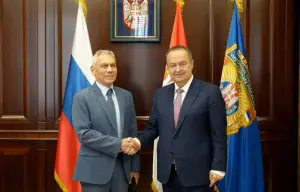
Continued cooperation with Russia in field of security, emergency situations
-
 Belgrade, 22 July 2026
New opportunities for expanding economic cooperation between Serbia, China
-
 Belgrade, 20 July 2026
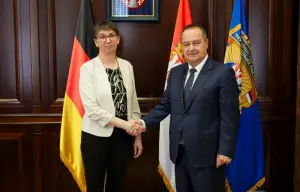
Cooperation in field of interior affairs important segment of relations with Germany
-
 Belgrade, 16 July 2026
Expo 2027 opportunity to further strengthen international partnerships
-
 Belgrade/Bratislava, 16 July 2026
Serbia, Slovakia continue to strengthen political, economic cooperation
-
 Belgrade, 14 July 2026
Serbia bilaterally resolves problems arising from EES implementation
-
 Gradina/Kalotina, 9 July 2026
Improving border cooperation between Serbia, Bulgaria