
Q:
A:
Djelic meets with Fule in Brussels
Belgrade/Brussels,
11 February 2010
Deputy Prime Minister for EU integration Bozidar Djelic met with new EU Enlargement Commissioner Stefan Fule in Brussels today.
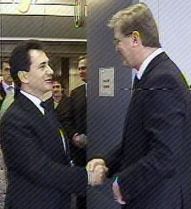
Bozidar Djelic, left, and Stefan Fule
Author:
Fonet
The main subject of talks with Fule was the time frame for putting Serbia’s application for EU candidate status on the agenda of the EU council of ministers, said Djelic after the meeting.
Serbia’s goal is to acquire candidate status by the end of 2010 or the beginning of 2011, said Djelic.
Fule stated at the meeting that as EU Enlargement Commissioner he will make every effort to send the EU Questionnaire to Serbia and to complete all other necessary administrative procedures, Djelic said.
The meeting with Fule was very constructive and it covered all aspects of Serbia’s EU integration process. It is more than symbolic that the new EU Enlargement Commissioner decided to meet with the Serbian delegation on his very first day in office, stressed Djelic.
Further development of regional cooperation, particularly relations between Serbia and Croatia, are one of the important elements of Serbia’s European future. Fule pledged that he will give personal attention to this matter, Djelic said.
The Serbian delegation also offered to make Belgrade the headquarters of the future transport union of South East Europe, he said.
Fule confirmed that EU High Representative Catherine Ashton will visit Belgrade on 18 February, Djelic said.
This visit demonstrates that the European Commission believes that the integration of the entire Western Balkans is an EU priority. This is something very positive and we welcome it, stressed Djelic.
The European Commission is ready to consider Serbia’s application for candidate status as a prioritised procedure at the demand of the council of ministers, said Fule after the meeting.
The Serbian delegation was the first one to be received by the new EU Enlargement Commissioner.
Serbia and the EU reached an agreement today on scientific and technological cooperation between Serbian scientists and main European research centres. Deputy Prime Minister Djelic, who is also Minister of Science and Technological Development, signed a memorandum of understanding with Director General of the EU Joint Research Centre (JRC) Ronald Schenkel.
Seven major scientific institutions from five EU countries belong to the JRC and its work serves as a scientific and technological data base for EU policies.
Serbia’s goal is to acquire candidate status by the end of 2010 or the beginning of 2011, said Djelic.
Fule stated at the meeting that as EU Enlargement Commissioner he will make every effort to send the EU Questionnaire to Serbia and to complete all other necessary administrative procedures, Djelic said.
The meeting with Fule was very constructive and it covered all aspects of Serbia’s EU integration process. It is more than symbolic that the new EU Enlargement Commissioner decided to meet with the Serbian delegation on his very first day in office, stressed Djelic.
Further development of regional cooperation, particularly relations between Serbia and Croatia, are one of the important elements of Serbia’s European future. Fule pledged that he will give personal attention to this matter, Djelic said.
The Serbian delegation also offered to make Belgrade the headquarters of the future transport union of South East Europe, he said.
Fule confirmed that EU High Representative Catherine Ashton will visit Belgrade on 18 February, Djelic said.
This visit demonstrates that the European Commission believes that the integration of the entire Western Balkans is an EU priority. This is something very positive and we welcome it, stressed Djelic.
The European Commission is ready to consider Serbia’s application for candidate status as a prioritised procedure at the demand of the council of ministers, said Fule after the meeting.
The Serbian delegation was the first one to be received by the new EU Enlargement Commissioner.
Serbia and the EU reached an agreement today on scientific and technological cooperation between Serbian scientists and main European research centres. Deputy Prime Minister Djelic, who is also Minister of Science and Technological Development, signed a memorandum of understanding with Director General of the EU Joint Research Centre (JRC) Ronald Schenkel.
Seven major scientific institutions from five EU countries belong to the JRC and its work serves as a scientific and technological data base for EU policies.
-
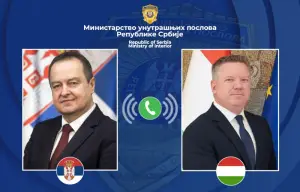 Belgrade, 24 July 2026
Serbia, Hungary partners in addressing regional security challenges
-
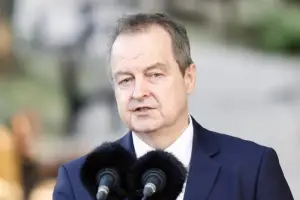 Belgrade, 24 July 2026
Dačić congratulates UK Home Secretary on reappointment
-
 Belgrade, 22 July 2026
Serbia follows modern technological achievements, attracts investments
-
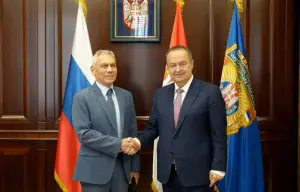 Belgrade, 22 July 2026
Continued cooperation with Russia in field of security, emergency situations
-
 Belgrade, 22 July 2026
New opportunities for expanding economic cooperation between Serbia, China
-
 Belgrade, 20 July 2026
Cooperation in field of interior affairs important segment of relations with Germany
-
 Belgrade, 16 July 2026
Expo 2027 opportunity to further strengthen international partnerships
-
 Belgrade/Bratislava, 16 July 2026
Serbia, Slovakia continue to strengthen political, economic cooperation
-
 Belgrade, 14 July 2026
Serbia bilaterally resolves problems arising from EES implementation
-
 Gradina/Kalotina, 9 July 2026
Improving border cooperation between Serbia, Bulgaria