
Q:
A:
Djelic, Belfrage open "Applied Nostalgia" photo exhibition in Belgrade
Belgrade,
16 December 2009
Serbian Deputy Prime Minister for European Integration Bozidar Djelic and Swedish State Secretary for Foreign Affairs Frank Belfrage opened yesterday evening the photographic exhibition of Belgrade and Stockholm called "Applied Nostalgia".
Opening the exhibition in Dom Omladine, Djelic pointed out that the beauty of the European Union is in the fact that it represents the unity of European nations, with full respect for their differences and particularities.
These photographs show how different we are, but at the same time similar. Here we can see that Stockholm and Belgrade are very much alike.
The photographs were taken by Agneta Bretan in Belgrade and Sanja Knezevic in Stockholm, while searching for similarities between the two cities.
The fact that wealthy countries like Sweden have good reasons to be part of the EU is one of the proofs why that can be good for Serbia as well, Djelic said.
According to him, Sweden had an excellent EU presidency and it faced with success many challenges, starting with the economic crisis up to their preparations for the UN summit on climate change.
Djelic thanked Sweden on behalf of Serbia for the fact that very important decisions for Serbia were made during Sweden's presidency over the EU, including the abolishment of visas and the unfreezing of the interim trade agreement.
Belfrage said that Sweden firmly believes in the advantages of EU enlargement, because it is in the interest of both candidate countries and EU member states, adding that that was one of the priorities of Sweden during its EU presidency.
EU countries have common values, such as democracy, respect for human rights, the rule of law and market economy, Belfrige explained.
He underlined that Serbia earned visa abolishment through strenuous work and by fulfilling all requirements, and the same goes for enforcement of the interim trade agreement.
The opening of the exhibition was attended by Head of the European Commission Delegation to Serbia Vincent Degert and ambassadors of the present and future EU presidency holders, Sweden and Spain respectively, Krister Bringeus and Ignacio de Palacio España.
This is the fourth exhibition of the "Applied Nostalgia" project, whose aim is the promotion of European values in Serbia, and the presentation of Serbia to Europe.
The project is realised during the six-month presidency over the EU of a specific country. Up until now, through "Applied Nostalgia", Belgrade has found similarities with Lisbon, Paris and Prague.
The organisers of the project are the Cabinet of the Serbian Deputy Prime Minister for European Integration, with the support of the European Movement in Serbia, the Swedish Embassy to Belgrade, the Serbian Embassy to Stockholm and Dom omladine centre in Belgrade. The project was also supported by the Swedish Institute and companies Jat Airways, BS Procesor and Epson.
The exhibition "Applied Nostalgia Stockholm-Belgrade" will mark the end of the Swedish presidency over the EU. It will be open to the public until December 30, 2009, in Dom Omladine.
These photographs show how different we are, but at the same time similar. Here we can see that Stockholm and Belgrade are very much alike.
The photographs were taken by Agneta Bretan in Belgrade and Sanja Knezevic in Stockholm, while searching for similarities between the two cities.
The fact that wealthy countries like Sweden have good reasons to be part of the EU is one of the proofs why that can be good for Serbia as well, Djelic said.
According to him, Sweden had an excellent EU presidency and it faced with success many challenges, starting with the economic crisis up to their preparations for the UN summit on climate change.
Djelic thanked Sweden on behalf of Serbia for the fact that very important decisions for Serbia were made during Sweden's presidency over the EU, including the abolishment of visas and the unfreezing of the interim trade agreement.
Belfrage said that Sweden firmly believes in the advantages of EU enlargement, because it is in the interest of both candidate countries and EU member states, adding that that was one of the priorities of Sweden during its EU presidency.
EU countries have common values, such as democracy, respect for human rights, the rule of law and market economy, Belfrige explained.
He underlined that Serbia earned visa abolishment through strenuous work and by fulfilling all requirements, and the same goes for enforcement of the interim trade agreement.
The opening of the exhibition was attended by Head of the European Commission Delegation to Serbia Vincent Degert and ambassadors of the present and future EU presidency holders, Sweden and Spain respectively, Krister Bringeus and Ignacio de Palacio España.
This is the fourth exhibition of the "Applied Nostalgia" project, whose aim is the promotion of European values in Serbia, and the presentation of Serbia to Europe.
The project is realised during the six-month presidency over the EU of a specific country. Up until now, through "Applied Nostalgia", Belgrade has found similarities with Lisbon, Paris and Prague.
The organisers of the project are the Cabinet of the Serbian Deputy Prime Minister for European Integration, with the support of the European Movement in Serbia, the Swedish Embassy to Belgrade, the Serbian Embassy to Stockholm and Dom omladine centre in Belgrade. The project was also supported by the Swedish Institute and companies Jat Airways, BS Procesor and Epson.
The exhibition "Applied Nostalgia Stockholm-Belgrade" will mark the end of the Swedish presidency over the EU. It will be open to the public until December 30, 2009, in Dom Omladine.
-
 Belgrade, 24 July 2026
Serbia, Hungary partners in addressing regional security challenges
-
 Belgrade, 24 July 2026
Dačić congratulates UK Home Secretary on reappointment
-
 Belgrade, 22 July 2026
Serbia follows modern technological achievements, attracts investments
-
 Belgrade, 22 July 2026
Continued cooperation with Russia in field of security, emergency situations
-
 Belgrade, 22 July 2026
New opportunities for expanding economic cooperation between Serbia, China
-
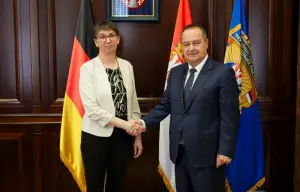 Belgrade, 20 July 2026
Cooperation in field of interior affairs important segment of relations with Germany
-
 Belgrade, 16 July 2026
Expo 2027 opportunity to further strengthen international partnerships
-
 Belgrade/Bratislava, 16 July 2026
Serbia, Slovakia continue to strengthen political, economic cooperation
-
 Belgrade, 14 July 2026
Serbia bilaterally resolves problems arising from EES implementation
-
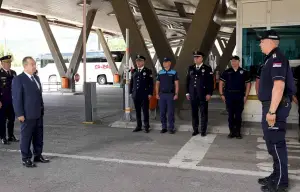 Gradina/Kalotina, 9 July 2026
Improving border cooperation between Serbia, Bulgaria