
Q:
A:
Serbia, Austria sign memorandum of understanding
Belgrade/Vienna,
6 November 2009
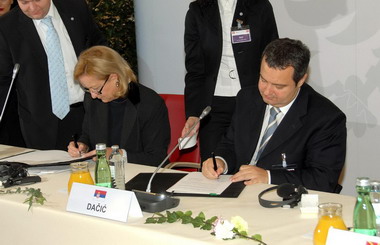
Serbian First Deputy Prime Minister and Minister of the Interior Ivica Dacic and Austrian Interior Minister Maria Fekter signed today in Vienna a Memorandum of Understanding concerning interior security cooperation.
Author:
Fonet
Dacic, who is visiting Austria, said at a press conference after the signing that the Memorandum applies to the period after the removal of visa restrictions for Serbian citizens.
He said that similar agreements were signed by the interior ministers of Montenegro and Macedonia, adding that this is a clear indication that we are moving towards a successful conclusion of the final phase of the visa liberalisation process.
He said that the signing of the memorandum is the first practical indication that EU countries are ready to remove visa restrictions, because the agreement concerns police cooperation for better interior security after the removal of visa restrictions for people from the three countries.
Dacic explained that the agreement concerns cooperation to control crime on the territory of the four signatory countries, adding that this includes the fight against all forms of crime such as robbery, theft, auto theft, organised crime, corruption, terrorism, illegal migration and drug and human trafficking.
He said that agreement was reached concerning cooperation for police training and a number of projects are already being carried out regarding integrated border management.
Dacic voiced his expectation that the visa liberalisation process will be successfully concluded, adding that Serbia is ready to accept all the positive, as well as the negative effects of open borders.
He said his Austrian counterpart noted that on November 30 in Prague the EU Council of Ministers of the Interior and Justice will make the final decision on visa abolishment and determine when it will be enacted.
Dacic stressed that since there are already announcements that visas might be abolished before January 1 due to Christmas holidays, Austria’s support is significant because visa abolishment will be the first concrete and practical benefit of the EU process which the citizens will feel.
Fekter stressed that Austria is in favour of visa abolishment for the citizens of Serbia, Montenegro and Macedonia, warning however that this brings along numerous risks to security.
She also said that Serbia, Montenegro and Macedonia have fulfilled the necessary standards, noting that Austria is offering its support to maintain and further develop these standards.
Fekter stressed that countries that signed the Memorandum have to draft action plans for the next two years stating concrete security steps to be taken and specifying responsibilities and deadlines for their realisation as the best way to oppose crime and the risks which open borders inevitably imply.
He said that similar agreements were signed by the interior ministers of Montenegro and Macedonia, adding that this is a clear indication that we are moving towards a successful conclusion of the final phase of the visa liberalisation process.
He said that the signing of the memorandum is the first practical indication that EU countries are ready to remove visa restrictions, because the agreement concerns police cooperation for better interior security after the removal of visa restrictions for people from the three countries.
Dacic explained that the agreement concerns cooperation to control crime on the territory of the four signatory countries, adding that this includes the fight against all forms of crime such as robbery, theft, auto theft, organised crime, corruption, terrorism, illegal migration and drug and human trafficking.
He said that agreement was reached concerning cooperation for police training and a number of projects are already being carried out regarding integrated border management.
Dacic voiced his expectation that the visa liberalisation process will be successfully concluded, adding that Serbia is ready to accept all the positive, as well as the negative effects of open borders.
He said his Austrian counterpart noted that on November 30 in Prague the EU Council of Ministers of the Interior and Justice will make the final decision on visa abolishment and determine when it will be enacted.
Dacic stressed that since there are already announcements that visas might be abolished before January 1 due to Christmas holidays, Austria’s support is significant because visa abolishment will be the first concrete and practical benefit of the EU process which the citizens will feel.
Fekter stressed that Austria is in favour of visa abolishment for the citizens of Serbia, Montenegro and Macedonia, warning however that this brings along numerous risks to security.
She also said that Serbia, Montenegro and Macedonia have fulfilled the necessary standards, noting that Austria is offering its support to maintain and further develop these standards.
Fekter stressed that countries that signed the Memorandum have to draft action plans for the next two years stating concrete security steps to be taken and specifying responsibilities and deadlines for their realisation as the best way to oppose crime and the risks which open borders inevitably imply.
-
 Belgrade, 24 July 2026
Serbia, Hungary partners in addressing regional security challenges
-
 Belgrade, 24 July 2026
Dačić congratulates UK Home Secretary on reappointment
-
 Belgrade, 22 July 2026
Serbia follows modern technological achievements, attracts investments
-
 Belgrade, 22 July 2026
Continued cooperation with Russia in field of security, emergency situations
-
 Belgrade, 22 July 2026
New opportunities for expanding economic cooperation between Serbia, China
-
 Belgrade, 20 July 2026
Cooperation in field of interior affairs important segment of relations with Germany
-
 Belgrade, 16 July 2026
Expo 2027 opportunity to further strengthen international partnerships
-
 Belgrade/Bratislava, 16 July 2026
Serbia, Slovakia continue to strengthen political, economic cooperation
-
 Belgrade, 14 July 2026
Serbia bilaterally resolves problems arising from EES implementation
-
 Gradina/Kalotina, 9 July 2026
Improving border cooperation between Serbia, Bulgaria