
Q:
A:
Agreement with IMF proof of Serbia’s macroeconomic stability
Belgrade,
5 November 2009
Serbian Deputy Prime Minister Mladjan Dinkic said today that Serbia’s agreement with the International Monetary Fund (IMF) is proof of the country’s macroeconomic stability.
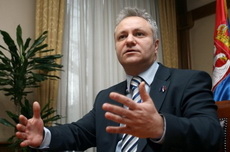
File photo of Mladjan Dinkic
Author:
Tanjug
In a statement to B92 television, Dinkic said that the agreement on further use of the credit stand-by arrangement is a guarantee that the dinar will remain stable, that inflation will fall and that investors can freely invest in Serbia.
He recalled that so far Serbia has withdrawn €788 million from the IMF’s loan and added that it will most probably not withdraw the rest of the money or will withdraw only a smaller amount if the National Bank of Serbia deems it necessary. According to Dinkic, Serbia already has the funds with which it can cover the planned budgetary deficit for the next year, which will be 4% of the gross domestic product (GDP). The funds mostly come in the form of soft loans, with a 1% to 2% interest rate. Serbia currently has €750 million in reserves and it also counts on the €440 million that the IMF approved in August. He added that Serbia should receive $500 million from the World Bank this year and next. Dinkic said that the level of Serbia’s debt is high, but that there is a limit, according to which the debt shouldn’t exceed 45% of GDP, and right now it stands at 32% of GDP. Speaking about the reform of the pension system, Dinkic said that the full effects will not be felt before 2020 because the reform will be gradual. One of the key measures is to tighten the conditions for early retirement. He explained that right now the age limit that allows early retirement is 53, but it will be gradually raised to 58.
The Deputy Prime Minister voiced hope that some of the US companies whose representatives visited Belgrade recently will decide to invest in Serbia.
He recalled that so far Serbia has withdrawn €788 million from the IMF’s loan and added that it will most probably not withdraw the rest of the money or will withdraw only a smaller amount if the National Bank of Serbia deems it necessary. According to Dinkic, Serbia already has the funds with which it can cover the planned budgetary deficit for the next year, which will be 4% of the gross domestic product (GDP). The funds mostly come in the form of soft loans, with a 1% to 2% interest rate. Serbia currently has €750 million in reserves and it also counts on the €440 million that the IMF approved in August. He added that Serbia should receive $500 million from the World Bank this year and next. Dinkic said that the level of Serbia’s debt is high, but that there is a limit, according to which the debt shouldn’t exceed 45% of GDP, and right now it stands at 32% of GDP. Speaking about the reform of the pension system, Dinkic said that the full effects will not be felt before 2020 because the reform will be gradual. One of the key measures is to tighten the conditions for early retirement. He explained that right now the age limit that allows early retirement is 53, but it will be gradually raised to 58.
The Deputy Prime Minister voiced hope that some of the US companies whose representatives visited Belgrade recently will decide to invest in Serbia.
-
 Belgrade, 24 July 2026
Serbia, Hungary partners in addressing regional security challenges
-
 Belgrade, 24 July 2026
Dačić congratulates UK Home Secretary on reappointment
-
 Belgrade, 22 July 2026
Serbia follows modern technological achievements, attracts investments
-
 Belgrade, 22 July 2026
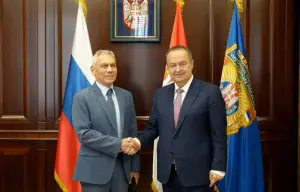
Continued cooperation with Russia in field of security, emergency situations
-
 Belgrade, 22 July 2026
New opportunities for expanding economic cooperation between Serbia, China
-
 Belgrade, 20 July 2026
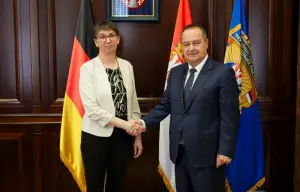
Cooperation in field of interior affairs important segment of relations with Germany
-
 Belgrade, 16 July 2026
Expo 2027 opportunity to further strengthen international partnerships
-
 Belgrade/Bratislava, 16 July 2026
Serbia, Slovakia continue to strengthen political, economic cooperation
-
 Belgrade, 14 July 2026
Serbia bilaterally resolves problems arising from EES implementation
-
 Gradina/Kalotina, 9 July 2026
Improving border cooperation between Serbia, Bulgaria