
Q:
A:
Serbia fulfils all conditions for visa liberalisation
Belgrade,
2 November 2009
Serbian First Deputy Prime Minister and Minister of the Interior Ivica Dacic said today that a decision regarding the removal of visa restrictions for Serbian citizens should be made at the EU ministerial conference at the end of December this year.
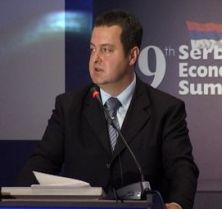
Ivica Dacic
Author:
infobiro.tv
In his introductory speech at the opening of the 9th Serbian economic summit, Dacic stressed that Serbia has met all the conditions for visa liberalisation set by the EU.
He specified that up until now over 1.2 million biometric passports have been issued, adding that from December, for the first time, passports will also include a biometric fingerprint which will allow passport holders to go through passport control and checks more quickly.
Dacic said that Serbia has passed all laws and regulations required for the successful fight against crime, including laws for the confiscation of illegally obtained assets.
He expressed his opinion that it cannot be said that Serbia is not doing enough to oppose organised crime, adding that the police have conducted several very successful investigations. He mentioned as an example the latest action, Morava, which resulted in the arrest of a number of drug dealers.
The Minister said that it is necessary to further strengthen regional police cooperation, adding that owing to the information provided by the Serbian police, in cooperation with other European police forces, a robbery of over 100 kilograms of gold was prevented in Sweden.
He said that criminal groups often work together on a regional level, which has made cooperation between southeast European countries even more necessary and Serbia has signed several agreements to make this kind of cooperation possible.
He specified that up until now over 1.2 million biometric passports have been issued, adding that from December, for the first time, passports will also include a biometric fingerprint which will allow passport holders to go through passport control and checks more quickly.
Dacic said that Serbia has passed all laws and regulations required for the successful fight against crime, including laws for the confiscation of illegally obtained assets.
He expressed his opinion that it cannot be said that Serbia is not doing enough to oppose organised crime, adding that the police have conducted several very successful investigations. He mentioned as an example the latest action, Morava, which resulted in the arrest of a number of drug dealers.
The Minister said that it is necessary to further strengthen regional police cooperation, adding that owing to the information provided by the Serbian police, in cooperation with other European police forces, a robbery of over 100 kilograms of gold was prevented in Sweden.
He said that criminal groups often work together on a regional level, which has made cooperation between southeast European countries even more necessary and Serbia has signed several agreements to make this kind of cooperation possible.
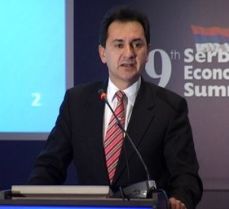
Bozidar Djelic
Author:
infobiro.tv
Deputy Prime Minister for EU integration and Minister of Science and Technological Development Bozidar Djelic reiterated that Serbia’s goal is to apply for EU candidacy before the year’s end and to have the Transitional Trade Agreement unfrozen.
He recalled that this week Chief Hague Prosecutor Serge Brammertz will be visiting Belgrade, voicing his hope that Brammertz’s report to the UN Security Council and EU leaders will contain a positive assessment of Serbia’s cooperation with the tribunal.
He noted that in the last report on Serbia’s progress the European Commission noted that everything Serbia has so far achieved concerning the implementation of the Transitional Trade Agreement will be regarded as an indicator of the agreement’s successful implementation.
This should shorten the period from application until acceptance of candidacy down to 6–12 months, Djelic noted, adding that according to the latest survey, 71% of Serbian citizens favour EU entry.
He welcomed the Greek government’s initiative for the Western Balkan’s EU entry before 2014, adding that this is an ambitious goal, but technically feasible and dependant on the political circumstances and consensus within the EU.
Djelic recalled that since 2000 Serbia received €2.9 billion in EU donations, adding that the new financial framework implies donations of up to €1.4 billion before 2013.
Next year Serbia is to receive €200 million as macro financial support from EU funds, Djelic noted.
He recalled that this week Chief Hague Prosecutor Serge Brammertz will be visiting Belgrade, voicing his hope that Brammertz’s report to the UN Security Council and EU leaders will contain a positive assessment of Serbia’s cooperation with the tribunal.
He noted that in the last report on Serbia’s progress the European Commission noted that everything Serbia has so far achieved concerning the implementation of the Transitional Trade Agreement will be regarded as an indicator of the agreement’s successful implementation.
This should shorten the period from application until acceptance of candidacy down to 6–12 months, Djelic noted, adding that according to the latest survey, 71% of Serbian citizens favour EU entry.
He welcomed the Greek government’s initiative for the Western Balkan’s EU entry before 2014, adding that this is an ambitious goal, but technically feasible and dependant on the political circumstances and consensus within the EU.
Djelic recalled that since 2000 Serbia received €2.9 billion in EU donations, adding that the new financial framework implies donations of up to €1.4 billion before 2013.
Next year Serbia is to receive €200 million as macro financial support from EU funds, Djelic noted.
-
 Belgrade, 24 July 2026
Serbia, Hungary partners in addressing regional security challenges
-
 Belgrade, 24 July 2026
Dačić congratulates UK Home Secretary on reappointment
-
 Belgrade, 22 July 2026
Serbia follows modern technological achievements, attracts investments
-
 Belgrade, 22 July 2026
Continued cooperation with Russia in field of security, emergency situations
-
 Belgrade, 22 July 2026
New opportunities for expanding economic cooperation between Serbia, China
-
 Belgrade, 20 July 2026
Cooperation in field of interior affairs important segment of relations with Germany
-
 Belgrade, 16 July 2026
Expo 2027 opportunity to further strengthen international partnerships
-
 Belgrade/Bratislava, 16 July 2026
Serbia, Slovakia continue to strengthen political, economic cooperation
-
 Belgrade, 14 July 2026
Serbia bilaterally resolves problems arising from EES implementation
-
 Gradina/Kalotina, 9 July 2026
Improving border cooperation between Serbia, Bulgaria