
Q:
A:
All conditions for removal of EU visa restrictions fulfilled
Belgrade,
28 September 2009
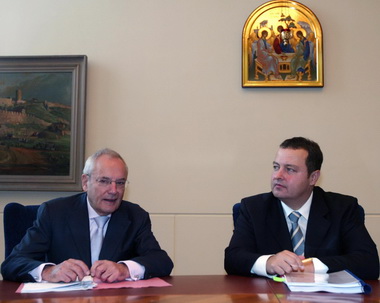
Serbian First Deputy Prime Minister and Minister of the Interior Ivica Dacic today stated that Serbia has met all criteria for the removal of visa restrictions for Serbian citizens.
Author:
Fonet
Speaking at a joint press conference, held with European Commission Vice President Jacques Barrot and Serbian Minister of Justice Snezana Malovic, Dacic said that Serbia is determined to implement all the strategies, laws and agreements related to the visa liberalisation process by the end of this year.
He said that Serbia wishes January 1, 2010 to be the date for the decision to remove visa restrictions to come into force.
He said that the recent violent attacks on foreigners in Belgrade will not jeopardise the visa liberalisation process, adding that they do affect Serbia’s image.
Dacic said that the police are looking for those who attacked and beat a Libyan citizen. He said that the problem of violence cannot be solved only by the police because it is related to the value system and the whole of society must make efforts to resolve it.
He stressed that the police are trying to locate the persons who were involved in the planning of the recent attack on a French citizen, adding that the suspects are known to the police from other cases.
Barrot said that an expert group of the European Commission will arrive in Serbia in the middle of October in order to assess Serbia’s progress regarding the visa liberalisation process and if their report is positive then on December 1 the European Commission will recommend to the EU Council of Ministers to remove visa restrictions for Serbian citizens from January 1, 2010.
He said that Serbia has made major progress regarding the visa liberalisation process and a lot has also been achieved in the process of reforms and legislation so what remains to be done is the implementation of the adopted laws.
Barrot said that it is necessary for Serbia to counter corruption and organised crime during the pre-accession period, adding that the Anti-Corruption Agency must be provided with financial support by the state.
He said that visa liberalisation will make it possible for young people to travel more easily in EU countries, reiterating that Serbia is welcome in the EU.
Malovic said that the West Balkan countries have sent the message to Europe that they are determined to fight against organised crime and corruption, adding that the creation of reliable institutions in Serbia is contributing to the stability of the entire region.
Creating reliable and dependable institutions will make Serbia more stable and will lead to increased foreign investment and a better standard of living, said Malovic.
He said that Serbia wishes January 1, 2010 to be the date for the decision to remove visa restrictions to come into force.
He said that the recent violent attacks on foreigners in Belgrade will not jeopardise the visa liberalisation process, adding that they do affect Serbia’s image.
Dacic said that the police are looking for those who attacked and beat a Libyan citizen. He said that the problem of violence cannot be solved only by the police because it is related to the value system and the whole of society must make efforts to resolve it.
He stressed that the police are trying to locate the persons who were involved in the planning of the recent attack on a French citizen, adding that the suspects are known to the police from other cases.
Barrot said that an expert group of the European Commission will arrive in Serbia in the middle of October in order to assess Serbia’s progress regarding the visa liberalisation process and if their report is positive then on December 1 the European Commission will recommend to the EU Council of Ministers to remove visa restrictions for Serbian citizens from January 1, 2010.
He said that Serbia has made major progress regarding the visa liberalisation process and a lot has also been achieved in the process of reforms and legislation so what remains to be done is the implementation of the adopted laws.
Barrot said that it is necessary for Serbia to counter corruption and organised crime during the pre-accession period, adding that the Anti-Corruption Agency must be provided with financial support by the state.
He said that visa liberalisation will make it possible for young people to travel more easily in EU countries, reiterating that Serbia is welcome in the EU.
Malovic said that the West Balkan countries have sent the message to Europe that they are determined to fight against organised crime and corruption, adding that the creation of reliable institutions in Serbia is contributing to the stability of the entire region.
Creating reliable and dependable institutions will make Serbia more stable and will lead to increased foreign investment and a better standard of living, said Malovic.
-
 Belgrade, 24 July 2026
Serbia, Hungary partners in addressing regional security challenges
-
 Belgrade, 24 July 2026
Dačić congratulates UK Home Secretary on reappointment
-
 Belgrade, 22 July 2026
Serbia follows modern technological achievements, attracts investments
-
 Belgrade, 22 July 2026
Continued cooperation with Russia in field of security, emergency situations
-
 Belgrade, 22 July 2026
New opportunities for expanding economic cooperation between Serbia, China
-
 Belgrade, 20 July 2026
Cooperation in field of interior affairs important segment of relations with Germany
-
 Belgrade, 16 July 2026
Expo 2027 opportunity to further strengthen international partnerships
-
 Belgrade/Bratislava, 16 July 2026
Serbia, Slovakia continue to strengthen political, economic cooperation
-
 Belgrade, 14 July 2026
Serbia bilaterally resolves problems arising from EES implementation
-
 Gradina/Kalotina, 9 July 2026
Improving border cooperation between Serbia, Bulgaria