
Q:
A:
Agreement on €100 m from IPA signed
Brussels/Belgrade,
17 September 2009
Deputy Prime Minister for EU integration Bozidar Djelic met today in Brussels with EU Enlargement Commissioner Olli Rehn to sign a financial agreement on IPA assistance of €100 million intended for Serbia’s budget.
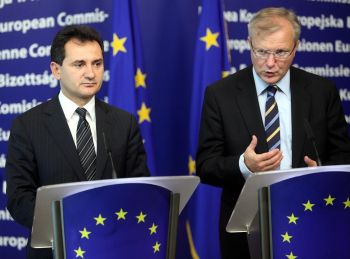
Bozidar Djelic, left, and Olli Rehn
Author:
Fonet
Djelic, who is on a working visit to EU institutions in Brussels, said that this budget support to the Serbian government will be used for pensions, infrastructure investments and subsidies for flat construction.
He explained that the conditions for receiving this kind of assistance are continued EU integration and further implementation of the macroeconomic programme which Serbia agreed upon with the IMF.
As for EU integration, Djelic said that a portion of the funds will be used to train personnel in this sector.
Djelic said that Rehn informed him that the European Commission believes it is time for the Transitional Trade Agreement to be implemented, thanks to the progress Serbia has made in EU integration and cooperation with the Hague tribunal.
We will attempt to unfreeze the agreement in October, but if it cannot be done our next opportunity will be at the EU summit in December, Djelic announced, adding that Chief Hague Prosecutor Serge Brammertz’s new report on Serbia’s cooperation with the Hague tribunal will also be considered at the summit.
In the upcoming period Serbia will do its best to ensure the implementation of the Transitional Trade Agreement, he said, adding that after that applying for candidacy will be a mere formality.
Rehn said that this support of Serbia’s budget is a sign of the EU’s solidarity with Serbia and should help to remove the consequences of the socio-economic crisis.
He commended Serbia’s commitment to EU integration, adding that the European Commission fully endorses Serbia’s European future.
Rehn also noted that the European Commission is resolved to continue aiding Serbia in fulfilling the necessary membership conditions and implementing legal and economic reforms.
The decision to provide financial support shows that the EU cares about Serbia, its people and its European future, Rehn concluded.
After talks with Commissioner for Monetary and Economic Affairs Joaquin Almunia, Djelic said that the EU will approve a further €200 million to Serbia as macrofinancial support.
Djelic said that these funds are being provided as a loan under very favourable terms.
He said that an agreement concerning the loan will be signed in November, adding that the funds will be used for assisting the budget and the EU integration process.
The EU has approved a total of €300 million for assisting the Serbian budget under the condition that Serbia continues to implement the plan that the Serbian government and the IMF agreed upon and also continues with EU integration reforms.
He said that at the meeting with European Commission representatives he was assured that the Commission’s regular report on Serbia’s progress towards the EU will be the most favourable so far, adding that it will be made public on October 14.
Djelic noted that the report will point to areas where further progress is to be achieved, but added that it will show that Serbia already has the administrative capacity to become an EU candidate and begin accession talks.
He explained that the conditions for receiving this kind of assistance are continued EU integration and further implementation of the macroeconomic programme which Serbia agreed upon with the IMF.
As for EU integration, Djelic said that a portion of the funds will be used to train personnel in this sector.
Djelic said that Rehn informed him that the European Commission believes it is time for the Transitional Trade Agreement to be implemented, thanks to the progress Serbia has made in EU integration and cooperation with the Hague tribunal.
We will attempt to unfreeze the agreement in October, but if it cannot be done our next opportunity will be at the EU summit in December, Djelic announced, adding that Chief Hague Prosecutor Serge Brammertz’s new report on Serbia’s cooperation with the Hague tribunal will also be considered at the summit.
In the upcoming period Serbia will do its best to ensure the implementation of the Transitional Trade Agreement, he said, adding that after that applying for candidacy will be a mere formality.
Rehn said that this support of Serbia’s budget is a sign of the EU’s solidarity with Serbia and should help to remove the consequences of the socio-economic crisis.
He commended Serbia’s commitment to EU integration, adding that the European Commission fully endorses Serbia’s European future.
Rehn also noted that the European Commission is resolved to continue aiding Serbia in fulfilling the necessary membership conditions and implementing legal and economic reforms.
The decision to provide financial support shows that the EU cares about Serbia, its people and its European future, Rehn concluded.
After talks with Commissioner for Monetary and Economic Affairs Joaquin Almunia, Djelic said that the EU will approve a further €200 million to Serbia as macrofinancial support.
Djelic said that these funds are being provided as a loan under very favourable terms.
He said that an agreement concerning the loan will be signed in November, adding that the funds will be used for assisting the budget and the EU integration process.
The EU has approved a total of €300 million for assisting the Serbian budget under the condition that Serbia continues to implement the plan that the Serbian government and the IMF agreed upon and also continues with EU integration reforms.
He said that at the meeting with European Commission representatives he was assured that the Commission’s regular report on Serbia’s progress towards the EU will be the most favourable so far, adding that it will be made public on October 14.
Djelic noted that the report will point to areas where further progress is to be achieved, but added that it will show that Serbia already has the administrative capacity to become an EU candidate and begin accession talks.
-
 Belgrade, 24 July 2026
Serbia, Hungary partners in addressing regional security challenges
-
 Belgrade, 24 July 2026
Dačić congratulates UK Home Secretary on reappointment
-
 Belgrade, 22 July 2026
Serbia follows modern technological achievements, attracts investments
-
 Belgrade, 22 July 2026
Continued cooperation with Russia in field of security, emergency situations
-
 Belgrade, 22 July 2026
New opportunities for expanding economic cooperation between Serbia, China
-
 Belgrade, 20 July 2026
Cooperation in field of interior affairs important segment of relations with Germany
-
 Belgrade, 16 July 2026
Expo 2027 opportunity to further strengthen international partnerships
-
 Belgrade/Bratislava, 16 July 2026
Serbia, Slovakia continue to strengthen political, economic cooperation
-
 Belgrade, 14 July 2026
Serbia bilaterally resolves problems arising from EES implementation
-
 Gradina/Kalotina, 9 July 2026
Improving border cooperation between Serbia, Bulgaria